Science

Next Hydrogen electrolyser technology for a planned hydrogen fueling station in British Columbia.

Next Hydrogen Designs 10 MW Hydrogen Fueling Station in British Columbia

Next Hydrogen has completed the engineering design for a planned 10 MW hydrogen fueling station in British Columbia. The project is intended to support cleaner transportation, including medium- and heavy-duty vehicles. A final investment decision is expected by the end of 2026, with construction potentially starting in late 2027 or early 2028 if the project moves forward.


Read More...

DefendEye Raises Investment to Scale Autonomous AI Drone Production

DefendEye has raised a new investment round led by NovaCapital to scale production of its Overwatch Drone. The autonomous AI drone is designed for first responders and can launch within seconds without a trained pilot. Its base station connects the drone to the cloud, allowing emergency teams and remote commanders to access live video and gain situational awareness during incidents.

Read More...
NUS researchers holding a lightweight carbon fibre epoxy aerogel made from recycled composite waste.

Singapore’s NUS Turns Aircraft Composite Waste Into Useful Aerogels

Researchers at the National University of Singapore (NUS) have found a new use for difficult-to-recycle aircraft composite waste. Their process turns carbon fibre and epoxy waste into lightweight aerogels that can provide thermal insulation, absorb sound and soak up oil. The approach could help reduce composite waste while creating useful materials from both parts of the discarded material.

Read More...
SciTec ground-based radar modernization program for the U.S. Space Force.

New Jersey firm to advance US’ ground-based radar digitization program

Firefly Aerospace’s SciTec has received a $93.7 million U.S. Space Force contract to advance ground-based radar digitization. The program will develop a common architecture and design for modernizing radar systems. The work builds on SciTec’s experience in missile warning, defense software and large-scale data processing, while supporting the Space Force’s effort to maintain and upgrade critical radar infrastructure.

Read More...
Illustration of LightHOUSE satellites helping spacecraft navigate and communicate between Earth and the Moon.

MIT Lincoln Laboratory designs LightHOUSE for moon missions

MIT Lincoln Laboratory is developing LightHOUSE, a proposed satellite system that could bring GPS-like navigation to spacecraft traveling between Earth and the Moon. The concept would use high-orbit satellites, laser communications and star-based imaging to estimate spacecraft position and speed. If successful, it could reduce reliance on Earth-based tracking systems, save spacecraft fuel and support future lunar missions.

Read More...

China’s Shenzhou-23 Crew Tests Space Robot During Busy Week

China’s Shenzhou-23 crew has completed a busy week aboard the space station, carrying out health studies, VR experiments and microgravity research. The astronauts also tested Xiaohang, a station robot designed to improve its movement planning through interaction with the crew. The work could help develop more capable robots for future long-duration space missions.

Read More...

IMDEA Materials Develops Catalyst Using 75% Less Platinum

Researchers at IMDEA Materials Institute have developed a Cu₃Pt catalyst that achieved performance similar to pure platinum while using 75% less platinum. The team used controlled mechanical compression to change the catalyst’s atomic and electronic structure. The result could help reduce material costs in hydrogen fuel cells, although large-scale production and long-term stability still need to be tested.

Read More...
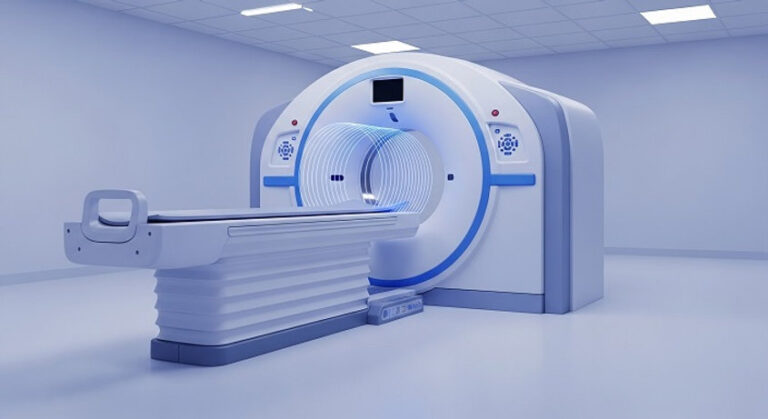
DUNE neutrino detector using AI to analyze particle interactions.

Fermilab Uses AI to Improve DUNE Neutrino Research

Fermilab is adding AI to the Deep Underground Neutrino Experiment to speed up particle analysis and improve detector operations. The technology will help identify neutrino interactions, track particles and search for rare signals such as supernova neutrino bursts. DUNE is expected to produce petabytes of data, making AI an important tool for managing the experiment and advancing neutrino research.

Read More...

SLAC Researchers Capture First Steps of Chemical Reactions

SLAC National Accelerator Laboratory researchers have created a molecular movie showing some of the first steps of a chemical reaction. Using the LCLS X-ray laser, the team tracked electron movement at attosecond speeds and captured Coster-Kronig decay and quantum electron coherence in real time. The results also showed that current computer models need more detail to accurately predict ultrafast chemical behavior.

Read More...

US Argonne Builds AI System to Speed Up Materials Discovery

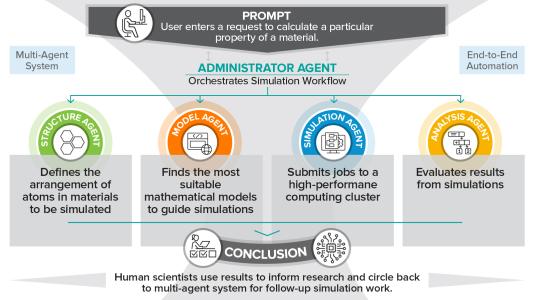
Argonne National Laboratory has created an AI-driven system that automates atomistic simulations used in materials research. The framework can reduce discovery time from months or years to just days by handling complex simulation tasks with multiple AI agents. The technology could speed up the development of batteries, electronics, aerospace materials, and other advanced technologies.

Read More...