

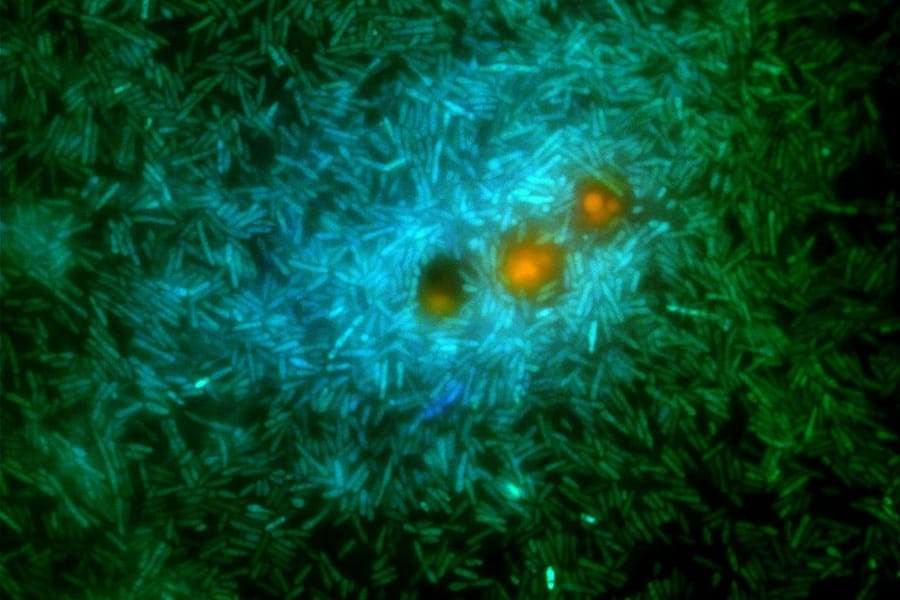
Marine bacteria break down fucoidan, a complex carbohydrate produced by algae, by dividing the task among specialized members of a microbial community, according to a study published in Nature.
Researchers found that hundreds of genes involved in processing the molecule could be reduced to two broad functional roles. The finding may help explain how some algal carbon remains in the ocean for extended periods.
Fucoidan is found in the protective outer structures of brown algae and other marine organisms. Its complex architecture contains numerous chemical bonds, branches and different types of sugars. That structure makes it difficult for individual bacteria to consume completely.
The molecule is relevant to the ocean carbon cycle because resistant organic material can remain intact as it moves away from surface waters. Some of that material can eventually reach deeper parts of the ocean. The length of time carbon remains there depends partly on how quickly microbes are able to break it down.
READ ALSO: https://modernmechanics24.com/post/swarm-aero-gamera-drone-mq9-replacement/
The research was led by Andreas Sichert, a former MIT postdoctoral researcher now at ETH Zurich, and Otto X. Cordero, an associate professor of civil and environmental engineering at MIT.
Scientists from ETH Zurich, the University of Vienna and the Tata Institute of Fundamental Research also contributed. The research was supported by the Simons Foundation through the Principles of Microbial Ecosystems collaboration.
Researchers Map Microbial Roles
Scientists had previously identified individual bacteria capable of breaking down parts of fucoidan. It was less clear whether a group of bacteria could collectively degrade the molecule and how such a community would divide the work. The researchers addressed the question by enriching a fucoidan-degrading bacterial community from coastal seawater.
The team isolated eight bacterial strains from the community. None was able to completely break down fucoidan independently. The researchers identified more than 453 genes associated with enzymes that can act on different parts of the molecule.
The large number of genes initially suggested a highly complicated system. Researchers then used a rapid mass-spectrometry method to track the consumption of individual sugar building blocks. This allowed them to determine which parts of fucoidan different bacteria were processing.
The analysis revealed two broad patterns. Some bacteria concentrated on the fucose-rich backbone of the molecule. Others were better at removing side branches containing less common sugars, including xylose and galactose.
That division was important for complete degradation. When bacteria with complementary capabilities were combined, the resulting communities broke down fucoidan more efficiently than expected from their individual performances. In some cases, the combined communities approached complete degradation of the polysaccharide.
WATCH ALSO: https://modernmechanics24.com/post/china-navy-hijack-rescue-drill-somalia/
Simple Model Explains Complexity
The researchers found that bacterial identity was less important than the functions performed by the organisms.
Instead of tracking hundreds of enzymes separately, they classified bacterial activity according to whether microbes mainly processed fucose or the less common sugars found inside branches. This provided a much simpler description of the community.
The team used data from communities containing one to three strains to train a predictive model. The model was then tested against communities containing as many as seven strains. It was able to predict their degradation patterns despite the additional biological complexity.
The model also worked across nine structurally different fucoidans from different types of algae. That result is significant because fucoidan does not have one uniform structure. Its chemical composition and branching patterns can vary between algae species.
The researchers said the findings show that predicting a complex biological system does not necessarily require identifying every component.
Instead, a small number of measurable functional traits may provide enough information to describe how a microbial community behaves. The approach could be tested on other complex biological materials whose detailed chemistry is difficult to characterize.
Implications For Ocean Carbon
The researchers also found evidence that bacteria with complementary fucoidan-degrading abilities occur together in natural ocean samples. That observation indicates that the division of labor seen in laboratory experiments may also exist in marine environments. It does not, however, establish how frequently the process occurs across the world’s oceans.
The team proposed the term ‘diversity-limited degradation’ for situations in which complex organic material persists because the microbial community lacks the right combination of specialists.
Under this framework, microbial diversity can influence how quickly carbon-rich material is returned to the environment. A missing functional role may therefore allow some algal carbon to remain intact for longer.
The findings add another layer to scientists’ understanding of the marine carbon cycle. Marine algae take up carbon as they grow, while bacteria and other organisms break down the organic material produced by them. The balance between production, degradation and transport determines how much carbon remains near the surface and how much reaches deeper waters.
READ ALSO: https://modernmechanics24.com/post/agm-190a-havoc-spear-cleared-combat/
The research may also have implications for biotechnology. Rather than engineering one microorganism to process every component of a complex biomass, researchers could use communities containing organisms with complementary capabilities. Such microbial consortia may eventually have applications in processing brown algae and other difficult-to-degrade polysaccharides.
The study also raises an evolutionary question about why a single bacterium has not developed the ability to consume fucoidan completely.
The researchers suggest that limits within sugar metabolism may play a role. Evolutionary interactions may also favor communities in which complementary specialists perform different stages of the process instead of combining all functions in one organism.
Cordero said the question points to a broader issue in biology: why many of the biochemical functions that drive Earth’s elemental cycles are distributed among different organisms. Understanding that organization may help researchers explain how microbial communities influence large-scale environmental processes.
The study’s central finding is that a system involving hundreds of enzyme-related genes can be described through a much smaller set of functional traits. Researchers will now need to determine how well this framework applies outside laboratory communities and across different marine environments.










One Response