

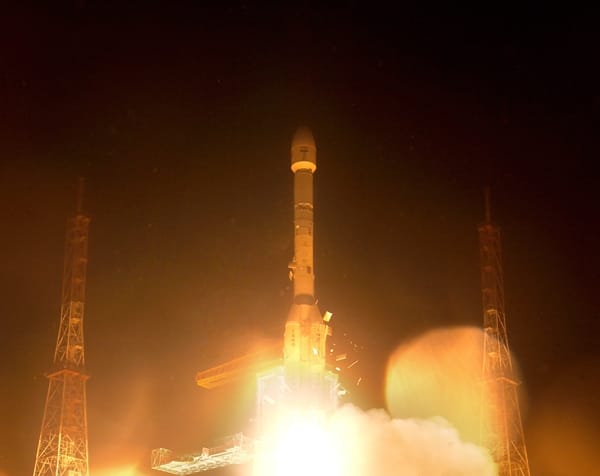
India launched the EOS-05 Earth observation satellite aboard its GSLV-F17 rocket on Friday, placing the spacecraft into a Sub-Geosynchronous Transfer Orbit after a flight lasting about 18 minutes.
The 51.7-metre rocket lifted off at 2:55 a.m. local time from the Second Launch Pad at the Satish Dhawan Space Centre in Sriharikota.
The successful mission expands India’s Earth observation capabilities in geosynchronous orbit and provides another operational flight for the country’s Geosynchronous Satellite Launch Vehicle (GSLV).
GSLV-F17 Completes Launch
GSLV-F17 is the 19th flight of India’s Geosynchronous Satellite Launch Vehicle, a three-stage rocket developed primarily for missions requiring greater launch energy and heavier payloads.
The vehicle has a liftoff mass of approximately 420.5 tonnes and stands 51.7 metres tall. Its three stages use different propulsion systems, culminating in a cryogenic upper stage that provides the high-efficiency thrust required during the final part of the ascent.
READ ALSO: https://modernmechanics24.com/post/ai-designed-soft-grip-3d-printed-robots/
The rocket carried the 2,367-kg EOS-05 spacecraft beneath a four-metre-diameter ogive-shaped composite payload fairing. The fairing protects the satellite from aerodynamic pressure, vibration and heating during atmospheric flight and is discarded once the vehicle reaches conditions where the spacecraft no longer requires that protection.
The launch followed a 27-hour countdown that began at 11:30 p.m. on Wednesday. Despite the pre-dawn timing and rain at the spaceport, members of the public gathered at Sriharikota to watch the launch. The vehicle lifted off on schedule and followed its planned ascent profile.
Cryogenic Stage Powers Ascent
GSLV’s three-stage architecture progressively builds the velocity required to deliver a spacecraft toward high-energy orbits. The lower stages provide the thrust needed to lift the rocket from the pad and accelerate it through the atmosphere, while the upper stage completes the final part of the ascent.
The cryogenic stage is particularly important because it uses extremely cold liquid propellants, typically liquid hydrogen and liquid oxygen. Cryogenic engines provide high performance relative to their propellant mass, making them well suited to upper-stage applications in missions involving geosynchronous and other demanding orbits.
Reliable operation of this stage is, therefore, critical for GSLV missions carrying heavier spacecraft toward high-altitude orbital destinations.
WATCH ALSO: https://modernmechanics24.com/post/apple-opens-advanced-center-houston/
EOS-05 Targets High Orbit
EOS-05 is an Earth observation spacecraft designed for operation from geosynchronous orbit, at an altitude of roughly 36,000 kilometres above Earth.
At this altitude, a satellite’s orbital period closely matches Earth’s rotation, allowing it to remain over or near the same broad region for extended periods. This makes geosynchronous orbit useful for applications requiring repeated observations of a large area.
The spacecraft’s high-altitude operating profile differs from that of conventional Earth observation satellites in low Earth orbit. Low-orbit spacecraft travel around Earth more rapidly and can capture higher-detail imagery from a shorter distance, but they move across different regions during successive passes.
A geosynchronous imaging satellite instead offers longer-duration views over a wider area, allowing changes to be monitored repeatedly without waiting for another orbital pass.
EOS-05 is intended to provide imagery for applications including agriculture and disaster management. Its observations can support monitoring of agricultural areas, land conditions and changes caused by natural disasters.
During events such as floods or cyclones, repeated satellite observations can provide authorities with updated information on affected regions.
From Transfer Orbit to Operations
GSLV-F17 placed EOS-05 into a Sub-Geosynchronous Transfer Orbit rather than directly into its final operational position.
A transfer orbit is an intermediate trajectory that moves a spacecraft from its launch vehicle’s injection point toward its intended orbit. After separation, EOS-05 will use its onboard propulsion system to perform additional orbital manoeuvres, progressively modifying its altitude and orbital characteristics.
The objective is to establish the spacecraft in its planned geosynchronous operating orbit, where it can begin its Earth observation mission. This phase requires accurate navigation, propulsion and ground control after separation from the launch vehicle.
The high-altitude orbit gives EOS-05 a broad and persistent field of view, making it particularly useful for applications in which frequent observation of a large region is more important than the highest possible spatial resolution.
READ ALSO: https://modernmechanics24.com/post/best-luvata-fusion-superconductor-supply/
Mission Follows Earlier Setback
The GSLV-F17 mission also follows the unsuccessful GSLV-F10/EOS-03 launch in 2021.
During that flight, an onboard computer halted the mission at about 307 seconds after liftoff following an anomaly associated with the Cryogenic Upper Stage. ISRO’s post-flight investigation identified the cryogenic stage as the source of the failure.
More recently, ISRO’s PSLV programme experienced two unsuccessful missions. The PSLV-C61/EOS-09 mission in May 2025 did not reach its intended outcome following a reported motor pressure issue, while the PSLV-C62 mission in January 2026 encountered an anomaly during its third-stage operation.
The successful GSLV-F17 flight provides a new operational result for India’s higher-energy launch programme.
Expanding Earth Observation
EOS-05 is designed to complement satellites operating in lower Earth orbits rather than replace them. Its geosynchronous position is suited to frequent observations over a large region, while lower-orbit spacecraft remain valuable for obtaining detailed imagery of smaller areas.
Together, the different orbital approaches allow India’s Earth observation programme to address a broader range of monitoring requirements.
For agriculture, repeated imagery can help track conditions across extensive farming regions. For disaster management, frequent observations can assist in identifying changes following major events and monitoring affected areas. The data can also contribute to broader land and environmental observation.
WATCH ALSO: https://modernmechanics24.com/post/lockheed-martin-grizzlymissile-launcher/
The successful deployment of EOS-05 demonstrates the combined role of spacecraft design and launch vehicle performance in high-orbit Earth observation missions.
GSLV-F17 provided the required injection into Sub-GTO, while EOS-05 will now carry out the orbital manoeuvres needed to reach its operational position. Once commissioned, the satellite is expected to strengthen India’s ability to collect regular Earth observation imagery from geosynchronous orbit.















One Response