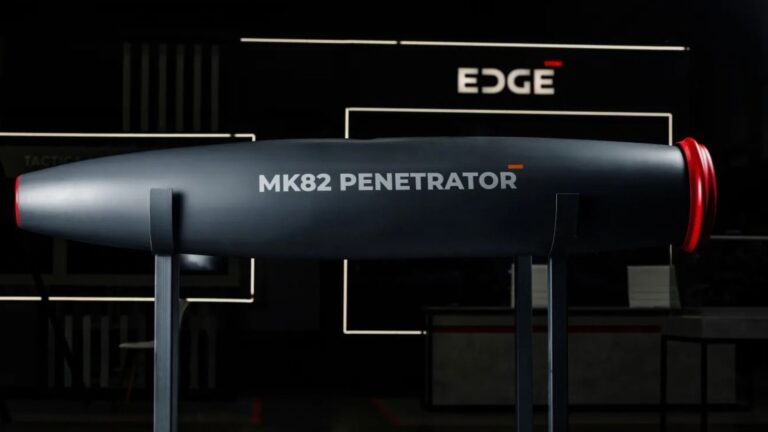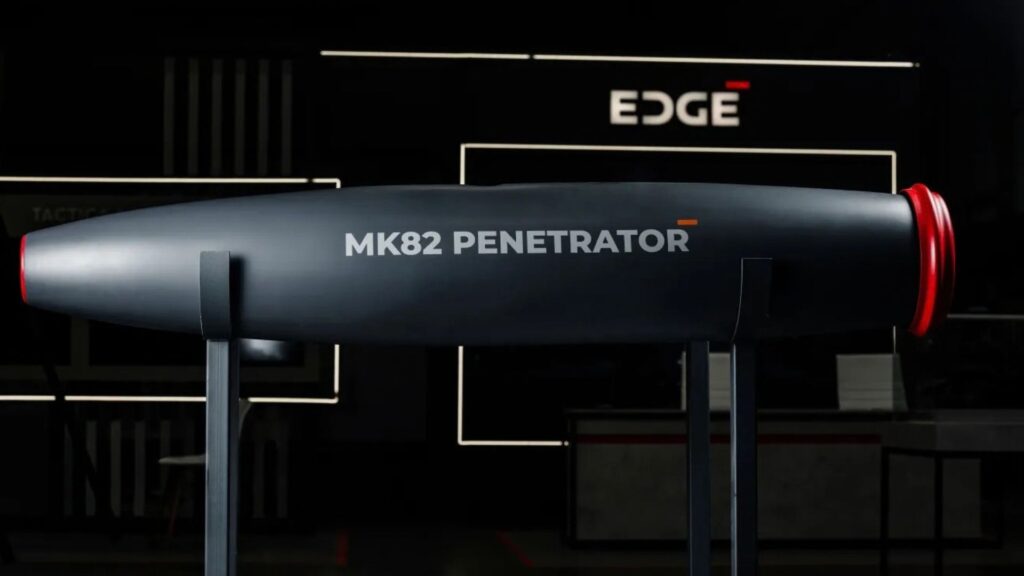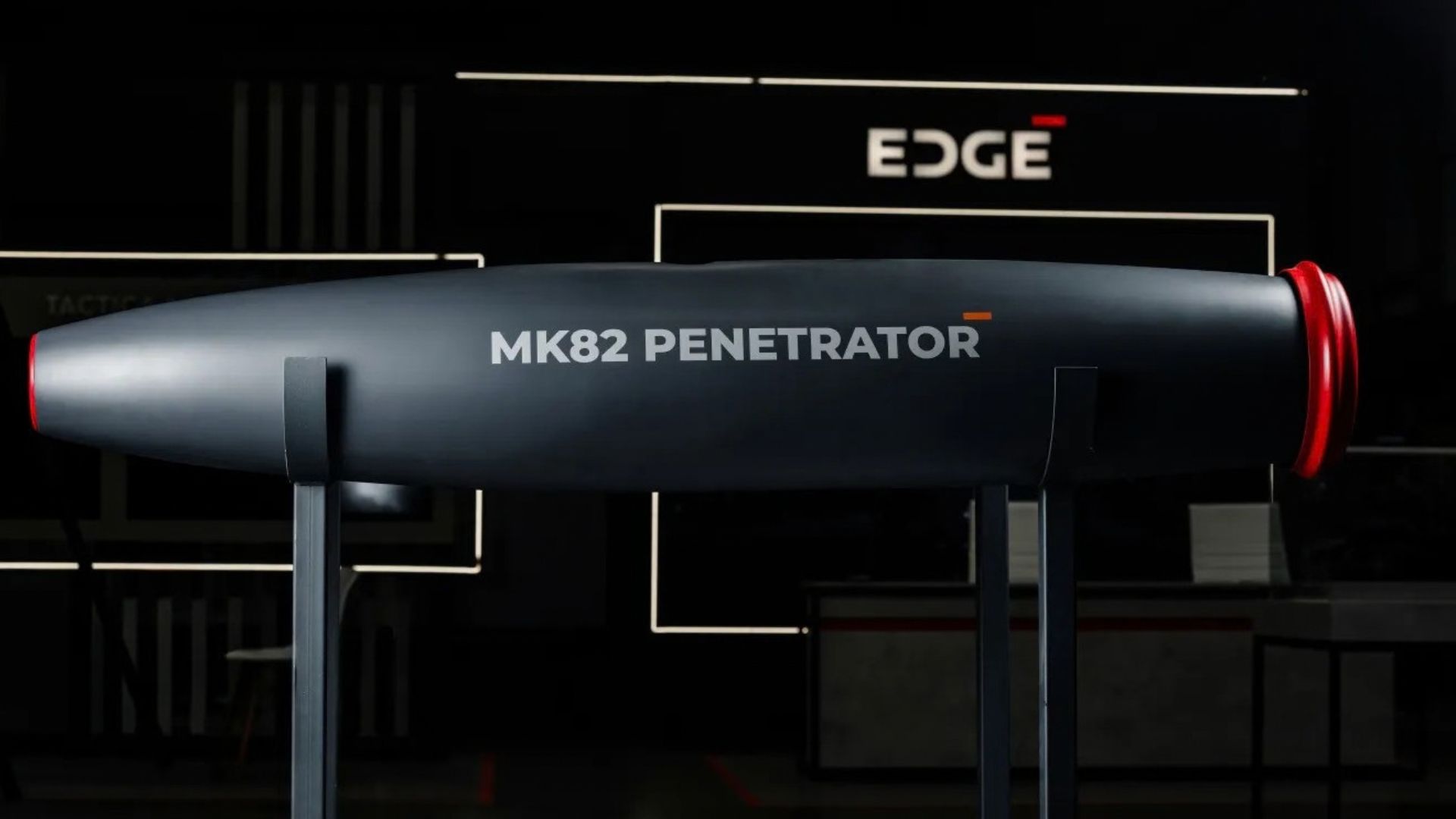
The United Arab Emirates has completed development of the MK 82 Penetrator, an air-launched weapon designed to defeat reinforced and hardened targets.
Developed by LAHAB, the munitions business of Emirati defence group EDGE, the weapon penetrated more than one meter of reinforced concrete during a qualification and performance test campaign.
The program adapts the established MK 82 bomb configuration for a dedicated penetrator role while retaining compatibility with aircraft and guidance systems already used with the weapon family.
Penetrator Built On MK 82
The MK 82 Penetrator is derived from the 500-pound-class MK 82 general-purpose bomb configuration. Its primary design change is a hardened weapon body intended to withstand the mechanical loads of impact against reinforced structures. This gives aircraft operators a penetrator option within a weapon format already integrated across a broad range of combat and strike aircraft.
EDGE said LAHAB completed development following testing against multiple hardened target types. The campaign included performance evaluation, qualification activities and environmental testing. During the trials, the munition reportedly penetrated more than one meter, or approximately 3.3 feet, of reinforced concrete.
The company also reported that the weapon avoided the “J” effect during penetration testing.
In this context, the term describes a change in the weapon’s trajectory as it enters and passes through a hardened target. Maintaining a stable impact path is important because excessive deflection can reduce the weapon’s ability to reach the intended point within a structure.
EDGE has not released the complete test dataset. Details such as concrete composition, reinforcement density, impact velocity, impact angle and target configuration have not been publicly disclosed. The reported penetration depth therefore represents a manufacturer-stated test result rather than a standard performance figure applicable to every hardened structure.
Existing Aircraft Integration
A major feature of the MK 82 Penetrator program is its focus on compatibility with existing aircraft configurations. EDGE says the weapon is intended for NATO-configuration aircraft, including fourth- and 4.5-generation multirole fighters, variable-geometry strike aircraft, advanced jet trainers and light attack platforms.
The company also identifies fifth-generation fighters among potential carrier platforms. Aircraft-level integration still depends on existing weapon certification, stores-management architecture, and clearance for the MK 82 family. This distinction matters because physical carriage compatibility does not, by itself, establish operational certification.
READ ALSO: https://modernmechanics24.com/post/atlas-sees-surface-nucleons-deeper/
The approach reduces the need for customers to introduce a completely separate aircraft-weapons architecture for the penetrator mission. Operators already cleared to employ compatible MK 82 weapons can potentially use the same broad aircraft integration framework, subject to platform-specific qualification.
The weapon can also be fitted with precision-guidance systems from EDGE’s AL TARIQ and THUNDER families. These guidance kits are intended to provide precision-engagement capability for compatible air-launched munitions. Their integration with the MK 82 Penetrator gives customers a path to combine hardened-target effects with guided delivery.
Qualification Supports New Role
The development campaign was designed to assess more than penetration performance.
EDGE said LAHAB conducted qualification testing covering environmental conditions and the weapon’s performance against hardened targets. Such testing forms part of the process required to establish whether a new munition can withstand storage, handling, carriage and operational conditions.
The penetrator mission places different structural demands on an air-launched weapon than conventional general-purpose bomb employment. The weapon must retain sufficient structural integrity during impact while maintaining its intended trajectory through the target. The reported absence of significant trajectory deviation during testing is therefore a stated element of the weapon’s qualification results.
LAHAB Chief Executive Officer Mohammed Arbabi said the company developed the weapon to expand customer capability while retaining familiarity and ease of use. He also linked the program to the UAE’s wider effort to strengthen domestic defense manufacturing capabilities.
For EDGE, the program expands its air-launched weapons portfolio into a more specialized munition category. It also demonstrates an approach centered on modifying an established weapon format rather than developing an entirely new aircraft-store architecture.
MK 83 Program Moves Ahead
The MK 82 Penetrator is the first of two planned variants in the program. EDGE said development of the larger MK 83 Penetrator has reached an advanced stage, extending the concept into a heavier bomb class. The company has not yet disclosed detailed performance specifications or a planned service-entry timeline for the MK 83.
The larger variant would broaden the penetrator family’s potential applications while allowing EDGE to build on technologies developed for the MK 82 program. Further details on its guidance options, aircraft integration and qualification results are expected as development progresses.
The program also supports the UAE’s effort to establish domestic capacity across the munition development cycle. That includes weapon design, engineering, qualification, testing and production, with the resulting systems aimed at both domestic requirements and potential international customers.
The completion of the MK 82 Penetrator gives EDGE a specialised hardened-target munition built around an established aircraft weapon format.
Its reported penetration exceeds one meter of reinforced concrete. The weapon is compatible with several aircraft. It can also use AL TARIQ and THUNDER guidance systems. These capabilities support development of a wider penetrator family. The MK 83 is now moving to the next development stage.