

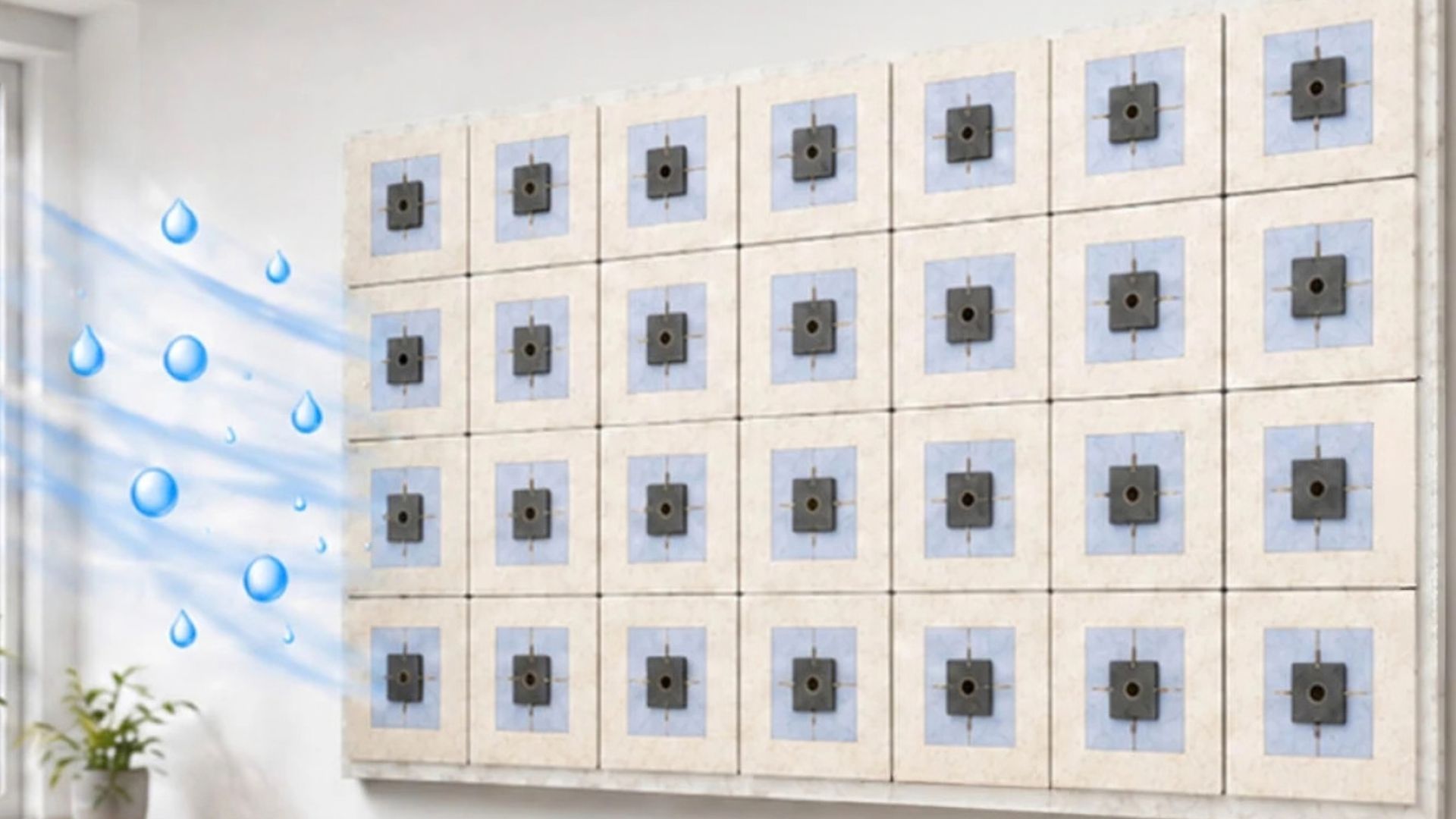
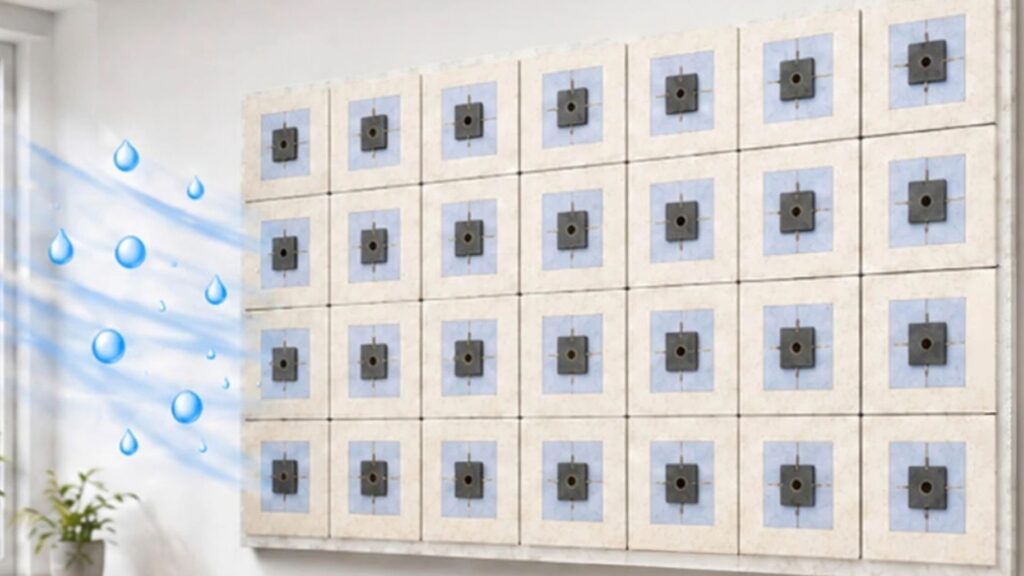
Researchers at Binghamton University have developed a wallpaper-like system that turns moisture in indoor air into electricity.
The technology uses humidity inside homes to produce a small electrical current without relying on sunlight or batteries. The team sees it as a possible power source for environmental sensors, wireless modules and other low-power devices.
The research, described in Advanced Energy Materials, focuses on moist-electric generators. These devices produce electricity by using water molecules present in humid air. Earlier systems mainly targeted outdoor environments, where they typically generated only microwatts per square centimeter.
Outdoor conditions also make such systems difficult to operate consistently. Humidity, temperature, sunlight and wind can change sharply during the day. Indoor spaces offer a more stable setting, with typical humidity levels between 30% and 60%, while cooking, bathing and human breathing add more moisture to the air.
Seokheun Choi, who leads the Binghamton University team, said indoor conditions give the technology a more predictable environment.
He said the main challenge with outdoor systems is their small output and exposure to changing weather. The researchers therefore focused on whether a controlled indoor environment could support continuous power generation.
Paper Forms The Wallpaper
The prototype uses laboratory-grade Whatman 3 MM paper, about 340 micrometers thick. The researchers arranged the material into 2-by-2-centimeter squares, each containing three functional areas. The design uses glycerol, polyvinylpyrrolidone, wax and graphite electrodes to manage the movement of water and electrical charge.
Glycerol sits around the edge of each square and attracts water vapour from the surrounding air. The moisture turns into liquid water inside the paper and moves toward the centre. Polyvinylpyrrolidone (PVP) holds water more tightly and has smaller pores, helping capillary action move the liquid through the material.
READ ALSO: https://modernmechanics24.com/post/uc-san-diego-light-magnetic-memory/
The center section contains a wax-treated area that works like a breathable rain jacket. It blocks liquid water while allowing water vapour to pass through its tiny pores. This creates a continuous movement of water from the outer section toward the centre and then into the air.
The researchers use laser-drilled holes filled with silver paint to connect the two sides of the paper. Electrical connections remain on the rear side to keep the front surface suitable for use as wallpaper. The manufacturing process combines wax printing, airbrushing, screen printing and laser processing without requiring a cleanroom.
Electricity From Water Movement
The electrical effect comes from chemical groups found in glycerol, cellulose and PVP. These groups help water release protons, which are positively charged hydrogen ions. A difference in proton concentration between the outer and inner sections drives an electrical current that graphite electrodes collect.
The output from individual tiles remains small. One tile produced about 0.34 volts at 80% relative humidity, while 10 tiles connected in a row produced about 2.9 volts. A larger 35-tile array powered a humidity sensor for about 15 minutes.
The largest test used 1,596 tiles. It produced about 3.5 volts at roughly 38% humidity. With a capacitor, which stores electrical energy and releases it when needed, the system could operate a wireless keyboard.
The study did not provide a total power figure for the full wallpaper-sized arrangement. That makes the demonstrated voltage more useful as an indication of the system’s operating potential than as a direct comparison with household electricity sources. The researchers are targeting devices that need very little power rather than appliances that require continuous high output.
Wallpaper Also Controls Humidity
The material has another function because the paper can absorb and release moisture. In a sealed chamber measuring 30 by 30 by 15 centimetres, 28 tiles reduced relative humidity from 75% to 50% in about four minutes. After absorbing water, the same material increased humidity from 15% to 20% in dry air over about 16 minutes.
A room-scale test also showed a measurable change. The largest array reduced humidity from 38% to 32% in about 15 minutes. The researchers describe this result as an early demonstration, not evidence that the material can provide long-term humidity control in occupied buildings.
Choi said the concept may eventually combine moisture management with electricity generation. Heating, ventilation and air-conditioning systems already consume energy to remove moisture from indoor air. A material that captures some of that moisture while producing power may offer another approach for managing indoor environments.
The researchers are still treating the wallpaper as a proof of concept. Durability, long-term performance, manufacturing at scale and reliable power output will need further testing before the material becomes a practical building product. For now, the most realistic applications are low-power sensors, wireless modules and internet-of-things devices.
If the system can maintain its performance over longer periods, sections of walls may eventually support their own sensors without conventional batteries or direct wiring. That would give buildings a way to use an existing indoor resource, moisture in the air, for small amounts of electricity.
The next stage will depend on whether the paper-based system can be made durable, printable and economical for larger-scale use.










One Response