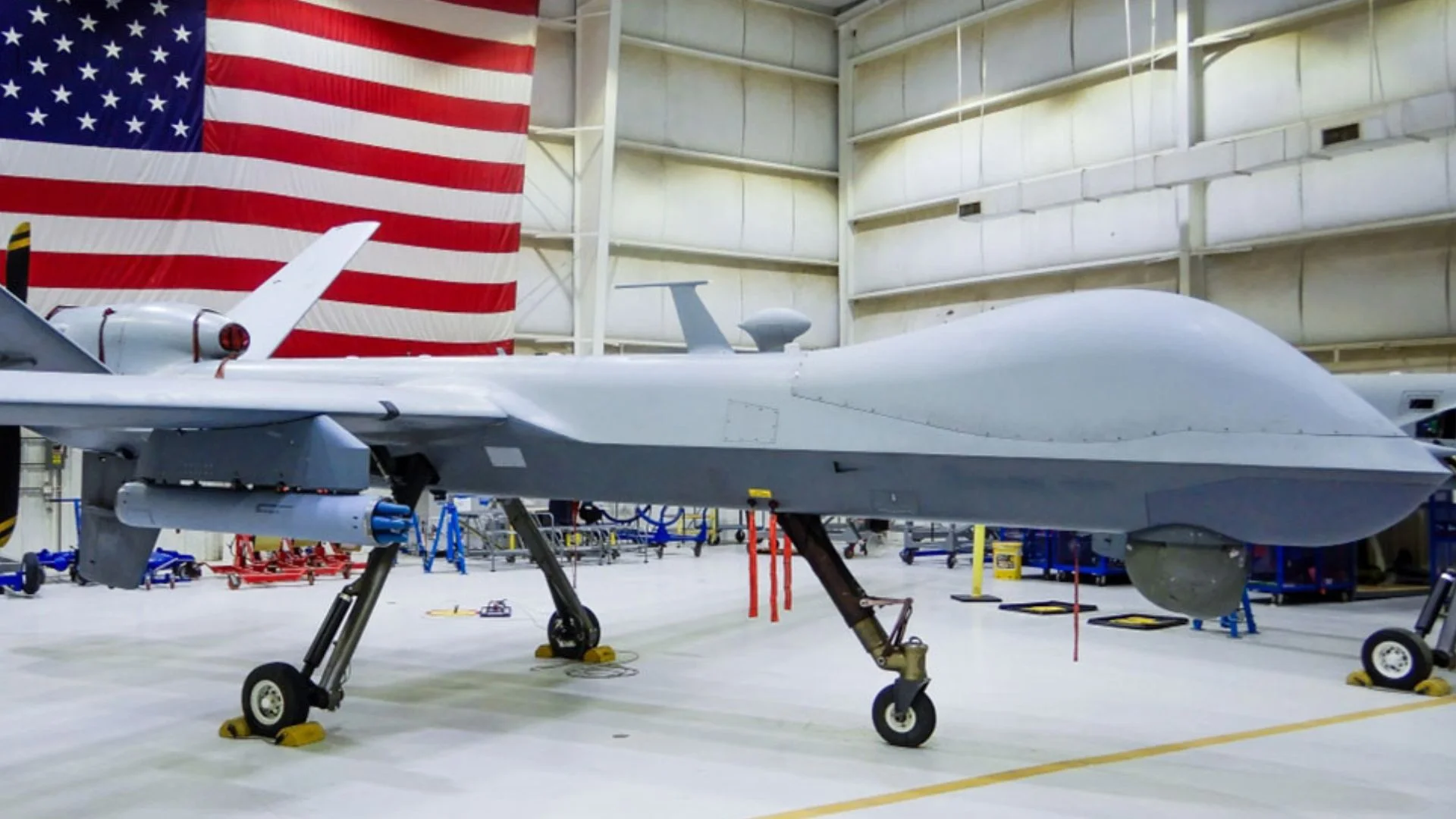
General Atomics Aeronautical Systems Inc. (GA-ASI) and the US Air Force have successfully tested the Advanced Precision Kill Weapon System (APKWS) on the MQ-9A Reaper drone.
The trials demonstrated how the long-endurance unmanned aircraft can use low-cost laser-guided rockets to counter aerial threats, including one-way attack drones.
The tests mark another step in expanding the MQ-9A’s combat role while improving affordability and operational flexibility.
MQ-9A Reaper Fires APKWS
The testing took place at the Nevada Test and Training Range in the US. Officials said the demonstrations included multiple firing profiles and engagements against aerial targets.
The MQ-9A crews launched laser-guided rockets using a specialized launcher mounted on the aircraft. According to the companies involved, every launch during the tests achieved its planned objective. The exercise was designed to evaluate how quickly the MQ-9A can adapt to emerging battlefield needs.
READ ALSO: US Navy Unveils LRAW Plan as AUKUS Pushes Next-Generation Anti-Submarine Warfare
APKWS is a laser-guided rocket system developed from the widely used Hydra 70 rocket. The system converts standard unguided rockets into precision-guided weapons by installing a guidance kit between the rocket motor and warhead. This gives military operators a lower-cost option than larger missiles, while still enabling accurate strikes.
GA-ASI President David R. Alexander said the APKWS system offers important advantages for countering one-way attack drones.
He explained that the smaller rockets allow the MQ-9A to carry more weapons during missions. He also said the integration effort showed how government and industry teams can rapidly develop and test new battlefield capabilities.
Why APKWS Matters
The growing use of low-cost attack drones in modern conflicts has increased demand for affordable air defense weapons. Larger missiles are effective but are often expensive to use against small drones. APKWS offers a cheaper alternative that can engage airborne threats without using high-value interceptors.
The MQ-9A Reaper already carries several types of precision weapons. It includes Hellfire missiles and guided bombs. Adding APKWS expands the aircraft’s ability to engage multiple targets during the same mission. It also increases the total number of munitions the aircraft can carry because APKWS rockets are smaller and lighter.
Military planners are increasingly focusing on layered defense systems to counter drone swarms and other unmanned threats. Aircraft such as the MQ-9A can remain airborne for long periods and monitor large areas. Combining endurance with lower-cost guided rockets creates a more flexible counter-drone platform.
WATCH ALSO: Apple launches iPhone 17 lineup with contoured edges, and thinner borders
The rapid pace of the testing program also reflects changing operational priorities inside the US military. Defense programs that once required years of development are now moving faster due to evolving threats. The APKWS integration effort moved from planning to flight testing in a relatively short period.
The MQ-9A Reaper first flew in 2001 as an upgraded and armed version of the earlier Predator drone. It was developed by GA-ASI using company funding before entering military service. The aircraft later became one of the most recognized remotely piloted combat systems used by the US and allied nations.
The aircraft can fly for more than 27 hours and operate at altitudes up to 50,000 feet. It can also reach speeds of around 240 knots while carrying surveillance systems and weapons. The platform has a total payload capacity of 1,746 kilograms, including external weapons.
GA-ASI designed the MQ-9A with triple redundant avionics and a fault-tolerant flight control system to improve reliability during missions. The aircraft uses a Honeywell TPE331-10 turboprop engine equipped with digital engine controls for better efficiency.
Operators can also configure the platform with radar systems, infrared sensors, laser designators, and electronic support equipment.
READ ALSO: NASA Mars Helicopter Rotor Blades Cross Mach 1 in Groundbreaking JPL Flight Tests
An Extended Range version of the MQ-9A adds wing fuel pods and reinforced landing gear, increasing endurance to up to 34 hours. Several countries operate the platform, including the US, UK, Italy, France, and Spain. NASA and the US Department of Homeland Security also use the aircraft for specialized missions.
The latest APKWS testing highlights how the MQ-9A continues to evolve beyond its original surveillance and strike role. As militaries search for affordable ways to defeat drone threats, integrating low-cost precision weapons on long-endurance aircraft may become important in future operations.