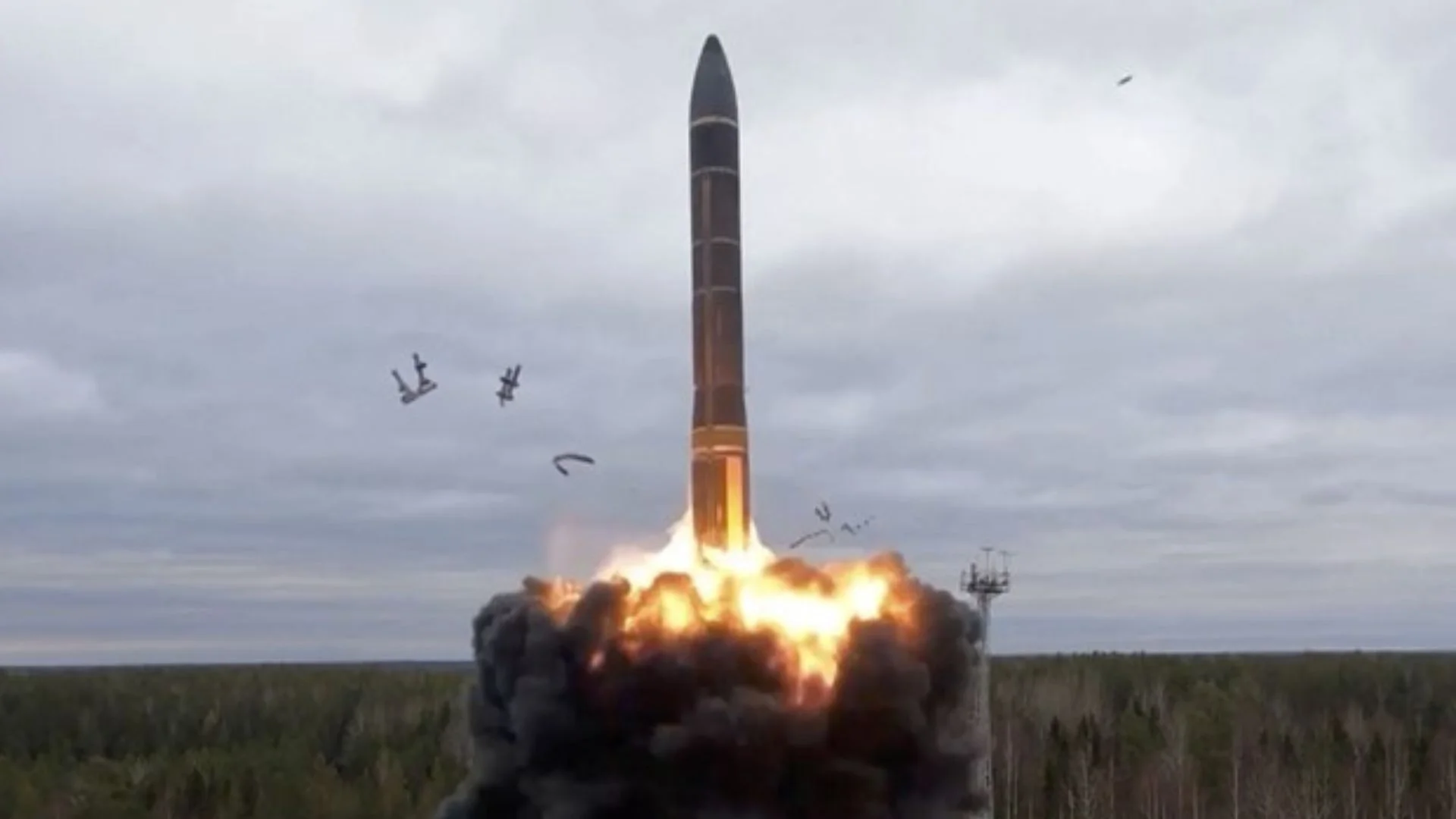
Russia on Tuesday conducted a test launch of its new Sarmat intercontinental ballistic missile, one of the most advanced nuclear weapons in its arsenal.
The missile is better known in NATO countries as ‘Satan II.’
President Vladimir Putin praised the launch and described the weapon as unmatched in strength and capability.
The Sarmat missile is designed to replace the aging Soviet-era Voyevoda missile system that has been in service for decades.
Russian officials say the new missile carries more warheads, travels farther, and can better evade enemy defenses. Moscow plans to deploy the missile into combat service before the end of the year.
READ ALSO: NASA and Microchip Build Spaceflight Chips With 100x More Power for Moon Missions
Satan II Missile Expands Russia’s Nuclear Reach
The Sarmat is classified as a heavy intercontinental ballistic missile(ICBM). These missiles are designed to travel thousands of miles and deliver nuclear warheads across continents within minutes.
According to Russian officials, the Sarmat can carry up to 10 tons of payload, including multiple nuclear warheads aimed at different targets.
Russian authorities say the missile has a range of more than 21,700 miles through suborbital flight paths. That means it can approach targets from unexpected directions rather than following traditional ballistic trajectories. This feature makes interception much harder for existing missile defense systems.
Putin said the Sarmat is more accurate than the older Voyevoda system while keeping the same destructive power. He also claimed the missile’s combined warhead strength is several times greater than Western counterparts.
Independent experts have not fully verified those claims, but analysts agree the missile is among the largest and most powerful nuclear delivery systems ever built.
The missile’s development began in 2011 as part of a broad modernization program for Russia’s nuclear forces. Moscow has spent years upgrading land-based missiles, nuclear submarines, and strategic bombers. The effort reflects Russia’s focus on maintaining nuclear parity with the US.
The Sarmat program has faced several technical challenges during testing. Before the latest launch, the missile reportedly had only one publicly known successful test. Reports in 2024 suggested another test ended in a major explosion at the Plesetsk Cosmodrome launch site in northern Russia.
WATCH ALSO: Elon Musk’s Neuralink Robot Makes Brain-Computer Connection Possible
Satellite images analyzed after that incident appeared to show damage near the launch pad. Despite those setbacks, Russian officials continued to present the Sarmat as a central part of the country’s future nuclear strategy. The latest test appears aimed at showing the program remains active and operational.
Russia Expands Strategic Weapons Program
The Sarmat missile is one of several advanced weapons unveiled by Putin in recent years. In 2018, he introduced a range of next-generation systems that he said could bypass American missile shields. Russia argues these systems are necessary to preserve the balance of nuclear power between Moscow and Washington.
Among those weapons is the Avangard hypersonic glide vehicle. Russian officials say it can travel at speeds up to 27 times the speed of sound while maneuvering in flight. Such speed and movement make it extremely difficult for current missile defense systems to track or intercept.
Russia has also deployed the Oreshnik intermediate-range ballistic missile. The missile reportedly has a range of about 3,100 miles, placing all of Europe within reach. Moscow has already used conventionally armed versions of the system in strikes against Ukraine.
Another major project is the Poseidon underwater nuclear drone. Russia says the unmanned system is designed to travel underwater for long distances before detonating near enemy coastlines. Analysts believe such a weapon could create massive radioactive contamination and coastal destruction.
Putin also spoke about the Burevestnik nuclear-powered cruise missile. Unlike conventional cruise missiles, it uses a miniature nuclear reactor for propulsion rather than conventional fuel. Russian officials claim this gives it virtually unlimited range and allows it to remain airborne for extended periods.
These weapons are part of Russia’s response to American missile defense systems developed after the US withdrew from a Cold War-era anti-ballistic missile treaty in 2001.
Russian military planners have long argued that US missile shields could weaken Moscow’s ability to retaliate after a nuclear attack. Maintaining that retaliatory capability remains a key part of Russian defense policy.
READ ALSO: Iran’s Uranium Stockpile Becomes Military Target as US-Israel Talks Shift to Action Plans
Nuclear Arms Treaty Collapse Raises Global Concerns
The latest missile test comes during a period of increasing nuclear uncertainty between Russia and the US. The last major nuclear arms control treaty between the two countries expired earlier this year. For the first time in more than 50 years, there are now no formal limits on the world’s two largest nuclear arsenals.
According to the Federation of American Scientists, the US possesses roughly 4,300 nuclear warheads while Russia holds around 3,700. Without treaty limits, both countries may expand or modernize their arsenals more aggressively. Security experts warn that this situation could fuel a new global arms race.
At the same time, Washington and Moscow recently agreed to restore high-level military communication channels. Those contacts had been suspended shortly before Russia launched its full-scale invasion of Ukraine in 2022. The talks are seen as an effort to reduce the risk of miscalculation between the nuclear powers.
Putin has repeatedly referenced Russia’s nuclear strength since the war in Ukraine began. Russian officials have often linked advanced missile programs to broader tensions with NATO and Western military support for Kyiv. The latest Sarmat launch reinforces Moscow’s message that it remains heavily invested in strategic nuclear deterrence.
The importance of the Sarmat missile extends beyond Russia’s military modernization plans. Its deployment signals that advanced nuclear weapons will remain central to global security competition for years ahead.
As arms control agreements disappear and new technologies emerge, the balance of nuclear power is entering a more uncertain and dangerous phase.