NASA has successfully tested next-generation Mars helicopter rotor blades that exceeded the speed of sound during experiments at the Jet Propulsion Laboratory in California.
The tests are part of efforts to develop more powerful aircraft for future Mars missions that can carry scientific instruments and support exploration tasks.
Engineers say the results will help shape a new generation of aerial vehicles designed to fly in the Red Planet’s thin atmosphere.
NASA’s JPL carried out the tests inside a specialized chamber built to simulate conditions on Mars. The chamber recreated the planet’s extremely thin atmosphere by using carbon dioxide under low pressure. Engineers then spun the rotor blades at very high speeds while exposing them to artificial Martian winds.
READ ALSO: Meet Gabi: South Korea’s Robot Monk Joins Buddhist Rituals Ahead of Buddha’s Birthday
The tests focused on rotor systems designed for future Mars helicopters, including aircraft planned for NASA’s proposed SkyFall mission. Unlike the Ingenuity helicopter, these future aircraft are expected to carry science equipment and heavier payloads. NASA wants the next generation of Mars helicopters to travel farther, stay airborne longer, and gather more scientific data.
NASA Pushes Mars Helicopter Blades Beyond Mach 1
During the experiments, the fastest parts of the rotor blades exceeded the speed of sound. Engineers recorded rotor tip speeds reaching Mach 1.08 during the final tests. On Mars, the speed of sound is lower than on Earth because the atmosphere is much thinner and colder.
At sea level on Earth, Mach 1 equals roughly 760 miles per hour. On Mars, the speed of sound is closer to 540 miles per hour because the atmosphere contains mostly carbon dioxide and has far fewer air molecules. This means aircraft flying on Mars face very different aerodynamic conditions.
NASA engineers completed 137 test runs inside the 25-Foot Space Simulator at JPL. The chamber has historically been used to test spacecraft and space technologies in controlled conditions. For the rotor experiments, the chamber air was replaced with carbon dioxide to match the density of a Mars-like atmosphere.
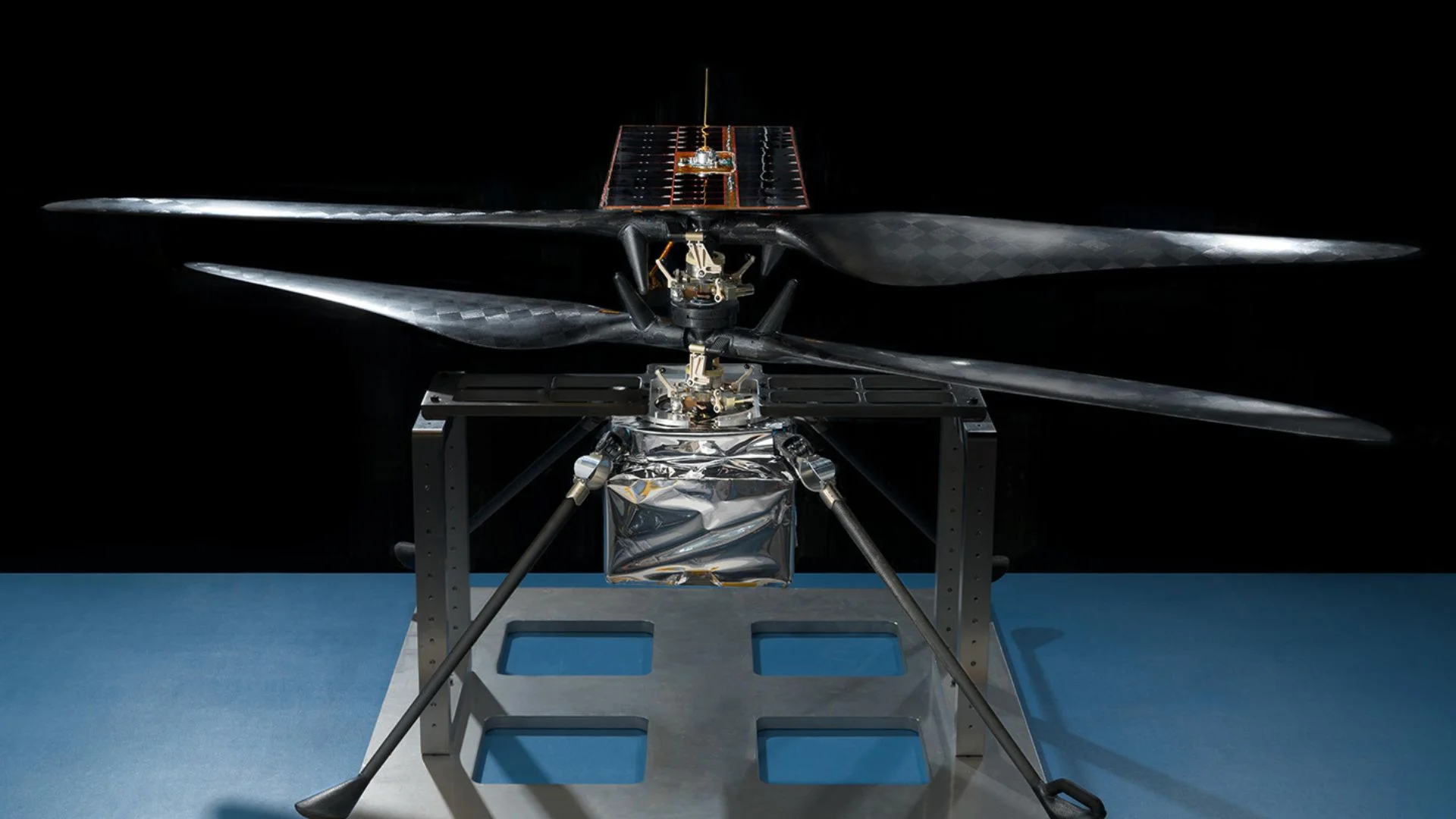
The team mounted a three-bladed rotor developed by aerospace company AeroVironment inside the testing facility. The rotor spun at speeds reaching 3,750 revolutions per minute during the trials. At those speeds, the blade tips approached Mach 1 before engineers introduced simulated Martian headwinds.
The researchers gradually increased wind speeds after each test run. The process allowed engineers to study how the rotor blades behaved under changing conditions. Special metal shielding was installed inside the chamber in case the blades broke apart during the high-speed tests.
The rotor blades remained stable even after crossing the sonic barrier. Engineers said the results increased the helicopter’s lifting capability by around 30 percent. More lift means future Mars aircraft may carry larger batteries, advanced sensors, and heavier scientific instruments.
WATCH ALSO: Poland and Portugal Gain New Space Capabilities After ICEYE Launch
Flying on Mars is much harder than flying on Earth because the planet’s atmosphere is extremely thin. Mars has only about one percent of Earth’s atmospheric density. Helicopters, therefore, need very fast-spinning blades to generate enough lift to stay airborne.
NASA’s Ingenuity helicopter faced the same problem during its historic flights on Mars. Ingenuity became the first aircraft to achieve powered flight on another planet in April 2021. The small helicopter completed 72 flights and proved that aerial exploration on Mars was possible.
Ingenuity’s blades never exceeded 2,700 revolutions per minute during operations on Mars. NASA engineers intentionally limited rotor speeds to avoid crossing the sound barrier. The team also wanted to reduce the risk of sudden Martian winds and dust storms.
JPL rotor test lead Jaakko Karras explained why engineers were cautious with Ingenuity’s flights. He said the team aimed to keep blade tips near Mach 0.7 under calm conditions. That safety margin prevented unexpected wind gusts from pushing the blades into unstable supersonic speeds.
Future Mars aircraft need much more performance than Ingenuity delivered. NASA plans to use larger helicopters for scientific research and mission support. These vehicles may transport instruments to difficult terrain that rovers cannot easily reach.
Low-altitude aerial exploration offers major advantages on Mars. Helicopters can quickly survey large regions, inspect cliffs, and study craters from above. They may also help scout landing sites and assist future human missions.
SkyFall Mission Plans Shape Future Mars Exploration
NASA’s SkyFall mission concept already incorporates findings from the new rotor tests. The mission is designed to send three next-generation Mars helicopters to the planet in December 2028. Engineers believe the upgraded aircraft will support more ambitious scientific missions.
The SkyFall project aims to expand aerial operations beyond what Ingenuity achieved. The helicopters are expected to carry scientific payloads rather than serve solely as technology demonstrations. NASA also wants them to operate more independently during exploration missions.
Engineers tested another rotor design during the recent experiments. This version used two blades instead of three and was slightly larger in diameter. The design achieved near-supersonic speeds at lower rotational speeds because of its longer blades.
The second rotor reached a similar tip speed of about 3,570 revolutions per minute. Engineers then exposed the system to simulated Martian headwinds to measure performance under stress. The tests helped researchers compare different rotor designs for future aircraft.
READ ALSO: Silicon Valley Pushes $200M Into Floating AI Data Centers Across the Pacific Ocean
NASA aerodynamicist Shannah Withrow-Maser said the results exceeded expectations during the final test runs. She explained that the team originally hoped to reach Mach 1.05 but eventually achieved Mach 1.08. Researchers are now analyzing the collected data to understand how much additional performance may still be possible.
The development comes as global space agencies increase focus on robotic exploration before future crewed missions to Mars. Aircraft can complement rovers by covering wider areas and reaching locations that ground vehicles cannot safely access. The technology may eventually become an important part of long-term Mars exploration systems.
NASA’s successful rotor tests mark another step in expanding aerial exploration beyond Earth. The findings show that future Mars helicopters may carry heavier payloads while operating in one of the most difficult flight environments known.
As engineers continue refining the designs, the next generation of Mars aircraft may play a larger role in exploring the planet during the next decade.