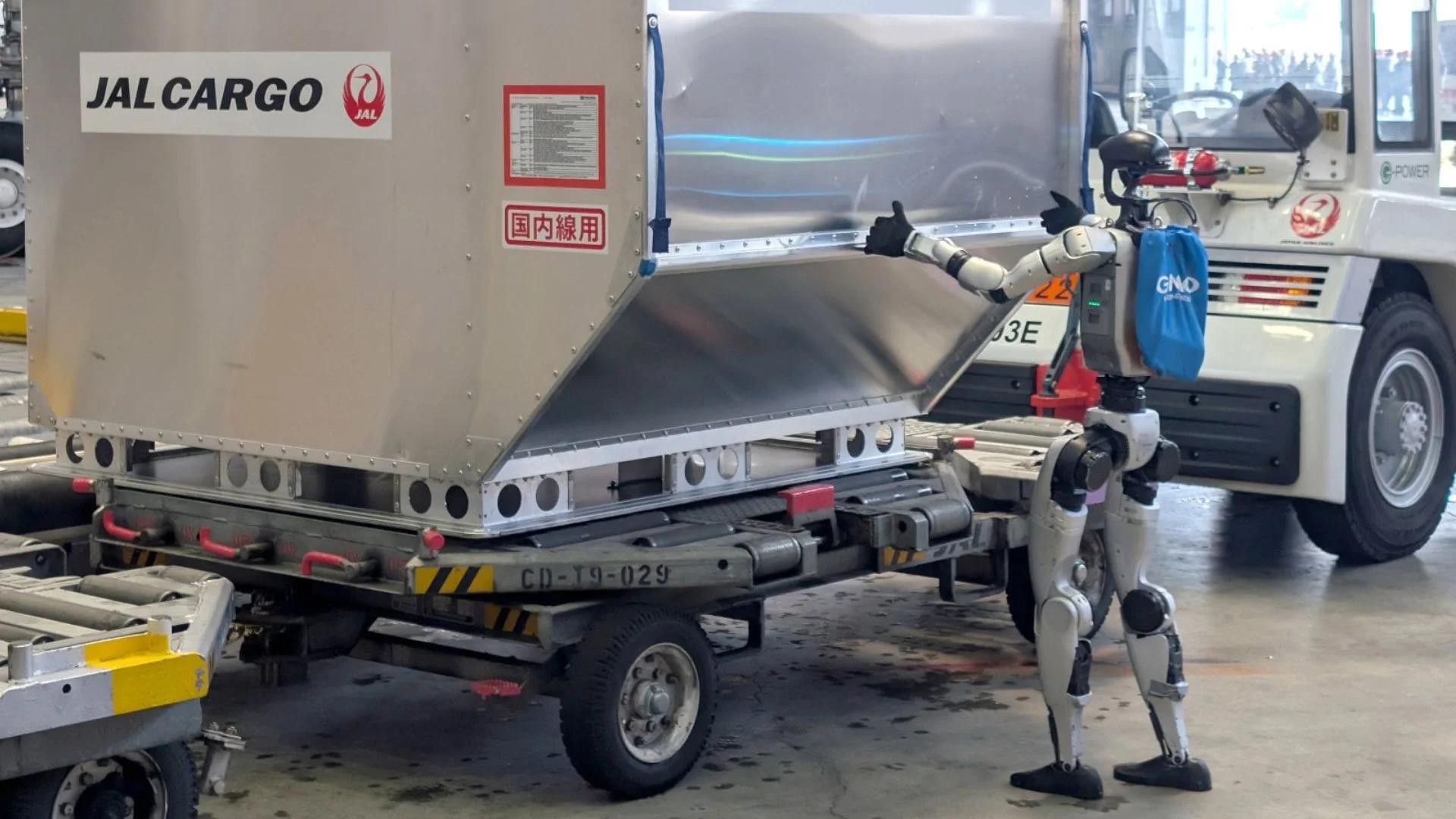
Japan Airlines has launched a new trial using humanoid robots at Tokyo’s Haneda Airport.
The airline partnered with GMO AI & Robotics to begin testing robotic support for airport ground operations. The project is scheduled to run for two years and officially starts this month.
The robots will help with physically demanding tasks around aircraft operations. These duties include loading and unloading baggage, handling cargo, towing aircraft equipment, and cleaning cabins between flights.
Japan Airlines said the experiment is designed to reduce pressure on workers and improve efficiency.
The airline described the project as Japan’s first use of humanoid robots in airport ground handling. Officials said the country’s aviation sector is facing severe labour shortages. Japan’s aging population and rising international tourism have made it harder for companies to recruit enough workers.
The airport trial reportedly uses humanoid robots developed by Chinese companies Unitree and UBTech. Unitree’s G1 robot stands about 1.3 meters tall and weighs around 35 kilograms. It is designed for agile movement and industrial tasks such as logistics and material handling.
READ ALSO: Meet Gabi: South Korea’s Robot Monk Joins Buddhist Rituals Ahead of Buddha’s Birthday
UBTech’s Walker E robot is larger and more human-sized. The machine stands around 1.72 metres tall and weighs roughly 73 kilograms. Its design enables it to perform more advanced movements and operations in workplace environments.
Chinese robotics companies are gaining attention in Japan as businesses search for automation tools. Several firms are now exploring robotic solutions for hospitals, factories, warehouses, and transport systems. Many Japanese companies see robotics as one way to manage long-term workforce shortages.
Tokyo-based AI start-up Zeals began a separate trial earlier this year using Unitree’s G1 robot at the University of Tsukuba Hospital. The robot helped guide patients to different locations inside the hospital, including laboratory areas. The project showed how humanoid robots can assist in customer service and navigation tasks.
UBTech also recently partnered with Honda’s China trading subsidiary. The companies plan to study how humanoid robots can support manufacturing, logistics, and warehouse operations. These partnerships show that Chinese robotics technology is becoming more visible in global industrial markets.
China has emerged as the world’s largest market for humanoid robots. According to consultancy Counterpoint Research, Chinese companies accounted for around 80 percent of global humanoid robot installations last year. About 16,000 humanoid robots were installed worldwide in 2025 across industries, including manufacturing, logistics, and research.
Humanoid robots are designed to perform tasks in environments created for humans. Unlike traditional factory robots that stay fixed in one place, humanoid machines can move around workplaces and interact with tools, equipment, and people. This flexibility makes them attractive for industries facing worker shortages.
WATCH ALSO: Elon Musk’s Neuralink Robot Makes Brain-Computer Connection Possible
Chinese humanoid robots have also attracted attention outside Asia. One recent incident involved a humanoid robot traveling on a Southwest Airlines flight in the US. The robot reportedly triggered extra security checks before it was cleared to board the aircraft.
Japan’s airport experiment may serve as an important test of the future of robotics in public infrastructure. If the trial succeeds, more airports and transport companies may adopt humanoid robots for daily operations. The results could also influence how countries facing labour shortages invest in automation over the next decade.