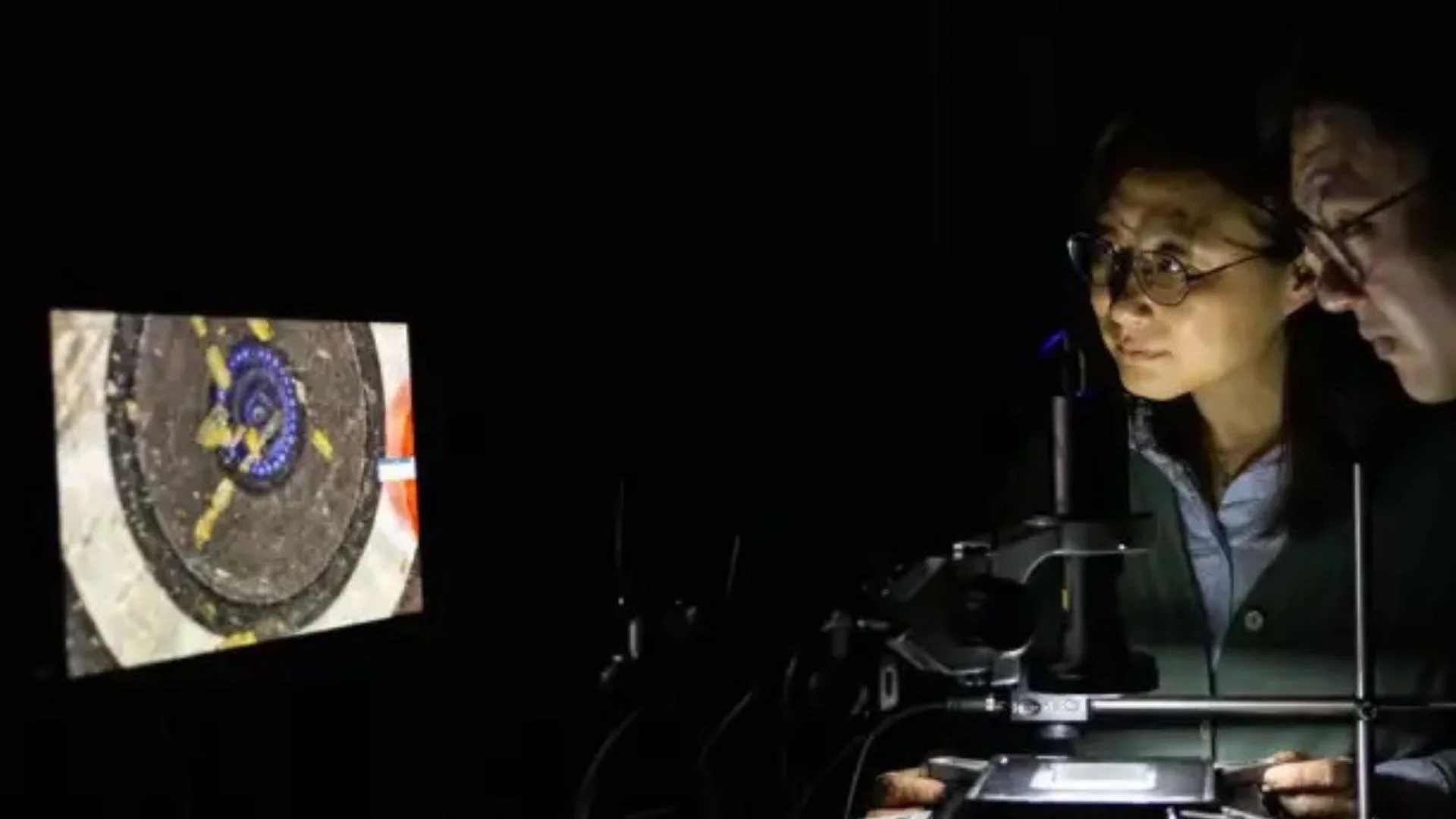
A team from the University at Buffalo has enhanced chiral semiconductors by enabling them to absorb visible light, allowing these handed materials to work with everyday light while still distinguishing between left- and right-handed light waves.
The findings, published in Nature Communications, bring fresh momentum to next-generation optoelectronic technologies.
Chiral materials are special because their structures are not mirror images of each other, just as left and right hands are not mirror images of each other. This property is common in nature. Even DNA has a right-handed twist. That handedness changes how molecules interact with each other and with light. Now, scientists are using this concept to design better electronic materials.
READ ALSO: Sun’s Double X-Class Flares Raise New Concerns Over Space Weather Risks
Chiral semiconductors already have one powerful ability. They can tell the difference between left- and right-circularly polarized light. This makes them useful for advanced sensing, communication systems, and light-based computing.
Most of these materials cannot absorb visible light well. Instead, they respond mostly to ultraviolet light, which carries more energy. This limitation has slowed their practical use.
To fix this, the researchers introduced a second molecule into the system. They combined a chiral semiconductor made from perovskite with a non-chiral organic molecule called F4TCNQ. This molecule is known for its strong ability to accept electrons.
When exposed to visible light, the chiral semiconductor interacts with light based on its handedness. At the same time, electrons move from the semiconductor into the dopant molecule. This process creates a state known as a charge-transfer state.
WATCH ALSO: Apple launches iPhone 17 lineup with contoured edges, and thinner borders
That state allows the material to absorb visible light, something it could not do effectively before.
Wanyi Nie, a physicist at the University at Buffalo, explains it clearly, “We transferred chirality into a non-chiral molecule. The material keeps its handedness and also gains the ability to respond to visible light.”
In simple terms, the material now does two jobs at once. It detects the direction of light waves and works with lower-energy light that is easier to use in real devices.
The research brought together experts from several major institutions, including Los Alamos National Laboratory, Brookhaven National Laboratory, University of California, Berkeley, and National Taiwan University. This collaboration helped combine knowledge from physics, chemistry, and engineering to solve the problem.
According to researchers, the chiral semiconductor acts like a basketball guard. It reads the situation and passes the ball, or electrons, to the dopant molecule. The dopant molecule then completes its action by enabling visible-light absorption. This teamwork between molecules is what makes the system effective.
Dave Tsai, a co-author of the study, highlights the importance of this interaction. He says the material can process light more effectively, opening the door to better sensors and communication systems.
READ ALSO: Hidden Carbon Clue Explains Violent Lightning Inside Volcanic Ash Clouds
While the results are promising, the researchers still want to understand the deeper physics behind the process. They know that chirality, the ability to distinguish left from right, is being transferred between materials. But they are still studying how electrons carry that information and what controls the process.
This development moves chiral semiconductors closer to real-world applications. By enabling visible light absorption, the materials become more practical for technologies that rely on everyday light sources. This includes optical communication systems, polarized light detectors, and even advanced photocatalysis.
The study shows that a simple chemical combination can unlock new behavior in complex materials. And sometimes, the smartest solutions come from letting two very different components work together.