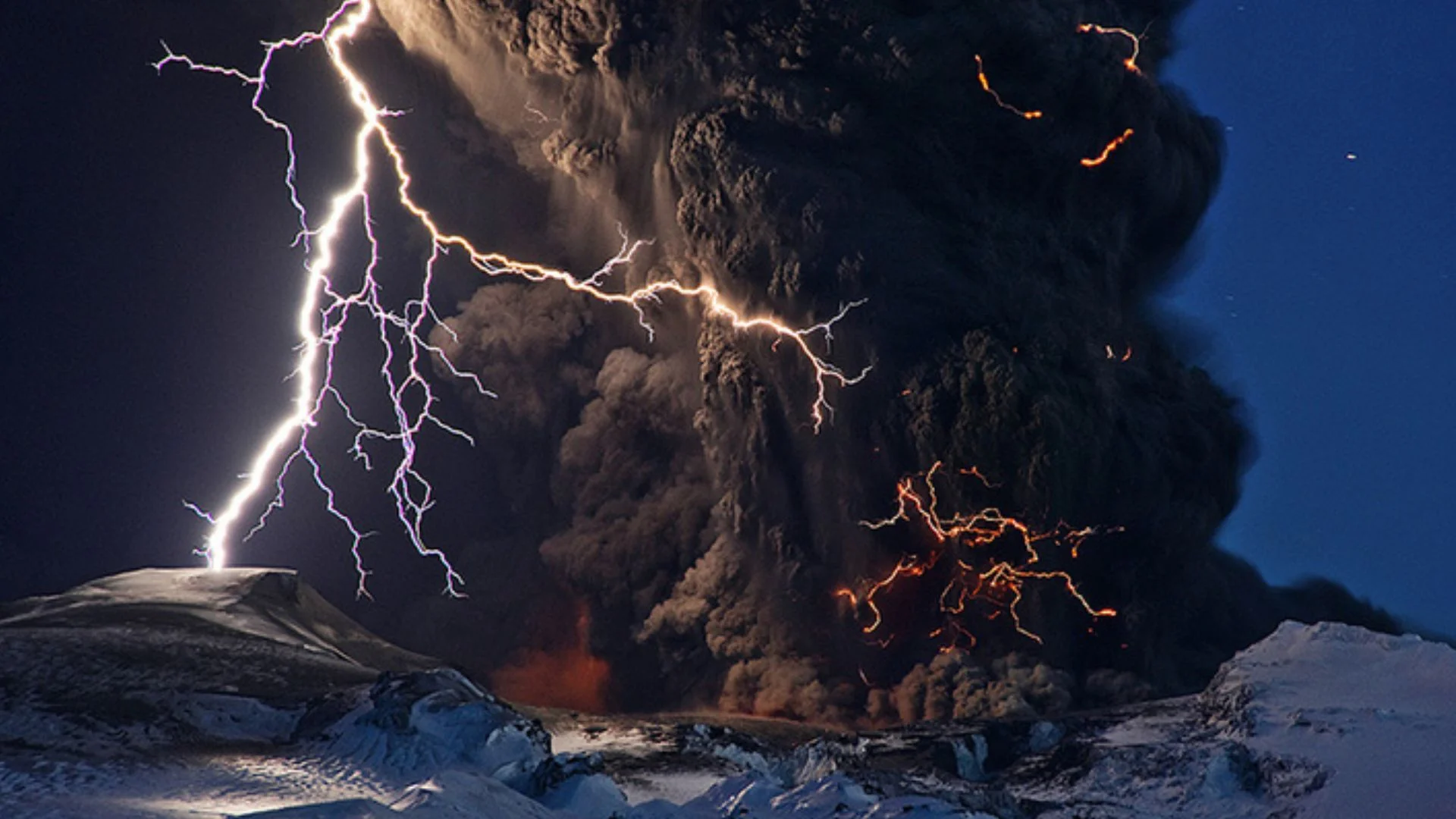
Scientists have uncovered a key detail behind one of nature’s most dramatic displays, lightning inside volcanic eruptions.
The new findings explain how dry clouds of ash and rock fragments generate powerful electrical charges, leading to intense lightning bursts during eruptions.
Volcanic lightning has long fascinated researchers. It appears as bright flashes within towering plumes of ash and smoke that rise high into the sky during eruptions.
READ ALSO: China Names J-35 Blue Shark as Carrier Stealth Fleet Nears Wider Deployment
One of the most striking examples occurred during the Hunga Tonga-Hunga Haʻapai eruption in 2022. That event produced more than 2,600 lightning flashes per minute, reaching heights of up to 31 kilometers above sea level.
Despite such observations, scientists have struggled to explain how these lightning storms form. In regular thunderstorms, the process is well understood.
Ice crystals moving upward collide with falling particles, such as soft hail, known as graupel. These collisions separate electrical charges, with ice gaining a positive charge and graupel gaining a negative one.
Volcanic plumes, however, are very different. They are mostly dry, filled with ash, dust, and rock fragments. Since these particles are made of similar materials, scientists found it difficult to explain how they could generate strong electrical charges through collisions.
A study published in Nature by researchers at the Institute of Science and Technology Austria reveals that the key lies in a thin layer of carbon-based material coating the particles.
WATCH ALSO: NASA rover discovered ancient microbial life signature on Mars
The team found that clean silica particles alone do not easily gain or transfer charge. However, when these particles are coated with tiny amounts of carbon-rich molecules, their behavior changes. During collisions, these coated particles can exchange electrical charge, enabling lightning.
The researchers also discovered that this coating forms naturally. When silica particles are heated, as they are inside a volcanic plume, they pick up carbon-containing molecules from the surrounding air. This creates the perfect surface conditions for charge transfer.
In simple terms, the extreme heat and strong upward movement inside a volcanic eruption help prepare the particles for electrical activity. As these particles collide in the turbulent plume, they build up charge, eventually releasing it as lightning.
This insight helps explain why volcanic lightning can be so intense and frequent. The combination of heat, ash, and rising air creates an environment where charged particles interact rapidly and continuously.
The findings mark an important step forward in understanding volcanic behavior. Lightning patterns can provide clues about the strength and structure of eruptions, making them useful for monitoring volcanic activity.
READ ALSO: PLA Holds Drills East Of Luzon, Calls It A Necessary Response As Asia Security Tensions
By solving this long-standing mystery, scientists now have a clearer picture of how eruptions generate electrical energy. The study also highlights how small changes at the microscopic level can lead to powerful natural phenomena.
However, scientists hope to use this knowledge to better predict volcanic events and improve safety measures for communities living near active volcanoes.