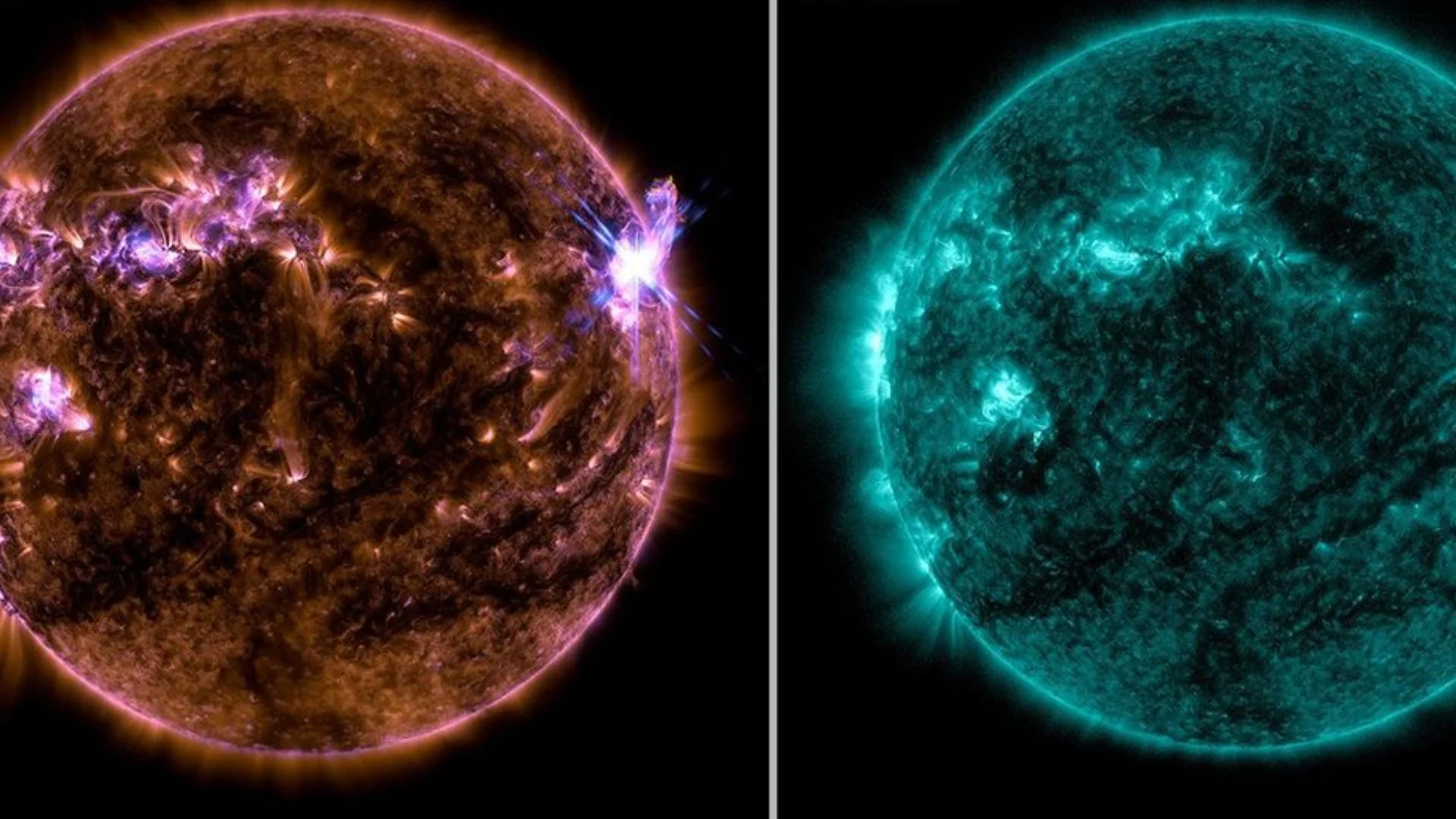
The Sun has released two powerful bursts of energy in quick succession, drawing attention from scientists and space weather watchers around the world.
These events, known as solar flares, were recorded by NASA’s Solar Dynamics Observatory, which continuously monitors the Sun.
The first flare reached its peak at 9:07 p.m. Eastern Time on April 23. The second followed hours later, peaking at 4:13 a.m. Eastern Time on April 24.
READ ALSO: Mosquito Reaches Iceland, Signaling a Hidden Ecological Shift Across the Arctic
Both were classified as X-class flares, the strongest category used by scientists to measure solar activity. The first was labeled X2.4, while the second was slightly stronger at X2.5.
Solar flares are intense bursts of radiation that come from the release of magnetic energy stored in the Sun’s atmosphere. These explosions can last from minutes to hours. While they occur millions of kilometers away, their effects can travel quickly across space and reach Earth.
Scientists use a classification system to measure the strength of solar flares. X-class flares are the most powerful. The number that follows, such as 2.4 or 2.5, shows how intense the flare is within that category. Even small increases in this number can mean significantly more energy being released.
These recent flares highlight the Sun’s active nature. When such powerful eruptions occur, they can affect Earth’s technology and systems. Radio communication can become disrupted, especially for aircraft and ships that rely on high-frequency signals. Navigation systems like GPS may also face temporary disturbances.
WATCH ALSO: US conducts powerful and deadly strike against ISIS terrorists in Northwest Nigeria
Electric power grids are another area of concern. Strong solar activity can induce currents in power lines, which may cause voltage problems or, in rare cases, damage infrastructure. Spacecraft and satellites orbiting Earth are also exposed to higher levels of radiation during such events, which can interfere with their operations.
Astronauts face increased risks as well. Outside Earth’s protective atmosphere, they are more vulnerable to the radiation produced by solar flares and related events.
Experts closely monitor these developments through organizations such as the NOAA Space Weather Prediction Center. This center provides forecasts, alerts, and warnings to help governments, industries, and the public prepare for potential impacts.
READ ALSO: Artemis II Returns: The Moon Mission That Went Farther Than Ever Before
NASA plays a key role in this effort. The agency observes the Sun using multiple spacecraft that study solar activity, the solar atmosphere, and the flow of particles and magnetic fields through space.
These observations help scientists better understand how solar events develop and how they may influence Earth.
Solar flares are a natural part of the Sun’s cycle, but strong events like these serve as a reminder of how connected Earth is to space weather. As technology becomes more advanced and dependent on satellites and communication systems, monitoring solar activity becomes increasingly important.