Chinese researchers say they are moving closer to building giant structures directly in space, where machines can assemble satellites and stations in orbit instead of launching them in one piece.
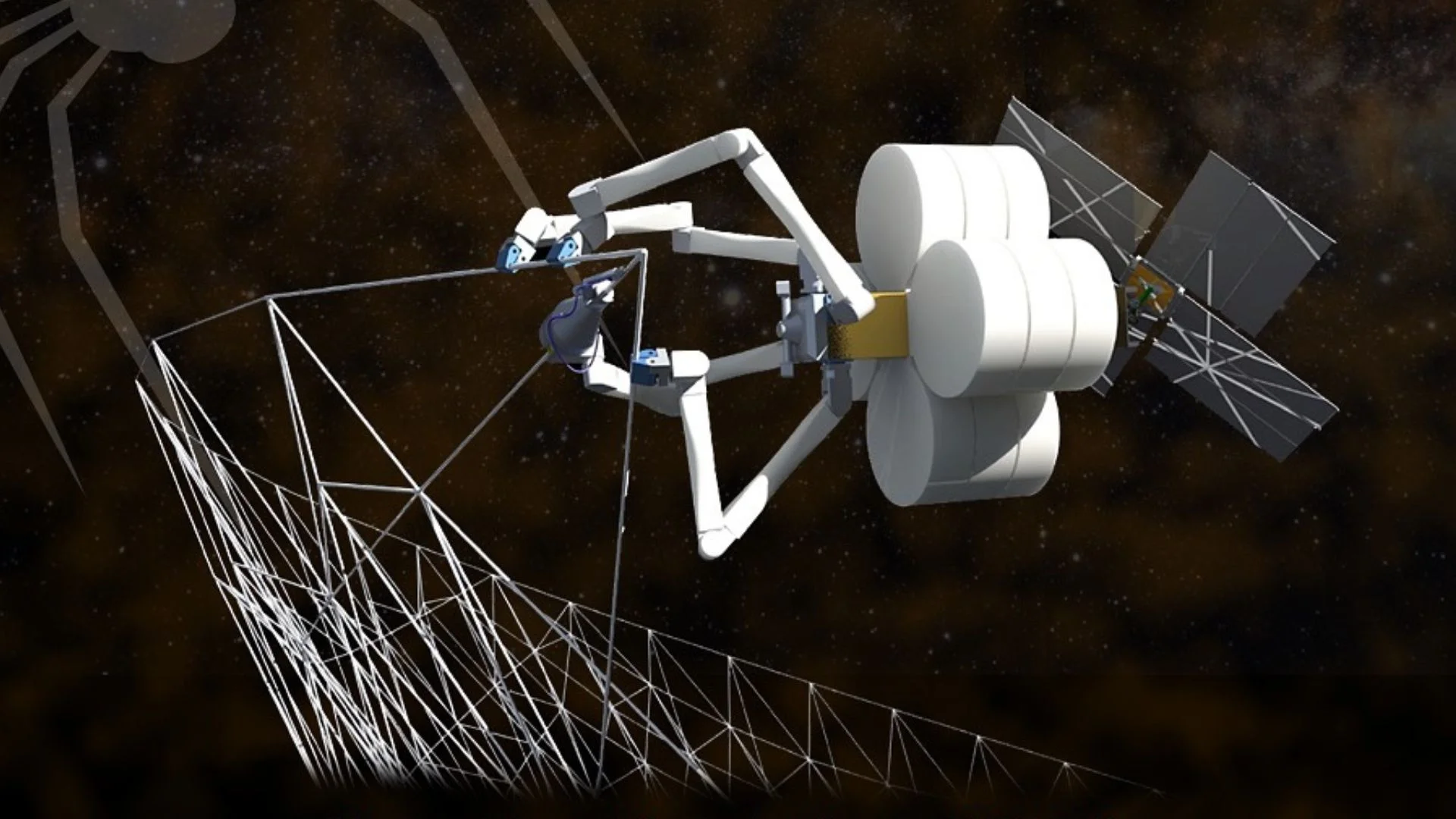
The idea was once explored by NASA through a project called SpiderFab. It imagined a robotic system that would act like a spider in space, spinning carbon fiber into massive antennas and solar arrays.
These structures would be far larger than anything that could fit inside a rocket. But the project never moved beyond early development. Now, a team from the Shenyang Institute of Automation says it has developed key technologies needed to achieve a similar goal.
The researchers focused on a key problem: building strong, reliable structures in space. Instead of sending fully assembled systems from Earth, they worked on methods to produce and connect parts directly in orbit.
READ ALSO: Mosquito Reaches Iceland, Signaling a Hidden Ecological Shift Across the Arctic
First, they created structural components from carbon fiber composites. These materials are known for being both lightweight and strong, qualities that are essential in space.
The team shaped the material into long, hollow tubes using heat and pressure. These tubes can act as the backbone of large space structures.
Next, they designed connectors using 3D printing. These joints link the tubes together. Instead of using bolts or glue, the team used lasers to bond the parts. This method creates strong, even connections that are more stable over time.
The researchers tested their approach by building a small antenna structure in the lab. The experiment showed that the concept works in practice. They published their findings in the journal Space: Science & Technology on April 3.
The team says their method offers a new way to build large systems in orbit. It is lightweight, strong, and reliable. More importantly, it removes the size limits imposed by rocket launches.
WATCH ALSO: US conducts powerful and deadly strike against ISIS terrorists in Northwest Nigeria
Today, spacecraft are designed and built on Earth. Engineers must fit them inside rocket fairings, which have strict size limits. They must also ensure the structures can withstand the intense forces during launch. This makes it difficult to send large or delicate systems into space.
Building structures directly in orbit solves these problems. Parts can be made and assembled in space, without worrying about size or launch stress. This can allow engineers to create massive antennas, solar power stations, and other systems that stretch hundreds of meters.
The idea itself is not new. Since the 1980s, astronauts have assembled structures in space using pre-built parts. A well-known example is the International Space Station. It measures about 109 meters in length and took more than 40 launches over 13 years to complete.
But scientists have long wanted to go a step further. Instead of assembling pre-made pieces, they want to manufacture structures entirely in space from raw materials. This would remove almost all size restrictions.
READ ALSO: From Weeks to Hours: AI’s Silent Takeover of US Nuclear Licensing
Over the years, several projects in the US and Europe have explored this idea. These include efforts to build and repair satellites in orbit. However, none of these systems has yet been fully realized.
The Shenyang team focused on two main challenges. The first was how to produce strong materials efficiently. The second was how to connect them reliably.
To improve the material, the researchers adjusted the temperature and processing speed. This helped them achieve better strength, stiffness, and durability. These properties are important for structures that must survive harsh space conditions.
Their laser-based joining method also offers clear advantages. Traditional bolts can loosen over time, and glue can weaken in extreme environments. Laser bonding creates more stable connections, which may last longer in orbit.
However, the work is not complete. The researchers say the next step is to test how these materials perform in real space conditions. They want to understand how ultraviolet radiation and cosmic rays affect the structures over time.
WATCH ALSO: YouTuber captures lightning in a bottle during stunning experiment
There are also broader challenges. The institute itself was added to a US trade restriction list in 2022 due to alleged links to China’s military. This has limited its access to some advanced technologies.
Even so, the progress highlights a growing global interest in building infrastructure in space. Such technologies can change how satellites, power systems, and even space habitats are created.
The dream of a space spider weaving giant structures in orbit may still be in development. But step by step, scientists are turning that idea into something far more real.