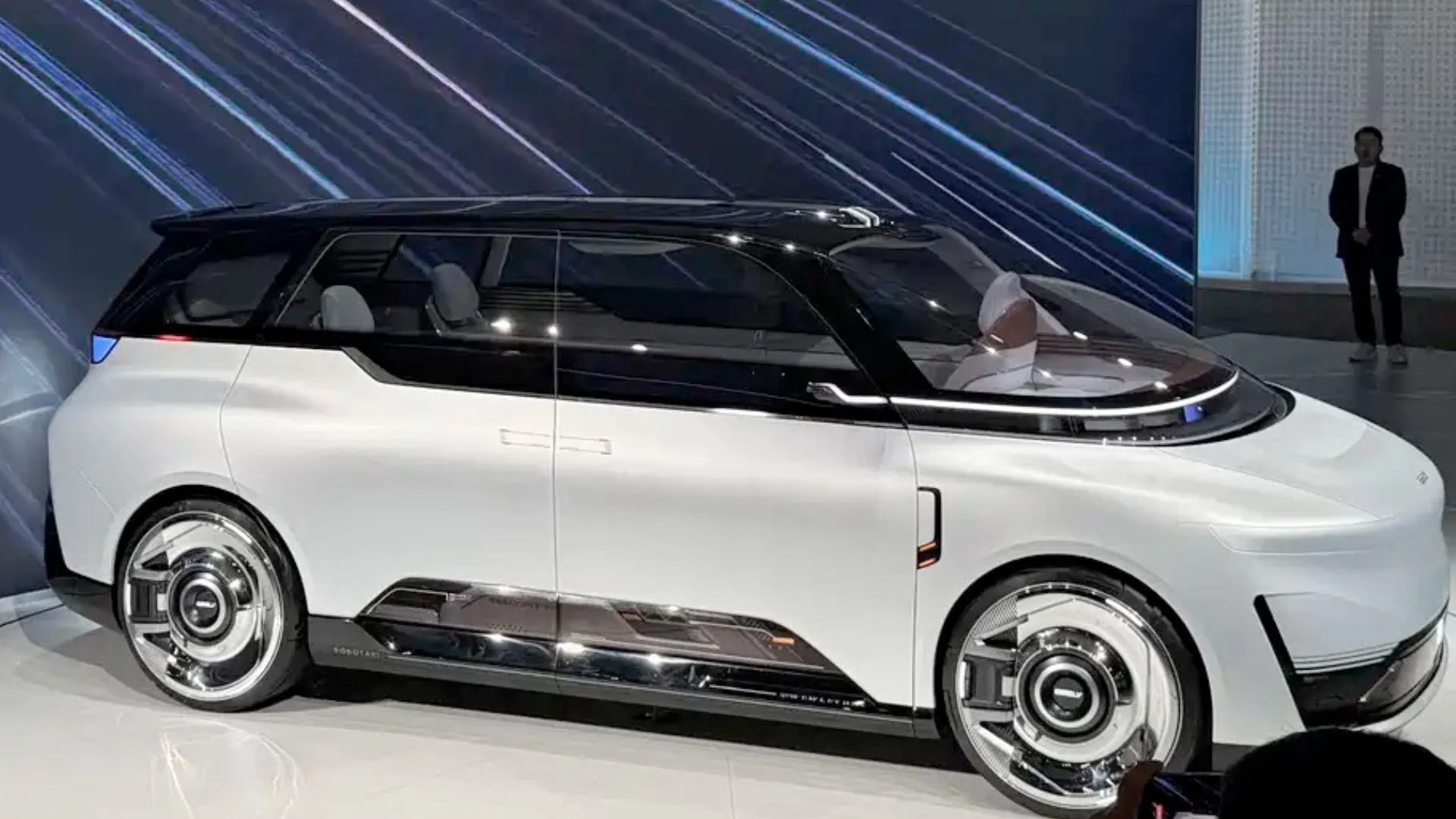
At the Beijing Auto Show 2026, Geely introduced a new driverless vehicle that signals its ambitions in autonomous mobility.
The company revealed the Eva Cab, calling it China’s first native robotaxi prototype built to operate without human control, similar in concept to Waymo’s systems.
The Eva Cab is powered by an advanced artificial intelligence system at its core. It uses a 196-billion-parameter Step 3.5 large model paired with an H9 computing platform that delivers 1,400 TOPS (trillions of operations per second).
READ ALSO: 94% Gone: Nanopillars in Plastic Film Tear Viruses Apart on Contact
Geely says the system processes decisions at 350 tokens per second and reacts three times faster than human drivers. The company adds that the vehicle can manage 99% of everyday driving situations, including difficult tasks such as navigating manual toll booths and finding paths on unmarked rural roads.
At the center of this system is Geely’s World Action Model (WAM). This technology moves beyond the traditional perception-decision method and creates a closed-loop system.
It allows the vehicle to plan ahead and adjust in real time. Geely says the system can “think and judge like an experienced driver,” especially in complex or unstructured traffic environments.
WATCH ALSO: EHang’s next-gen autonomous eVTOL completes first public flight
The robotaxi is equipped with 43 sensors, including LiDAR and high-definition cameras. These form a full 360-degree perception network with no blind spots. The system constantly tracks pedestrians, vehicles, and obstacles to reduce risk. Geely reports a 95% success rate in multi-turn U-turn scenarios, a key test for human-like driving ability.
The design of the Eva Cab also stands out. It removes the steering wheel and traditional controls entirely, showing confidence in full autonomy. The vehicle uses an AI-powered digital chassis that reacts in just four milliseconds. Geely says this enables active risk avoidance and ensures the vehicle stays stable even in extreme situations.
Looking ahead, Geely plans to bring the robotaxi to real-world use soon. A customized version developed with Caocao Mobility is expected to enter mass production in 2027, marking the start of commercial operations.
READ ALSO: Locus Array Debuts: The Warehouse Robot That Rewrites Fulfillment
The launch comes as Geely reshapes its autonomous-driving strategy. Earlier efforts involving Zeekr and Waymo on a robotaxi based on the Zeekr Mix have faced challenges, with reports indicating weak sales performance for the model this year.
The Eva Cab now represents a fresh direction as Geely pushes to bring unmanned driving into everyday transport.