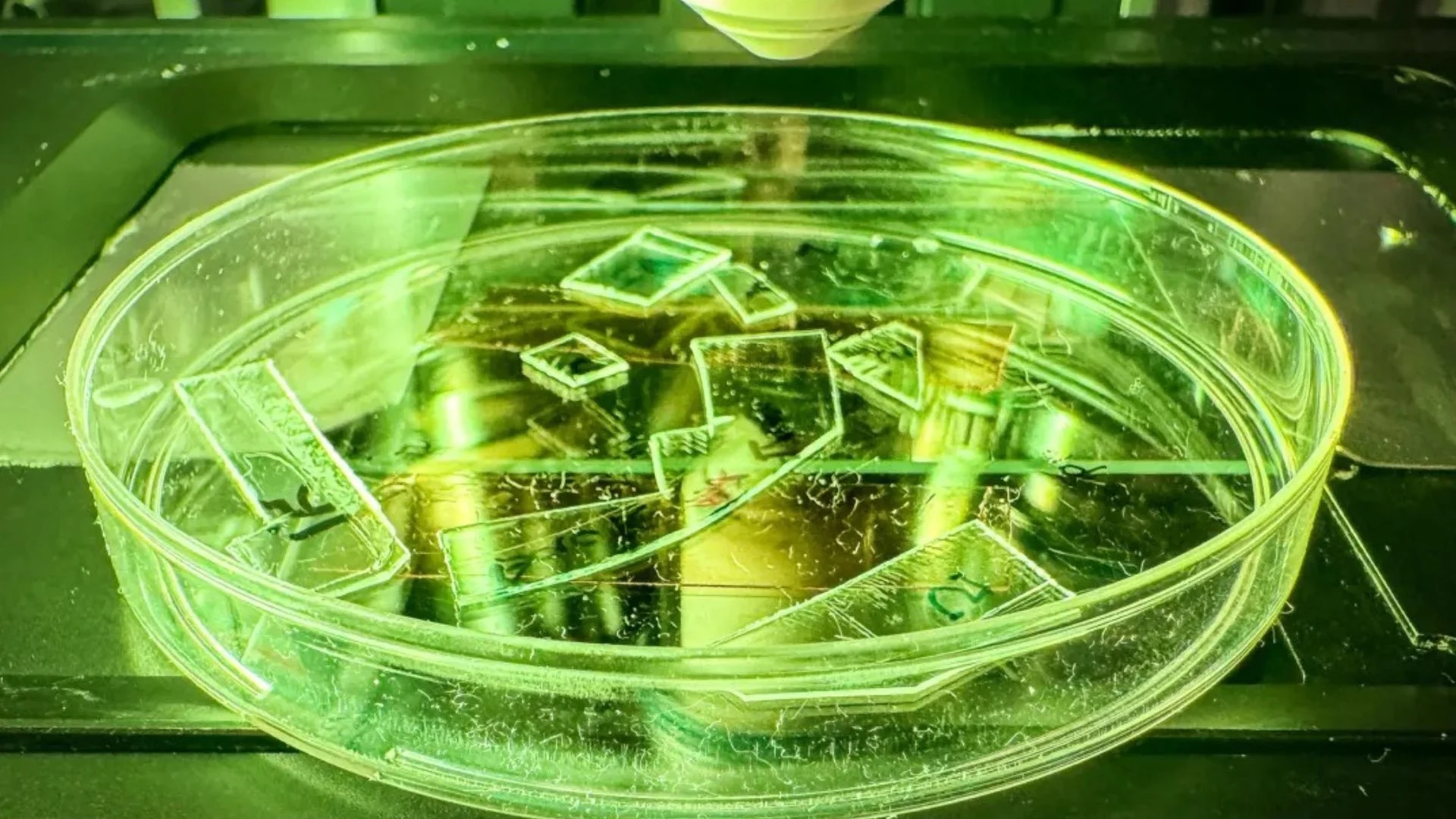
Scientists have developed a new type of plastic film that can destroy viruses the moment they come into contact with its surface.
Instead of using chemicals, this material works in a completely different way. It physically pulls viruses apart, making them harmless almost instantly.
This ultra-thin film could help reduce the spread of infections from everyday objects. Items like smartphones, keyboards, and hospital equipment often carry viruses. A surface that can deactivate viruses on contact could make these objects much safer to use.
READ ALSO: Mosquito Reaches Iceland, Signaling a Hidden Ecological Shift Across the Arctic
The material is also designed with real-world use in mind. Unlike older antiviral surfaces made from metals or silicon, this one is made from flexible plastic. That means it can be produced more easily and at a lower cost. It also makes it suitable for covering a wide range of surfaces.
The secret behind this film lies in tiny structures called nanopillars. These are extremely small features embedded in the plastic’s surface. When a virus lands on the film, these nanopillars grab onto it and stretch its outer layer. This stretching continues until the virus breaks apart.
This method is very different from earlier designs. Some older surfaces tried to puncture viruses using sharp structures. But this new approach focuses on pulling and stretching rather than on pushing. Researchers found that this method works more effectively against viruses.
The study, published in Advanced Science, tested the film using the human parainfluenza virus 3 (hPIV-3). This virus is known to cause illnesses like bronchiolitis and pneumonia. In laboratory experiments, the results were strong. Within just one hour, about 94% of the virus particles were either destroyed or so severely damaged that they could no longer infect cells.
WATCH ALSO: India’s indigenous Zorawar light tank has fired an anti-tank guided missile
Samson Mah, the study’s lead author and a PhD candidate at RMIT University in Australia, said the team focused on keeping the material simple and affordable. He explained that they chose low-cost materials so the technology could be easily scaled up.
“As nanofabrication tools improve, our results show clearly which nanopatterns are most effective at destroying viruses,” Mah said.
He added that the team designed the film with large-scale production in mind. “We can adapt our mold to roll-to-roll manufacturing, so industries can produce antiviral plastic films using existing factory systems,” he said.
Another key finding from the research is that the spacing between nanopillars matters more than their height. The team discovered that when nanopillars are placed closer together, they are more effective at destroying viruses.
Mah explained that tightly packed nanopillars can press on a virus from multiple points at once. This increases the force on the virus’s outer layer, stretching it beyond its limit until it breaks.
“When we adjusted the spacing and height, we found that spacing plays a much bigger role,” he said. “Closer nanopillars can attack the same virus together, which makes the surface more powerful.”
READ ALSO: MIT Builds a Bridge Between Classical Physics and Quantum Worlds With a Simple Idea
The researchers identified an ideal spacing for maximum effectiveness. Surfaces with nanopillars about 60 nanometers apart performed the best. When the distance increased to 100 nanometers, the antiviral effect dropped. At 200 nanometers, the effect was almost gone.
These findings provide a simple design rule for creating virus-killing surfaces. It is not just about making sharp structures, but about placing them at the right distance from each other.
Earlier studies had shown that rigid materials, such as silicon with nanospikes, could damage viruses. This new work expands that idea. It shows that both sharp and blunt nanoscale structures can work, provided they are arranged correctly.
So far, the research has focused on hPIV-3, which is an enveloped virus. Enveloped viruses have a soft, fatty outer layer. This makes them easier to break mechanically.
The team now plans to test the film on other types of viruses. In particular, they want to study non-enveloped viruses. These viruses lack the same outer membrane, making them harder to destroy.
WATCH ALSO: Lightweight advanced materials are transforming aerospace innovations
Researchers are also looking at how the film performs on curved surfaces. Curved shapes can alter nanopillar spacing, potentially affecting their ability to destroy viruses.
Elena Ivanova, a distinguished professor at RMIT and co-author of the study, said the team is ready to move toward practical use. She believes the material has strong potential for everyday applications.
“We see this surface as a strong option for real-world use, and we are ready to work with companies to refine it for large-scale production,” Ivanova said.
If developed further, this plastic film could become a simple and effective way to make common surfaces safer. Physically destroying viruses without chemicals offers a new approach to reducing the spread of infections in daily life.