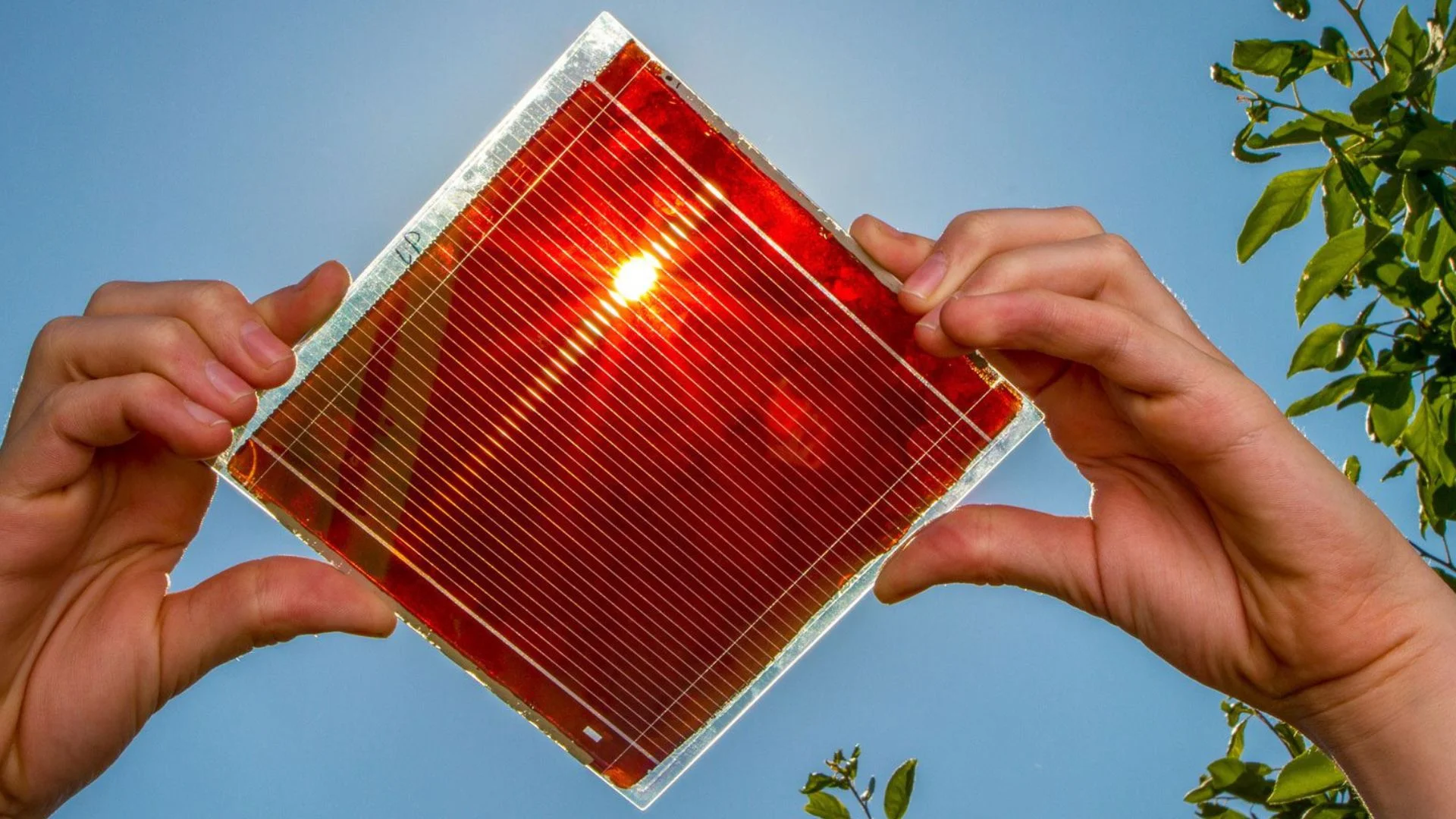
A simple contact between two perovskite layers makes solar cells more efficient and stable without adding chemicals or coatings.
The work was carried out by teams from Korea University and the University of Surrey. Their findings, published in Nature Energy, describe a method that relies on a natural interaction between two perovskite films.
This interaction improves the material’s internal structure and enhances its performance.
Perovskite solar cells have gained global attention in recent years. They are cheaper and easier to produce than traditional silicon solar panels. They also show strong efficiency in converting sunlight into electricity.
READ ALSO: USS Spruance Fires Deck Gun After 38 Years: What Triggered This Rare Strike?
However, their long-term stability has remained a major concern. Heat and humidity can quickly degrade these materials, limiting their real-world use.
The new method directly addresses this issue using a surprisingly simple approach. Instead of adding stabilizing layers or chemical treatments, the researchers placed two perovskite films in physical contact.
That contact alone triggered a molecular-level reaction. This reaction reorganized the crystal structure of the light-absorbing layer, not just at the surface, but throughout the entire depth of the material.
As a result, the material became more ordered and more durable. It also improved its efficiency at converting sunlight into electricity.
Solar cells made using this technique achieved a certified power conversion efficiency of 25.61%. This result was independently verified by the Solar Energy Research Institute of Singapore, adding strong credibility to the findings.
WATCH ALSO: Britain delivers laser-guided Air defense missiles to Ukraine six months ahead of schedule
The improvement was not limited to efficiency. The treated material also showed much better resistance to heat.
In accelerated aging tests, it required about twice as much thermal energy to degrade as similar materials reported in recent studies. This marks a meaningful step forward in a field where durability is a major challenge.
Dr. Jae Sung Yun, a co-author of the study and an expert in nanoscale imaging at the University of Surrey, explained why this work stands out.
“Perovskite solar cells can change how we generate electricity. They are cheaper than silicon panels and now offer very competitive efficiency,” he said.
He added that durability has always been the main obstacle. “What excites me is how simple this solution is. We place two films in contact, and that alone reorganizes the material at a molecular level. Our advanced imaging confirms this change happens throughout the material, not just at the surface. We do not add chemicals or extra steps.”
READ ALSO: Artemis Moon Landing Timeline Shaken as NASA’s Spacesuits Lag Behind Schedule
The process behind this improvement is known as contact-triggered cationic interaction(CCI). When the two films touch, forces at the interface cause charged particles, called cations, inside the material to rearrange into a more uniform pattern.
This alignment reduces structural defects. Fewer defects mean less energy is lost as heat. More energy is instead converted into electricity, improving overall performance.
Another key improvement was observed in the lifetime of charge carriers within the material. Charge carriers are particles that carry electricity. In treated samples, their lifetime increased from 4.48 microseconds to 5.89 microseconds. This is an important indicator of better solar cell quality.
To confirm these changes, the research team used a highly advanced imaging technique called photo-induced force microscopy (PiFM). This method allows scientists to study materials at an extremely small scale. It combines atomic force microscopy with infrared spectroscopy, enabling detailed chemical mapping beyond the limits of traditional light-based methods.
Using PiFM, the team directly observed the uniform chemical structure formed by the CCI process. This confirmed that the molecular changes were happening exactly as expected across the material.
Professor Ravi Silva, Director of the Advanced Technology Institute at the University of Surrey, emphasized the importance of the findings.
WATCH ALSO: High-pressure monster gun can make 40-ton military vehicle more lethal on battlefields
“This study shows that we can improve both efficiency and durability without adding any new chemicals or steps,” he said. “We only need to control how two films interact at the point of contact. That is a very elegant solution, and the performance results support it.”
He also highlighted the broader impact of the research. “Stability under real-world conditions is the key challenge for perovskite solar cells. This kind of progress is important as we work to scale these materials for large-area and flexible applications.”
The University of Surrey is currently working on scaling perovskite technologies through a £2.7 million program focused on flexible solar materials. In such applications, durability is not optional; it is essential.
This new contact-based method brings the field one step closer to making perovskite solar cells practical for widespread use. Solving a core weakness with a simple adjustment opens the door to more reliable and efficient solar energy systems in the future.