A newly identified crocodile cousin preserved for 210 million years is offering fresh insight into how early predators evolved and adapted.
The fossil, discovered in northern New Mexico, reveals a species built for crushing larger prey. Researchers say the find helps explain how early crocodile relatives diversified during the late Triassic period.
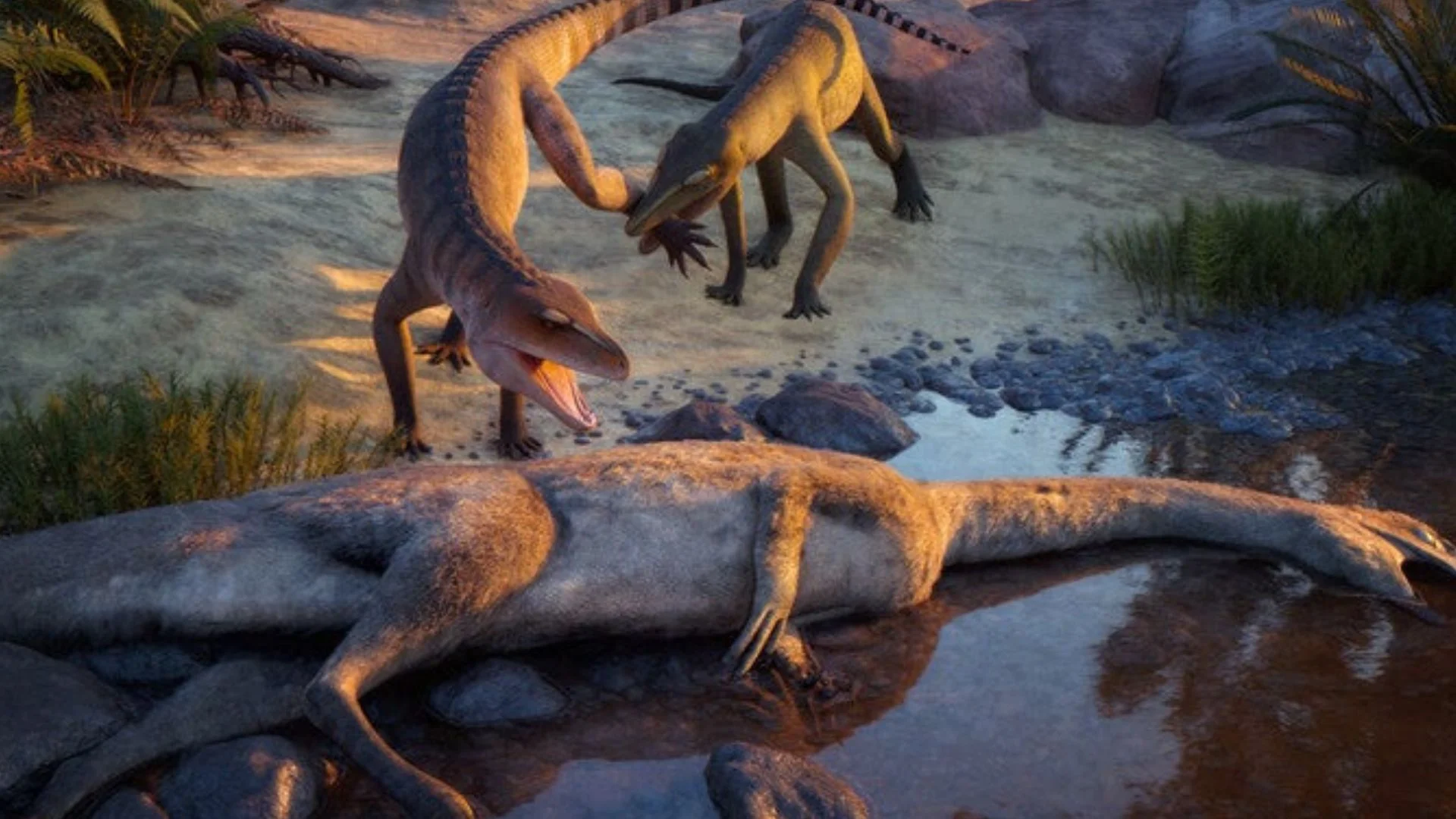
The fossil belongs to a newly named species called Eosphorosuchus lacrimosa. It was found alongside another crocodile cousin, Hesperosuchus agilis, in what appears to have been a sudden burial event. Both animals were preserved together in rock for millions of years.
Scientists believe the two animals died at the same moment due to a natural disaster, such as a flash flood or mudslide. Their remains were quickly buried, which helped protect the bones from decay. Over time, geological processes locked them inside stone, preserving them in remarkable detail.
READ ALSO: Tech Takes Turn: Stretchable Screens And Robots That Feel Are Moving From Labs Into Life
The fossils were originally excavated in 1948 from a site known as Ghost Ranch. This area is well known for its rich collection of prehistoric remains. It has yielded fossils of early reptiles, fish, and dinosaurs, including the carnivorous Coelophysis bauri.
For decades, the newly identified species was thought to belong to Hesperosuchus. Researchers revisited the fossil after noticing differences in its skull and facial structure. A detailed study confirmed that it represented a distinct species.
To better understand the fossil, scientists used computed tomography(CT scanning). This technology allows researchers to see inside solid objects without damaging them. By digitally separating the bones, they identified features that set the species apart.
WATCH ALSO: Humanoid Robots Are Learning to Work Like Humans in Warehouses
The new species had a shorter snout and a stronger skull compared to its cousin. Its jaw muscles were more developed, suggesting it could bite with greater force. These traits indicate it likely hunted larger or tougher prey.
In contrast, Hesperosuchus had a longer snout and was built for speed. It had strong hind legs and lighter forelimbs, making it well-suited for chasing smaller prey near rivers. The differences between the two species highlight how closely related animals are adapted to different ecological roles.
Researchers say this discovery provides a rare snapshot of life during the late Triassic period. At that time, two major reptile groups were emerging. One lineage would eventually lead to modern crocodiles, while the other would give rise to dinosaurs and birds.
Early dinosaurs during this period were relatively small and lightly built. They often walked on two legs and resembled long-legged birds in their posture. Meanwhile, crocodile relatives were four-legged predators that moved quickly across land.
The coexistence of these two crocodile relatives suggests early specialization among predators. Instead of competing directly for the same food, they likely hunted different types of prey. This type of ecological separation is common in modern ecosystems as well.
READ ALSO: US Marine Corps Moves to Equip Amphibious Combat Vehicles with Active Protection Systems
Scientists describe this as an example of functional diversification. It shows how species evolve distinct physical traits to fill unique roles in their environments. Such adaptations can reduce competition and support greater biodiversity.
The fossil also highlights the importance of museum collections in modern research. Even specimens collected decades ago can yield new discoveries when studied with advanced tools. This case shows how technology continues to unlock hidden details from old finds.
Researchers emphasize that well-preserved fossil sites like Ghost Ranch are rare. Many fossils are incomplete or mixed together, making identification difficult. In this case, preservation enabled scientists to study two animals at the same moment in time.
The discovery provides valuable evidence about how early crocodile relatives evolved into diverse forms. It also helps scientists understand the broader changes happening during the ‘Age of Reptiles.’ These changes eventually shaped the ecosystems that followed.
WATCH ALSO: US firm successfully demonstrates ship-based Sea Launcher for autonomous underwater vehicle ops
The study adds to the growing body of knowledge about how ancient predators adapted to survive. By examining their physical traits, scientists can infer how they hunted and interacted. This helps build a clearer picture of life on Earth millions of years ago.
Researchers believe more discoveries may still be hidden in existing collections. As imaging and analysis methods improve, older fossils may reveal new species and insights. This ongoing work continues to refine our understanding of evolutionary history.
The identification of Eosphorosuchus lacrimosa marks an important step in studying early crocodile evolution. It shows that even closely related species can develop very different survival strategies. Such findings help explain the complexity of ancient ecosystems.
Looking ahead, scientists expect further research to uncover more about early reptile diversity. Each new discovery adds detail to the story of how modern animals evolved. The fossil record remains a key tool for understanding the deep past and its lasting impact on life today.