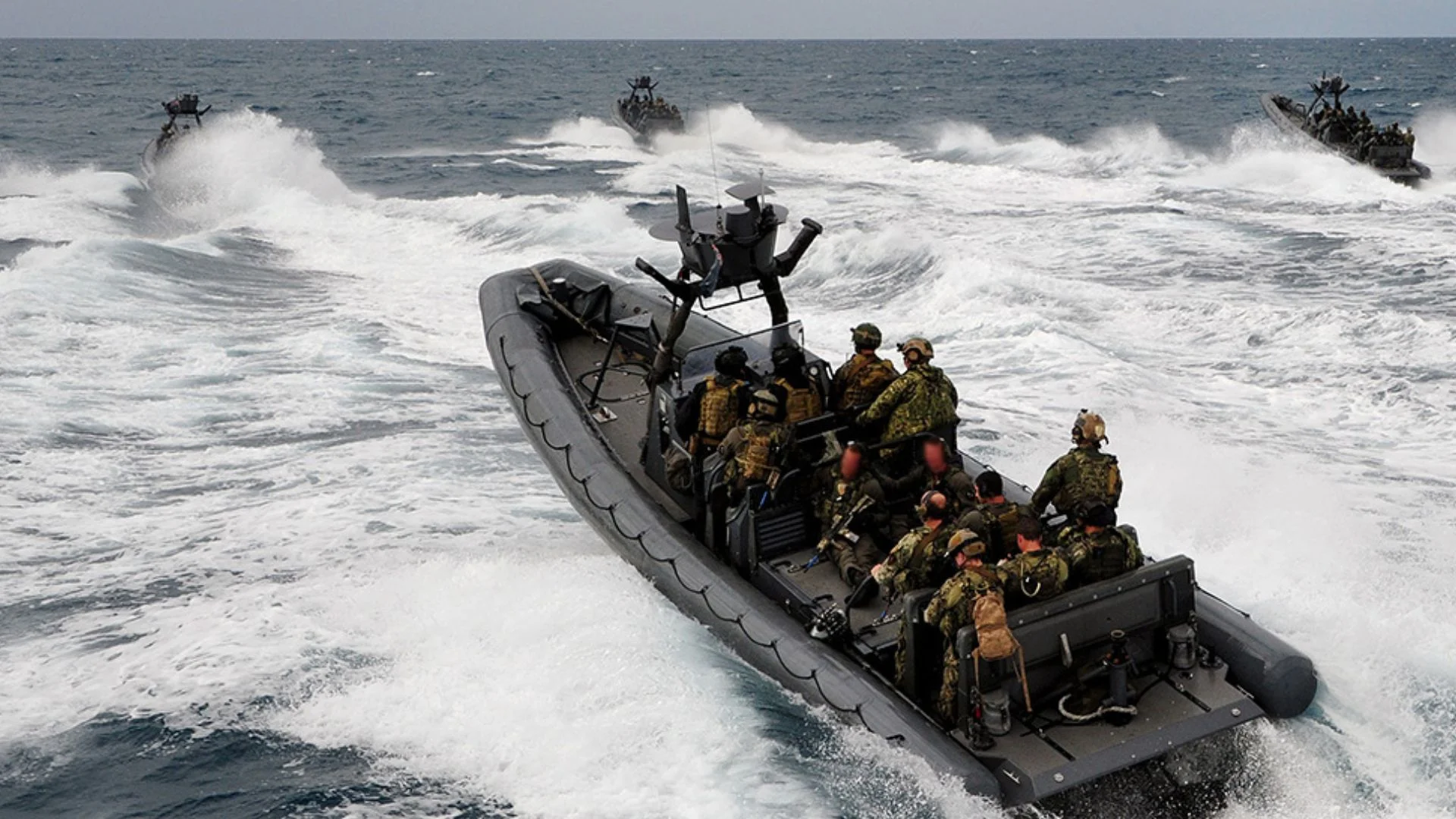
The US Navy has awarded a $325.9 million contract to eight American shipbuilders to procure up to 474 Rigid-hull Inflatable Boats(RHIBs).
The contract announcement, published by the Department of Defense on April 30, 2026, marks one of the largest single small-craft acquisitions in recent Navy history. It shows a deliberate shift toward coastal warfare tools that can operate where destroyers and aircraft carriers simply cannot.
The deal carries a ceiling value of $650.1 million if all options are exercised over the next ten years. Only a small portion of funding is committed at the time of award, with the bulk flowing through future delivery orders tied to developing fleet needs.
Initial deliveries are scheduled to begin as early as July 2026, signaling that the Navy wants these boats in the water quickly.
READ ALSO: MIT Quantum Sensor Reads Multiple Signals Together: Changing How We Measure Reality
Eight US manufacturers have been selected to build the boats. They are ASIS Boats USA, doing business as Ocean Craft Marine; Brig USA, doing business as Fluid Marine Response; Ghostworks Marine; Ribcraft USA; St. Johns Ship Building; Structural Composites; US Marine Inc.; and The Whiskey Project Group. Spreading production across multiple coastal and inland facilities reduces the risk of supply disruption, boosting the Navy’s ability to sustain steady output.
The contract was managed by the Naval Sea Systems Command and competed through the Procurement Integrated Enterprise Environment. Fifteen companies placed bids, and eight were selected to supply boats under an indefinite-delivery, indefinite-quantity structure. This system gives the Navy the flexibility to order more boats as demand rises without renegotiating the core terms.
What is a RHIB?
A rigid-hull inflatable boat is built around a solid, lightweight hull made from advanced composite materials, with inflatable tubes running along both sides. The combination gives the boat structural toughness that a pure inflatable lacks, while the air-filled collar adds extra buoyancy and cushions hard impacts during boarding. The hull typically features a deep-V profile, which cuts cleanly through waves and allows stable, high-speed runs in rough water.
These boats are fast. Depending on engine configuration and cargo, military RHIBs can exceed 40 knots, roughly 46 miles per hour on open water. Think of them as the pickup trucks of the sea: compact, capable of carrying heavy loads, and built to get where larger vehicles cannot go. Their shallow draft allows them to enter rivers, narrow coastal channels, and shallow bays that would strand a conventional warship.
READ ALSO: Cornell Student Develops Ultra-Precise Microchips to Boost Tech Reliability
Onboard systems are highly adaptable. Operators can fit these boats with navigation radars, encrypted communications, weapon mounts, and other mission-specific gear. This structural modularity means the same hull type can serve as a troop carrier, a patrol craft, or a boarding and search platform, depending on the equipment installed before a mission begins.
Who Uses RHIBs and Why They Matter
Navy expeditionary units, coastal riverine squadrons, and special warfare teams rely heavily on RHIBs. These groups are tasked with missions that require speed and stealth over brute force. Special operations forces use RHIBs to insert quietly into denied coastlines; riverine units use them to control waterways and choke points; and interdiction teams use them to intercept vessels suspected of smuggling weapons, narcotics, or personnel.
RHIBs are also central to visit, board, search, and seizure operations, often referred to as VBSS. In these undertakings, an RHIB pulls alongside a suspect vessel while armed sailors prepare to board, inspect cargo, and detain crew if necessary. The boat’s inflatable collar protects both the craft and the target vessel from damage during close-quarters contact. Speed and stability make the difference between a successful interdiction and a vessel that slips away.
Search-and-rescue crews also use RHIBs, as do harbor security teams assigned to protect naval installations and critical port infrastructure. The same qualities- speed, agility, and shallow-water reach- make these boats equally useful whether the mission calls for offensive action or protective patrol. Few platforms in the naval inventory offer this range of roles at this price point.
WATCH ALSO: Drum-shaped antenna reflector on NASA-ISRO NISAR satellite deployed
The Strategic Picture: Why Now?
The timing of this contract is not coincidental. US defense planners have increasingly focused on the Indo-Pacific region, where potential conflict would likely play out across thousands of islands, narrow straits, and coastal waters. In that kind of environment, the ability to move quickly in shallow water and maintain a continuous presence near shore is a decisive military advantage. Large surface ships are visible and vulnerable in these restricted spaces; RHIBs are not.
The Navy’s concept of distributed naval operations drives much of this thinking. The idea is to spread forces across a wide area in smaller, faster, and harder-to-track units rather than concentrating power in a few large platforms that present easy targets. A fleet of 474 fast boats, networked and dispersed, is far more difficult for an adversary to track, target, and destroy than a single destroyer sitting in a harbor. The math favors the swarm.
This approach also improves deterrence. An adversary calculating the cost of a coastal confrontation now has to account for hundreds of small, armed, fast-moving craft that can emerge from any direction. Concentration of force at critical points becomes possible in minutes rather than hours. The Navy does not need a permanent presence everywhere if it can surge rapidly to wherever pressure is needed.
Selecting eight manufacturers rather than one or two shows a deliberate industrial strategy. Single-source contracts create fragility: if one factory floods, burns, or faces a labor dispute, the entire program stalls. Multiple sources keep production lines running and create competition that can drive down costs over time. The Navy has distributed work across both coastal and inland facilities, further reducing geographic concentration risk.
READ ALSO: Safran and MBDA Eye 2029 Delivery for France’s Next-Gen Thundart Rocket Artillery
All eight selected companies are domestic US firms. Keeping production onshore ensures supply chain security, supports American manufacturing jobs, and simplifies the logistics of auditing, quality control, and contract compliance. For a program that could run for a decade and eventually deliver hundreds of boats, that stability matters.
The composite materials at the heart of these hulls stand for a significant upgrade over older aluminum or fiberglass designs. Composites are lighter, stronger for their weight, and more corrosion-resistant, an important quality for boats that spend their lives in saltwater. That weight savings translates directly into higher speed, greater range, and the ability to carry heavier payloads without sacrificing performance.
With deliveries beginning as soon as July 2026, the Navy is wasting no time getting these boats into service. The indefinite-quantity structure of the contract means procurement can accelerate if operational demand increases, whether due to a crisis in the Pacific, increased maritime interdiction requirements, or the need to replace aging small craft across the fleet. The program is designed to grow with the threat.
The US Navy is investing in agility. Not just the agility of individual boats, but the organizational agility to respond faster, operate closer to shore, and complicate an adversary’s targeting assessment with sheer numbers. In the modern maritime battlespace, small and fast is increasingly becoming an important asset, not a compromise.
As coastal conflicts and hybrid threats shape the next generation of naval warfare, the Navy’s bet on 474 composite RHIBs represents more than a procurement decision. It is a statement about how America intends to fight and win in the littoral zones that will define the next major test of maritime power.