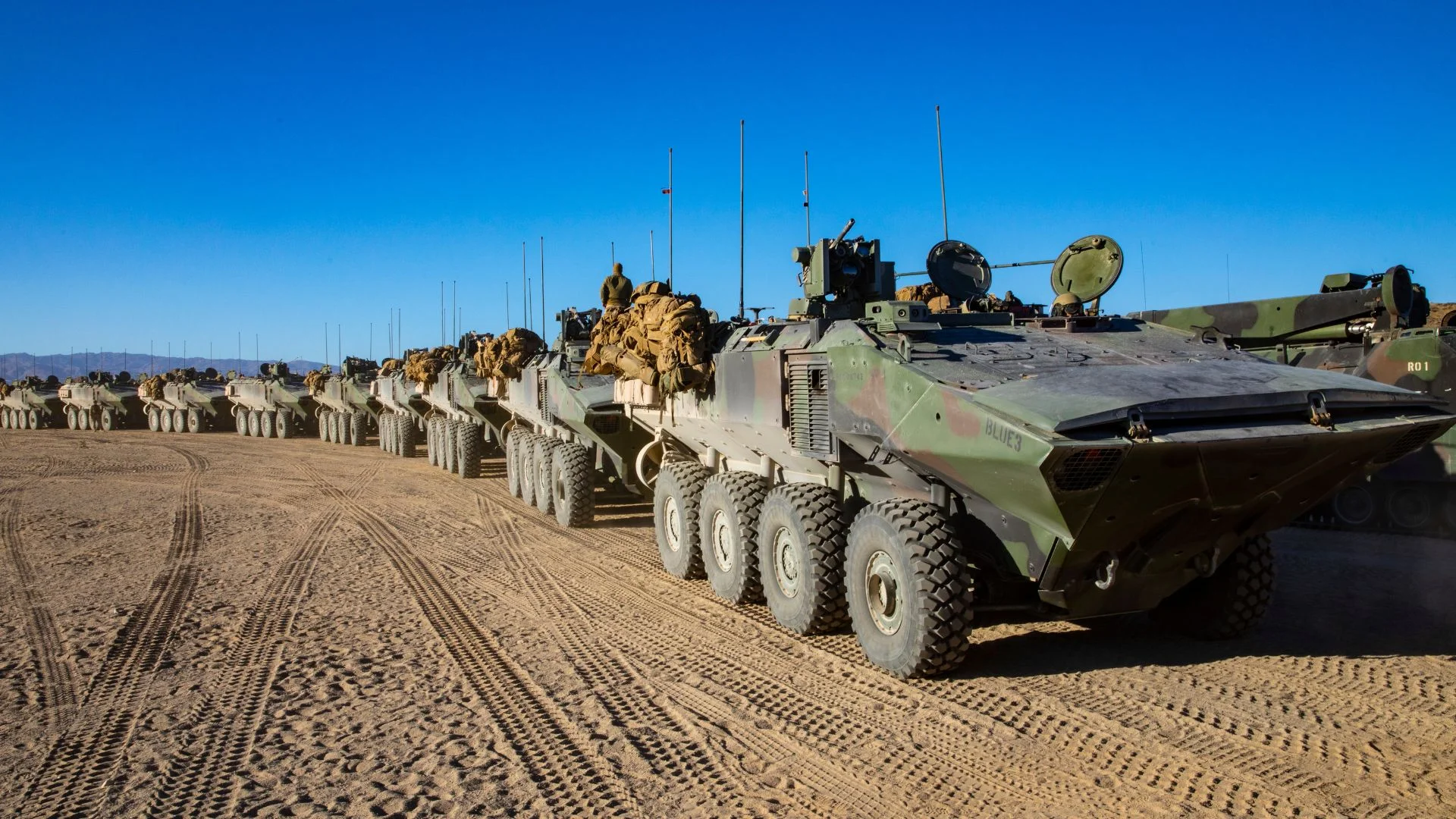
The Marine Corps is working to equip its 8×8 wheeled Amphibious Combat Vehicles (ACVs) with Active Protection Systems(APS).
These systems are designed to detect and destroy threats before they hit the vehicle. Officials say this move will significantly improve protection against anti-armor weapons.
APS technology is already used in many modern armored platforms worldwide. It uses sensors such as radar and cameras to track incoming threats. Once detected, the system launches a countermeasure to destroy or deflect the threat mid-air.
Traditionally, APS has been used to defeat anti-tank guided missiles and rocket-propelled grenades. However, the nature of warfare is changing rapidly. Today, drones have become a major threat to armored vehicles.
READ ALSO: Russia’s Soyuz 5 Lifts Off After Years of Delays: What It Means for Moscow in Space
Many APS solutions can now counter drones as well. Some systems already demonstrate success in shooting down unmanned aerial systems. Others are being upgraded specifically to handle this growing danger.
Chris Melkonian, Program Manager for Advanced Amphibious Assault, shared updates at a defense event. He explained that the Marine Corps is actively working with vendors to develop APS for ACVs. He said the goal is to move this capability into production soon.
Melkonian stressed that current ACVs will not remain the same in the future. He said the vehicles are evolving with new technologies and upgrades. He added that APS will play a key role in this transformation.
The Marine Corps currently operates multiple versions of the ACV. These include the personnel carrier ACV-P and the command-focused ACV-C. Additional variants, such as the ACV-30 and ACV-R, are also in development.
WATCH ALSO: This Microsoft AI Could Change Cancer Treatment Forever
The ACV-30 will feature a turret-mounted 30mm cannon. The ACV-R will serve as a recovery vehicle with specialized equipment. The Marines aim to bring both variants into service by 2028.
Overall, the Marine Corps plans to acquire 608 ACVs. This includes hundreds of personnel carriers and dozens of specialized variants. The fleet will support amphibious missions and land combat operations.
The ACV replaced the older Assault Amphibious Vehicle fleet. The Marines officially retired those Cold War-era vehicles recently. The new ACV family is seen as critical for future missions.
Budget documents reveal more details about the APS effort. The Marines have requested over $28 million in fiscal year 2027 for APS-related equipment. This funding will support production kits, installation, and spare parts.
Initial plans focus on equipping 21 ACV-P vehicles with APS. These upgrades will add a new defensive capability to existing units. However, officials have not yet revealed which APS system will be selected.
READ ALSO: REK: S.F.’s Robot Fight Hub, Humanoid Bots Battle, Perform & Are Available to Rent or Buy
The US military has already tested APS on other platforms. The US Army has installed the Trophy system on some M1 Abrams tanks. This system has proven effective in real combat conditions.
Another system, Iron Fist, is also being integrated into US Army vehicles. It will be used on Bradley Fighting Vehicles and future platforms. These examples show growing confidence in APS technology.
Despite its strengths, APS has limitations. Most systems can only engage a limited number of threats at a time. This makes large drone swarms a serious challenge.
Melkonian acknowledged that APS is not a complete solution. He said the Marines are already exploring next-generation systems. The focus is on lighter and more advanced technologies.
The Marine Corps is also studying other counter-drone measures. These include directed energy weapons and improved sensors. Such tools could enhance overall defense against aerial threats.
Top-down attacks are another concern for armored vehicles. Drones and missiles often target the roof’s weaker armor. This has led to interest in additional overhead protection systems.
WATCH ALSO: From Ice to Innovation: US Coast Guard Deploys Drones in Antarctic Mission
Some armies are using add-on armor structures to counter these threats. These include cage-like designs placed over vehicles. However, such solutions can interfere with other systems, such as APS.
Melkonian emphasized the importance of situational awareness. He said better sensors and onboard video systems can help detect threats early. This data can then feed into counter-UAS systems.
The Marines are also working on reducing vehicle signatures. Lower visibility makes it harder for enemies to detect and target ACVs. This includes efforts to reduce heat, sound, and visual cues.
Improving water mobility is another priority. Amphibious vehicles must operate effectively on land and at sea. Enhancements will ensure better performance during beach landings.
Environmental challenges also influence vehicle design. Marines often operate in harsh, humid conditions. Systems must be durable and resistant to moisture and corrosion.
Melkonian highlighted the need for marinized solutions. He said every new system must work reliably in marine environments. This requirement applies to APS as well.
He explained that many technologies are not designed for such conditions. The Marines carefully evaluate each solution before adoption. Only systems that meet strict standards will be selected.
The Marine Corps continues to study available APS options. Officials say they are conducting market research to find the best fit. Future contracts will be announced when decisions are finalized.
The addition of APS marks a major upgrade for the ACV fleet. It reflects lessons learned from modern conflicts worldwide. The growing drone threat has made such systems more important than ever.
In the end, the Marines aim to build a more survivable and capable force. APS will form one layer of a broader defense strategy. Together with other upgrades, it will help ACVs face future battlefield challenges.