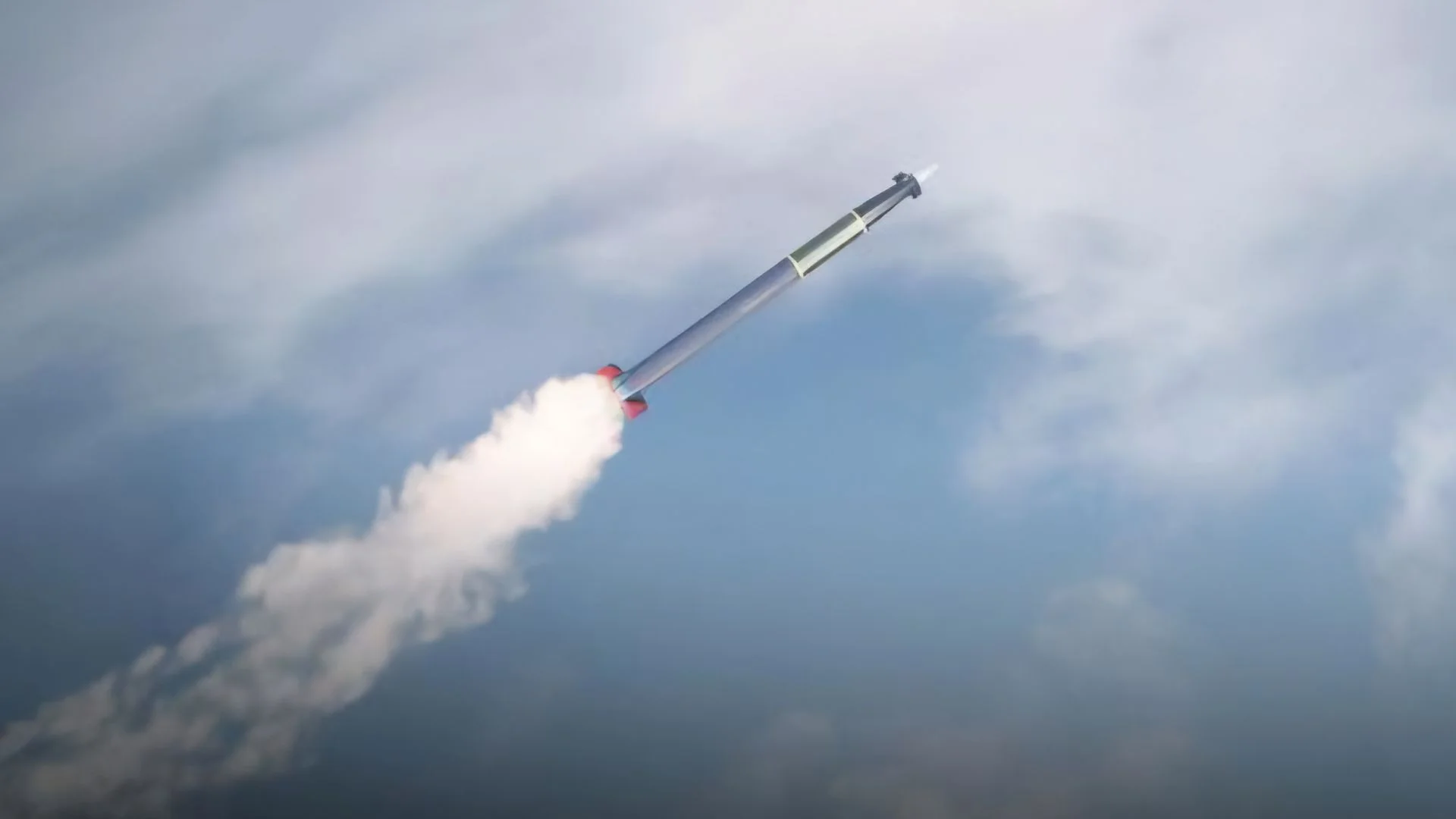
France has sharpened its long-range strike ambitions as Safran and MBDA successfully test a next-generation rocket-artillery munition.
They are now positioning themselves to deliver an operational system by 2029, pending military approval.
The development is part of France’s Long-Range Land Strike program, a key effort to strengthen its ground forces for future high-intensity conflicts.
The two companies carried out the first test firing of their new ‘Thundart’ munition on April 14. The launch took place at the Île du Levant test range in the Mediterranean.
READ ALSO: Boeing X-37B Mission at 230 Days Is Rewriting Space Tech Testing in Orbit
The Thundart rocket is designed for ground-to-ground strikes. It currently has a range of up to 150 kilometers. Engineers are already exploring options to extend that range further. This successful test shows that the system is moving from concept to real capability.
France is preparing to replace its aging rocket artillery systems. The current fleet includes nine Lance-Roquettes Unitaire (LRU) systems.
The government plans to introduce at least 13 new systems by 2030. By 2035, that number could grow to 26 launchers, along with around 300 munitions. The goal is to build a full rocket artillery battalion by the end of the decade.
French Armed Forces Minister Catherine Vautrin has made the importance of this program clear.
She said recent wars have shown how critical long-range strike capabilities are on the battlefield.
Vautrin told lawmakers that the ability to strike effectively at long distances is now essential. She called replacing the LRU system a top priority and described it as indispensable for the French Army.
Safran and MBDA say they can meet France’s operational deployment timeline by 2030. They have also stated that, if officially selected by the Direction Générale de l’Armement (DGA), they are ready to begin deliveries as early as 2029.
WATCH ALSO: Engineers from Australia have introduced a spray that enhances the fire-resistance of clothing
To support long-term development, both companies are considering forming a joint venture focused on the Thundart system and future upgrades. Around 100 employees are already working on the project across both firms.
One of Thundart’s strongest points is its independence. The system is fully designed and produced in France. It is also not subject to the US International Traffic in Arms Regulations (ITAR), which often restrict the export or use of systems.
Safran and MBDA say Thundart is currently the only European-made system that has demonstrated a strike range beyond the existing LRU.
Vautrin has expressed strong support for a sovereign solution. She said France should do everything possible to develop its own system, but added that performance, cost, and delivery speed will decide the final choice.
France is not limiting itself to domestic options. The government is also reviewing off-the-shelf systems from international suppliers. These include the Chunmoo system from South Korea’s Hanwha Aerospace, the PULS system from Elbit Systems, and the HIMARS system from Lockheed Martin.
READ ALSO: Human-like Robots in McDonald’s Uniforms in China, But Only for a Reason
France has also shown interest in India’s Pinaka rocket system. The DGA has been tasked with comparing all options carefully to understand their strengths and weaknesses.
The Thundart system will use a launcher mounted on an eight-wheel Scania France truck. Each launcher can carry up to eight rockets. It will also feature ‘shoot and scoot’ capability. This allows the system to fire quickly and move away before enemy forces target it.
The rocket itself uses propulsion developed by Roxel, MBDA’s rocket-engine unit. It carries a 100-kilogram payload and travels at high supersonic speed.
Thundart uses an adapted version of Safran’s AASM guidance kit. This system combines multiple technologies, including inertial navigation, laser targeting, and infrared guidance.
Safran recently tested a new AASM seeker that improves accuracy and flexibility. Deliveries of this upgraded seeker are expected to begin in 2027. The companies also say the system is designed to resist electronic warfare, a key requirement in modern combat.
WATCH ALSO: Called Ascentia, the platform is developed by American company Collins Aerospace
Safran and MBDA say they are prepared to scale up production quickly. MBDA plans to increase its missile production by 40% in 2026 compared to the previous year.
Safran has already boosted production of its AASM guidance kits fourfold between 2022 and 2025. This readiness could help France meet its tight deadlines if Thundart is selected.
France now must choose between a sovereign system like Thundart or proven systems already in service around the world. The final decision will shape the future of French artillery and its role in modern warfare. However, the successful Thundart test has clearly strengthened the case for a homegrown solution.