In a major step forward for sensing technology, researchers at the Massachusetts Institute of Technology (MIT) have developed a new type of quantum sensor that can measure multiple physical properties simultaneously.
This advance moves quantum sensing closer to real-world applications in fields such as medicine, materials science, and physics.
Quantum sensors are not new. Scientists have already been using them to detect extremely small signals that traditional tools cannot.
These sensors rely on the strange behavior of quantum physics, including entanglement and superposition, to achieve very high sensitivity. They can track tiny changes in magnetic fields, temperature, gravity, and even cellular activity.
READ ALSO: This Raytheon Camera Sees Heat Changes First, Targets Can’t Stay Hidden
But there has been a major limitation until now. Most solid-state quantum sensors can only measure one physical quantity at a time.
For example, a sensor might measure temperature or a magnetic field, but not both simultaneously. When scientists try to measure multiple signals simultaneously, the data often overlap, making separation difficult. This leads to unreliable results.
The team at MIT has found a way around this problem. They developed a method that enables a single quantum sensor to measure multiple properties simultaneously without mixing signals.
The key to this approach lies in a quantum effect called entanglement. In simple terms, entanglement links particles together so that they behave as a single system, even when they are separate.
Building on this idea, the researchers designed a system that can capture more information in a single go. In their experiment, the team demonstrated this approach using a widely studied quantum sensor, the nitrogen-vacancy (NV) center in diamond.
WATCH ALSO: Cartoon-like humanoid robot learns everyday kitchen chores from humans
This type of sensor operates at room temperature, making it practical for real-world applications. Many other quantum systems require extremely cold conditions, which limit their use.
An NV center forms when a carbon atom in a diamond is replaced by a nitrogen atom, and a nearby space in the crystal structure remains empty. This tiny defect creates a special electronic spin that responds to external conditions, such as magnetic fields and temperature. Scientists can read this spin using light, making it a powerful sensing tool.
However, the problem has always been that different physical effects change the spin in similar ways. This makes it hard to separate signals when measuring multiple properties.
The MIT team solved this by using two quantum bits, or qubits, instead of one.
Lead researcher Takuya Isogawa explained the idea clearly. He said that with a single qubit, you only get a simple result, like a coin toss showing heads or tails. But when you use two qubits, the number of possible outcomes increases. This allows scientists to extract more detailed information from the system.
READ ALSO: Rice University Study Solves Decades-Old Mystery in Light Crystals
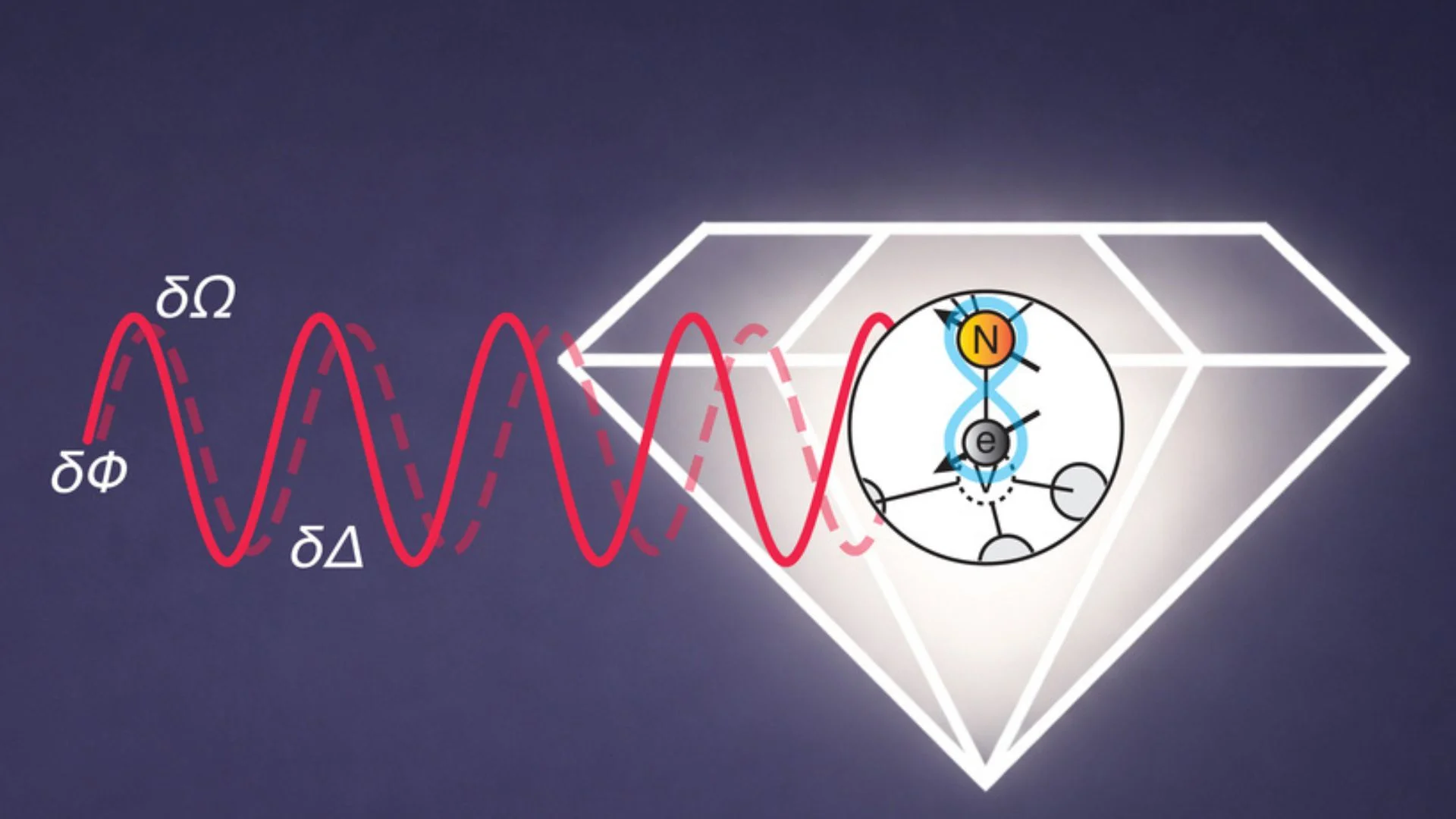
In their setup, the researchers used two different spins as qubits. One came from the NV center’s electron, and the other from a nearby nitrogen atom. They linked these spins via entanglement, enabling them to act as a single system.
This setup enabled the team to measure three microwave field properties simultaneously: amplitude, frequency, and phase. Normally, these measurements would require separate experiments. Now, they can be captured in a single step.
To achieve this, the researchers used a technique known as Bell state measurement. This method exploits entangled states to extract multiple parameters from a quantum system.
While Bell-state measurements have been used before, they typically require extremely low temperatures. The MIT team developed a new method to perform this measurement at room temperature, a significant improvement for practical use.
The researchers worked with a small diamond measuring just 5 square millimeters. They shone a laser into the diamond and observed its fluorescence to read the quantum states. They also used a microwave antenna to control the electron spin and a radio frequency field to control the nuclear spin.
WATCH ALSO: Chinese humanoid robot learns to stitch detailed embroidery patterns autonomously
By combining these elements, they created a system where both qubits could interact and provide richer data.
The results showed that their approach outperformed traditional methods. Measuring multiple parameters at once not only saved time but also improved accuracy. Sequential measurements often introduce errors because conditions can change between steps. By capturing everything at once, the new method reduces these risks.
Isogawa highlighted the importance of this improvement. He explained that repeating experiments to measure different quantities takes time and reduces sensitivity. It also makes experiments more vulnerable to noise and errors. Their new approach avoids these issues.
Quantum sensors are already being used in biology to study processes inside cells. For example, they can track enzymes, metabolites, and other tiny components that are difficult to observe with conventional tools. By measuring multiple parameters simultaneously, scientists can gain a more complete picture of these systems.
This could be especially useful in cancer research, where understanding complex cellular behavior is important.
The technology also has applications in materials science. Researchers can use it to study how atoms and electrons behave inside different materials. This knowledge is important for developing new electronics, energy systems, and advanced materials.
READ ALSO: World’s Oldest Octopus Fossil Was Never an Octopus, Teeth Reveal True Identity
In physics, sensors can help explore phenomena such as spin waves in condensed-matter systems. These are subtle effects that require high precision to detect.
Isogawa pointed out that NV center sensors are particularly valuable because they offer both high resolution and versatility. They can measure many different physical quantities while maintaining very fine spatial detail.
Another advantage is their ability to work in non-uniform environments.
In many real-world situations, physical conditions vary from place to place. Traditional sensors struggle in these cases because they cannot capture multiple variables simultaneously within a small area. The new approach solves this problem by combining high spatial resolution with multiparameter sensing.
This makes it useful for studying complex systems in which different factors vary across space. The researchers also emphasized that their work bridges a gap between theory and practice.
Multiparameter quantum sensing has been studied for years, but most demonstrations were limited to simple systems or focused on photons. This new work shows that the concept can be applied to solid-state sensors that are already widely used.
The research team included several contributors from different institutions. Along with Isogawa, the study involved Guoqing Wang and Boning Li, as well as collaborators from the University of Tokyo and the Chinese University of Hong Kong. The project was led by Professor Paola Cappellaro, a leading expert in quantum engineering.
WATCH ALSO: US conducts powerful and deadly strike against ISIS terrorists in Northwest Nigeria
Their work was supported by organizations including the US National Science Foundation, the National Research Foundation of Korea, and the Research Grants Council of Hong Kong.
Looking ahead, the team plans to further improve the precision of their measurements. While their current system successfully measures multiple parameters simultaneously, they aim to improve the accuracy of each measurement.
They also want to explore how the technique performs in more complex and heterogeneous materials. This research marks an important step toward making quantum sensors more practical and widely usable.
By solving one of the field’s key challenges, the MIT team has opened the door to new possibilities in science and technology. Their work shows that quantum sensors are not just powerful but also adaptable, capable of handling the complexity of real-world systems.