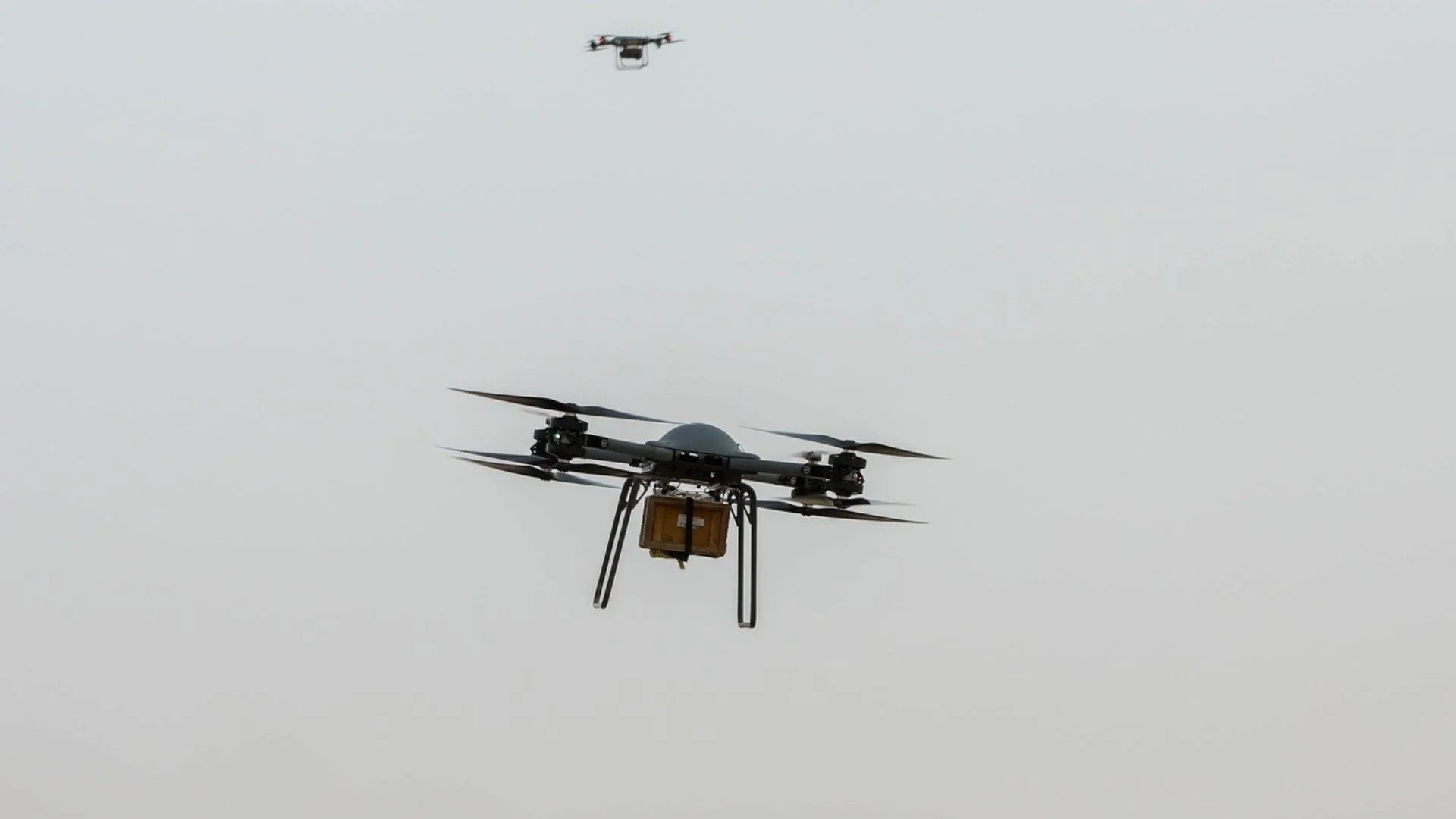
The US Army has tested a new combat role for one of its battlefield resupply drones by turning it into a rocket launcher.
During recent trials in Alabama, engineers mounted a three-shot rocket system onto the Tactical Resupply Vehicle 150(TRV 150) drone. The experiment shows how the Army is trying to give smaller combat units more firepower using low-cost autonomous systems.
The testing took place at Fort Rucker, Alabama, as part of a joint effort between the Army and defense industry partners. The Tactical Resupply Vehicle 150(TRV 150) was fitted with a launcher designed to fire 70mm rockets. The drone was originally built to carry supplies and equipment across difficult battlefield terrain.
The rocket launcher used in the test was based on the Advanced Precision Kill Weapon System(APKWS). This system already operates on AH-64 Apache attack helicopters and converts standard rockets into guided precision weapons. By placing it on a drone, the Army hopes to expand the use of precision strike systems to smaller military formations.
READ ALSO: North Korea Tests AI-Guided Cruise Missile With Terrain-Matching, Autonomous Navigation
Survice Engineering, the company behind the drone, funded the project internally instead of waiting for a formal Army requirement. Company officials said they wanted to demonstrate the technology early to speed up innovation. The first successful firing with a single-shot launcher happened in May 2025 before the latest three-shot test.
TRV 150 as Battlefield ‘Pickup Truck’
The TRV 150 is mainly used as a logistics drone for the US Army and Marine Corps. It can carry up to 150 pounds of cargo, including ammunition, food, medical gear, and other battlefield supplies. Military operators can send it to specific coordinates while the drone calculates its own route and flight path.
Engineers describe the system as highly autonomous and easy for soldiers to use in combat zones. The software handles much of the navigation work and reduces the need for complex pilot training. This allows troops to focus on missions instead of manually controlling the aircraft throughout the flight.
Adding rockets changes the drone from a supply carrier into a lightweight attack platform. Unlike large combat drones, the TRV 150 is smaller and designed for frontline support missions. The Army sees value in using a single aircraft for both resupply and limited-strike operations during fast-moving combat.
WATCH ALSO: Researchers from German have developed a diving robot that can easily collect underwater waste
Pentagon Pushes Faster Drone Development
The new testing effort comes as the Pentagon increases investments in drone technology and autonomous warfare systems. Military planners believe future conflicts will depend heavily on unmanned aircraft for surveillance, logistics, and precision attacks. Lessons from recent wars have shown how low-cost drones can influence battlefield operations.
In 2025, the Pentagon created Joint Interagency Task Force 401 to streamline and accelerate drone acquisition across the military branches. The Department of Defense is also building a dedicated drone testing site in Mississippi to support rapid development programs. Officials want faster testing cycles to keep pace with evolving drone technology worldwide.
The Pentagon has also launched a counter-drone marketplace that connects the US and allied countries with compatible defense systems. This effort aims to improve cooperation and speed up access to anti-drone technologies. Military leaders see both offensive and defensive drone systems as key for modern warfare planning.
The Army’s latest drone experiment highlights how unmanned systems are taking on more combat roles beyond surveillance and supply delivery.
If future tests succeed, smaller units could gain access to affordable precision strike tools without relying entirely on helicopters or larger aircraft. The project also signals a wider shift toward flexible and multi-role autonomous systems across the US military.