A team of scientists at the University of Osaka has developed a new method to convert carbon dioxide into a useful industrial gas using vibrations rather than heat.
Their work introduces a fresh approach to carbon recycling that works under simple conditions, without the need for high temperatures or pressure.
The research, published in Journal of Materials Chemistry A, focuses on converting carbon dioxide (CO₂) into carbon monoxide (CO).
CO is widely used in industries such as fuel production and chemical manufacturing. However, producing CO from CO₂ usually requires substantial energy, making it costly and less sustainable.
READ ALSO: KAIST Robot That Sees Terrain And Chooses Its Own Path Conquers Obstacles With Ease
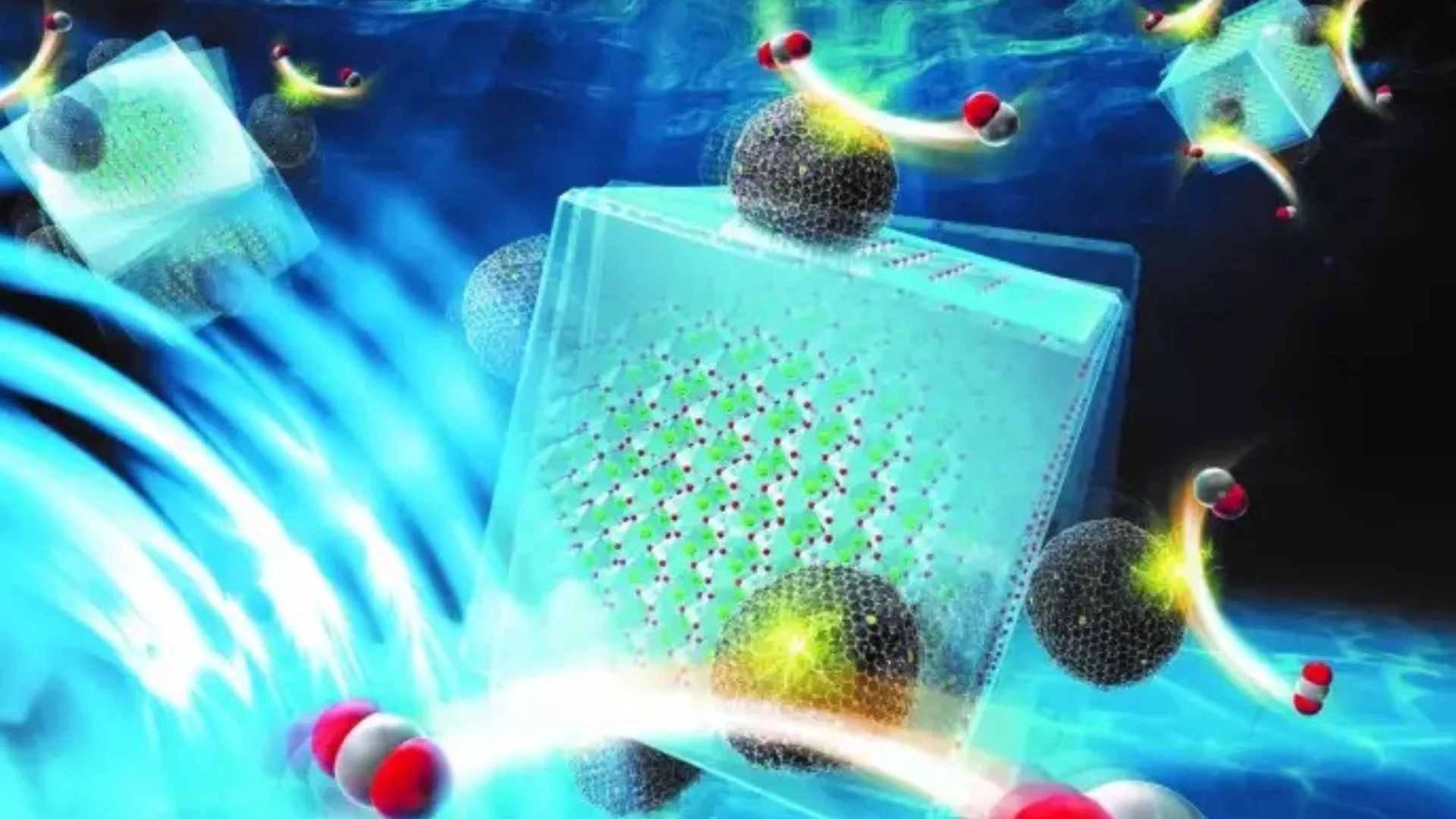
In this study, the researchers used a different energy source, mechanical vibration. They designed a special catalyst that reacts when exposed to ultrasonic waves. These vibrations generate tiny electric charges inside the material, which then drive the chemical reaction.
At the center of this discovery is a material called barium titanate (BaTiO₃). It belongs to a group of substances known as piezoelectric materials. These materials can generate electric charges when squeezed, shaken, or vibrated. The team used this property to trigger the conversion of CO₂ into CO.
To improve performance, the scientists modified the material. They added a thin layer of nitrogen-doped carbon and placed single nickel atoms across its surface. These nickel atoms act as highly active reaction sites, while the carbon layer facilitates the efficient flow of electrical charges.
WATCH ALSO: Lightweight advanced materials are transforming aerospace innovations
The results were clear and impressive. During five hours of ultrasonic vibration, the new catalyst produced 377 millimoles of CO per gram. In comparison, pure barium titanate produced only 123 millimoles per gram. This means the modified catalyst performed over three times better.
Even more notable was the reaction’s selectivity. The system produced only carbon monoxide. It did not generate hydrogen, methane, or formic acid, common byproducts in similar reactions. This near-perfect selectivity makes the process cleaner and more efficient.
Further analysis showed why the catalyst worked so well. The nickel atoms were spread out individually in a stable structure known as Ni–N₄. This arrangement kept them active and prevented them from clumping together, which often reduces performance. The catalyst also remained stable after repeated use, showing strong durability.
The research highlights the potential of underused energy sources, such as vibration. Mechanical energy is often wasted in industrial processes, transport systems, and natural environments. This study shows it can be captured and turned into something valuable.
Senior author Dr. Yoshifumi Kondo emphasized the importance of this direction. He said researchers need practical ways to reuse carbon dioxide if they want to reach carbon neutrality. He added that his team has now identified key design ideas for making effective catalysts for this type of reaction.
READ ALSO: $1.5T Pentagon Budget Surge: Golden Dome, AI and Drones Lead 42% Jump
Looking ahead, the researchers plan to explore how other forms of low-grade energy, such as waste heat, can also be used in similar systems. Their goal is to create simple, low-energy technologies that can recycle CO₂ on a larger scale.
This work opens a new path toward turning emissions into resources, using nothing more than motion and smart material design.