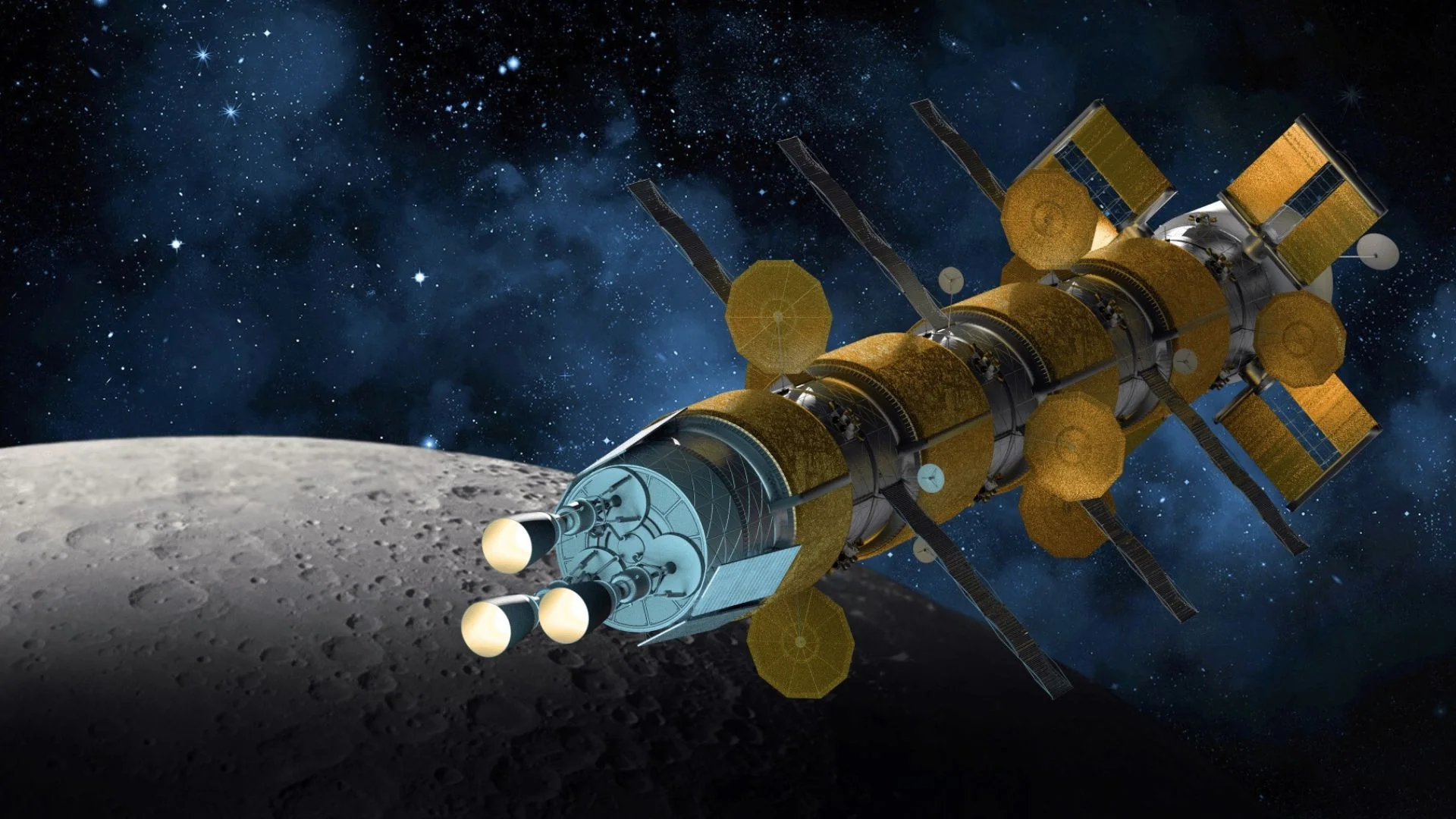
The White House has unveiled a new, ambitious plan to deploy nuclear power in space. The strategy aims to build reactors capable of operating beyond Earth and supporting long-term missions to the Moon, Mars, and beyond.
The initiative, announced by Michael Kratsios, director of the White House Office of Science and Technology Policy, lays out a coordinated effort between civilian and military agencies. It reflects a broader push by the Trump administration to strengthen America’s position in space.
The Pentagon is expected to demonstrate an orbital nuclear reactor as early as 2031. This would mark a major step toward sustained nuclear power operations in space.
Kratsios spoke at the Space Symposium, where he described nuclear power as essential for future missions. He said nuclear systems will provide electricity, heating, and propulsion needed for a permanent presence beyond Earth. He emphasized that such capabilities are critical for both robotic missions and eventual human exploration.
READ ALSO: Ukraine Unveils 3600 km/h Koral Missile; The Missile Changing Its Air Shield
The new strategy is called the National Initiative for American Space Nuclear Power. It follows an executive order signed in December, which directed agencies to accelerate efforts in this area.
A key feature of the plan is collaboration. NASA and the Pentagon will run parallel design competitions. These competitions will focus on developing space-based nuclear reactors. Officials say the efforts will be mutually reinforcing, meaning both agencies will benefit from shared progress and knowledge.
The goal is to develop low- to mid-power reactors first. These systems would be tested in orbit and on the lunar surface. Over time, the program aims to scale up to high-power reactors capable of producing at least 100 kilowatts of electricity.
NASA has been assigned specific responsibilities under the plan. The agency will work on a mid-power reactor, including a lunar version. This system is expected to be ready for launch by 2030. It will support surface operations on the Moon, including potential habitats and research stations.
Meanwhile, the Pentagon will focus on its own mission. It plans to deploy a mid-power reactor in orbit by 2031, depending on funding availability. This reactor would support military and strategic operations in space.
In the first year of the initiative, the Defense Department will contribute its existing funding to support NASA’s efforts. This approach is designed to build a strong foundation before moving into independent projects.
WATCH ALSO: Boston Dynamics Atlas humanoid robot demonstrates remarkable mobility, balance
Starting in the second year, the Pentagon will take a more active role. It will support at least two competing vendors through the early design and testing stages. These vendors will develop concepts for the future orbital reactor.
The plan also allows flexibility. If vendors working directly with the Pentagon fail to meet technical or program goals, officials can select alternative partners. These could include companies already working with NASA on related nuclear technologies.
The White House memo highlights several tools to effectively manage the program. These include fixed-price contracts and milestone-based proposals. The government will also secure rights to use the technologies developed under the program.
Within 90 days, the Office of Science and Technology Policy will release a detailed roadmap. This document identifies challenges and outlines ways to overcome them. It will also guide the initiative’s long-term direction.
The push for space nuclear power comes amid growing global competition. The US is racing to maintain its leadership in space. Rivals like China and Russia are also advancing their own lunar and space programs.
Recent missions have highlighted this competition. The Artemis II mission, for example, successfully sent astronauts around the Moon. It demonstrated the US’s capability to conduct deep-space missions and set the stage for future lunar landings.
READ ALSO: 150M Trees, Hidden Fuel: Date Palm Waste Holds Massive Energy Potential
Officials believe nuclear power will be a key advantage in this race. Unlike solar power, nuclear systems can operate continuously, regardless of sunlight conditions. This makes them ideal for long-duration missions and operations in harsh environments, such as the lunar surface.
The strategy also builds on earlier work. NASA has already been exploring nuclear thermal propulsion. While the new plan focuses more on shared technologies, nuclear propulsion remains an option for future missions, especially crewed trips to Mars.
Some past efforts have faced setbacks. The Defense Advanced Research Projects Agency (DARPA) ended a nuclear propulsion demonstrator program last year. However, knowledge gained from that project could still support the new initiative.
The White House is also encouraging private sector involvement. Companies will be invited to contribute ideas and technologies. The upcoming National Space Transportation Policy is expected to promote investment in launch infrastructure and related systems.
Kratsios stressed the importance of a unified approach. He said government agencies and private companies must work together to achieve these goals. He added that innovation and speed will be important in turning the vision into reality.
WATCH ALSO: China Sets World Record with 700 km/h Maglev
The plan signals a clear shift in US space policy. It moves beyond exploration and focuses on building long-term capabilities. Nuclear power, once seen as a distant goal, is now central to that vision.
The initiative could change how missions are conducted in space. It could enable permanent bases on the Moon and support deeper exploration missions. For now, the focus is on turning plans into working systems within the next decade.