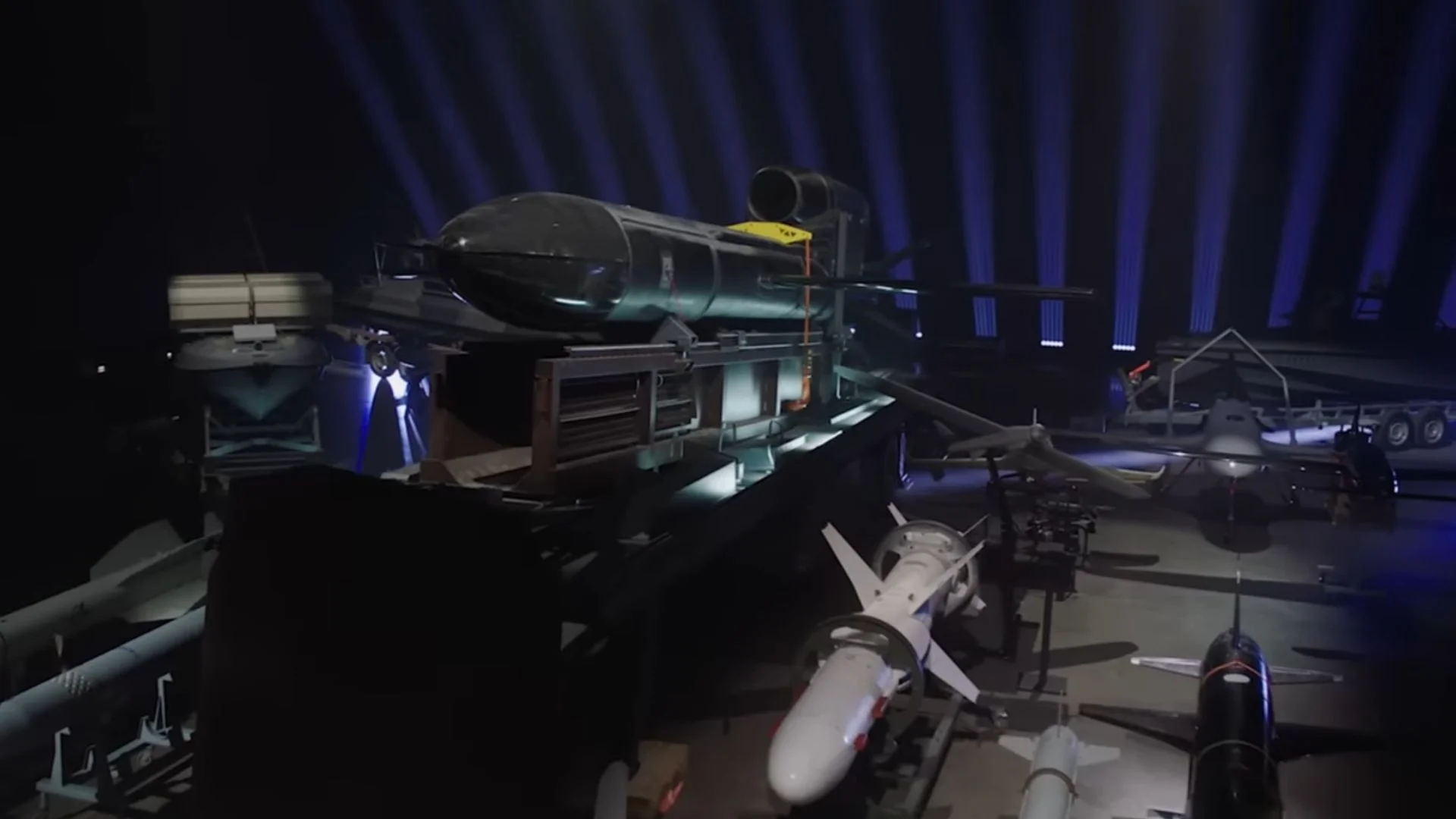
Ukraine has seemingly unveiled its long-secret Koral surface-to-air missile, marking its first public appearance.
The sighting came during a recent exhibition of domestically developed weapons, signaling progress in Kyiv’s push to strengthen its own military capabilities.
The missile was not officially named during the display. However, its design and features closely match earlier concepts of the Koral, sometimes spelled Coral. This has led analysts and observers to strongly believe that this is indeed Ukraine’s next-generation air defense interceptor.
The unveiling took place during a defense industry event attended by Ukrainian President Volodymyr Zelensky. The exhibition showcased a wide range of indigenous weapons, including missiles, drones, and hybrid systems. It highlighted Ukraine’s growing focus on developing its own military technologies rather than relying entirely on foreign support.
READ ALSO: Artemis Mission’s Laser Communication Is Changing How NASA Sees the Moon
Among the systems displayed were the Neptune ground-launched cruise missile, the Areion missile-drone derived from the Palianytsia platform, and the Vilkha guided artillery rocket. These systems represent Ukraine’s expanding domestic defense ecosystem, which has become increasingly important during the ongoing war.
The missile believed to be Koral stood out. Its structure suggested it might not be just a concept or mockup. Instead, it appeared closer to a test article or even a production-ready weapon. Still, officials have not confirmed its exact status. There is also a possibility that certain design features were intentionally altered to mislead foreign intelligence.
Ukraine’s interest in developing such a missile is not new. As early as 2021, the Luch Design Bureau introduced the Koral concept. At that time, it was planned as a medium-range air defense missile with a range of 30 to 50 kilometers.
However, by 2023, the expected range had increased significantly to around 100 kilometers. This upgrade would push it into the lower tier of long-range air defense systems.
WATCH ALSO: Hyundai’s Atlas humanoid robot wins top honor for its advanced design and capabilities
The missile is said to weigh around 300 kilograms and carry a 25-kilogram warhead. It is expected to travel at speeds of up to 3,600 kilometers per hour. These specifications suggest a fast, capable interceptor designed to counter modern aerial threats.
Importantly, Ukrainian engineers have aimed to give the missile some level of anti-ballistic capability. Oleh Korostelev, head of the Luch Design Bureau, had earlier stated, “Koral should work against ballistic targets. Of course, not all classes, but it must work on ballistic targets.” This means the missile could potentially intercept certain types of incoming ballistic missiles, adding a critical layer to Ukraine’s defense.
The guidance system is another key feature. The missile is expected to use an active radar-homing seeker developed by Radionix, a Ukrainian company. This technology allows the missile to track and engage targets independently during the final phase of flight, increasing its accuracy and effectiveness.
Korostelev had previously said that the missile’s development was about 70 percent complete. Since then, progress appears to have continued steadily, although details remain limited due to strict secrecy.
Ukraine’s Ministry of Defense has made air defense a top priority. In late 2023, officials emphasized the need for mobile surface-to-air systems with ranges exceeding 100 kilometers. The Koral missile is believed to be a key part of this plan.
READ ALSO: China Rocket Engine Seabed Test at 200m Shows Underwater Missile Launch Possible
There are also signs of international cooperation. Reports indicate that Ukraine has entered into an agreement with Spain to work on air defense technologies. This partnership involves Luch, Radionix, and Spain’s Sener Group, which is known for producing components used in IRIS-T missile systems. Such collaborations could help accelerate the development and production of advanced systems like Koral.
Despite these developments, many aspects of the missile remain unknown. It is believed to use several existing and proven components. These may include its motor, navigation system, and proximity fuze. By relying on tested technologies, Ukraine can reduce development time and improve reliability.
The missile is also expected to feature a gas-dynamic control system. This would combine traditional aerodynamic surfaces with thrust-vectoring capabilities, allowing it to maneuver sharply during the final stage of interception. Such agility is crucial for hitting fast and highly maneuverable targets, especially at high altitudes.
Earlier Koral designs included forward-mounted thrusters similar to those on the Patriot PAC-3 missile. These thrusters would provide extreme precision during the final moments of interception. However, the latest version appears to have removed these features, possibly replacing them with larger control fins.
Ukraine’s need for such a missile is clear. Before the full-scale war, the country relied heavily on Soviet-era systems like the S-300P, S-300V1, and Buk-M1. While some of these systems are still in use, they are aging and increasingly difficult to maintain.
Western systems like the Patriot and SAMP/T have improved Ukraine’s air defense capabilities. However, they are expensive and available only in limited numbers. This creates a gap that domestic systems like Koral aim to fill.
To address shortages, Ukraine has also developed creative solutions. The so-called “FrankenSAM” program combines existing Soviet and Western technologies to produce hybrid air defense systems. These include setups that use R-73 air-to-air missiles launched from ground platforms.
Other innovations include modified Osa vehicles armed with R-73 missiles, as well as uncrewed surface vessels carrying these weapons. While effective in certain roles, these systems generally lack the range and capability expected from a dedicated long-range interceptor like Koral.
If fully developed and deployed, the Koral missile could play a major role in Ukraine’s defense strategy. It would not only replace older Soviet systems but also reduce reliance on costly Western interceptors.
WATCH ALSO: HMND-01 Alpha Shows How Simulations Fast-Track Humanoid Robots
There are still many unanswered questions. It is unclear whether the missile has completed testing or entered mass production. The type of launcher it will use is also unknown. Some experts suggest it could be integrated with existing platforms, including modified S-300 or even Patriot systems.
Ukraine’s defense innovation hub, Brave1, has hinted at broader progress. Its head, Andriy Hyrtseniuk, said in 2025 that multiple domestically developed missiles had already been tested. He added that some were even used in actual combat.
The recent public appearance of the Koral missile, even without official confirmation, sends a strong message. It shows that Ukraine is actively working to build a self-reliant and modern air defense network.
This effort comes at a time when Russian missile and drone attacks continue to intensify. It also reflects concerns that Western allies may struggle to maintain a steady supply of advanced systems due to global conflicts and competing demands.
In this context, the Koral missile represents more than just a new weapon. It symbolizes Ukraine’s determination to adapt, innovate, and defend itself under challenging conditions.
While much about the system remains hidden, its emergence suggests that Ukraine is moving closer to fielding a powerful new shield in the skies.