Europe’s first reusable spacecraft is moving closer to launch after clearing major tests tied to reentry and landing operations.
The European Space Agency (ESA) recently completed thermal protection trials and assembled a full-scale landing test model for its Space Rider vehicle.
The program marks a major step in Europe’s effort to develop reusable orbital systems that can safely return cargo and scientific experiments to Earth.
ESA Space Rider Tests Reentry and Landing Systems
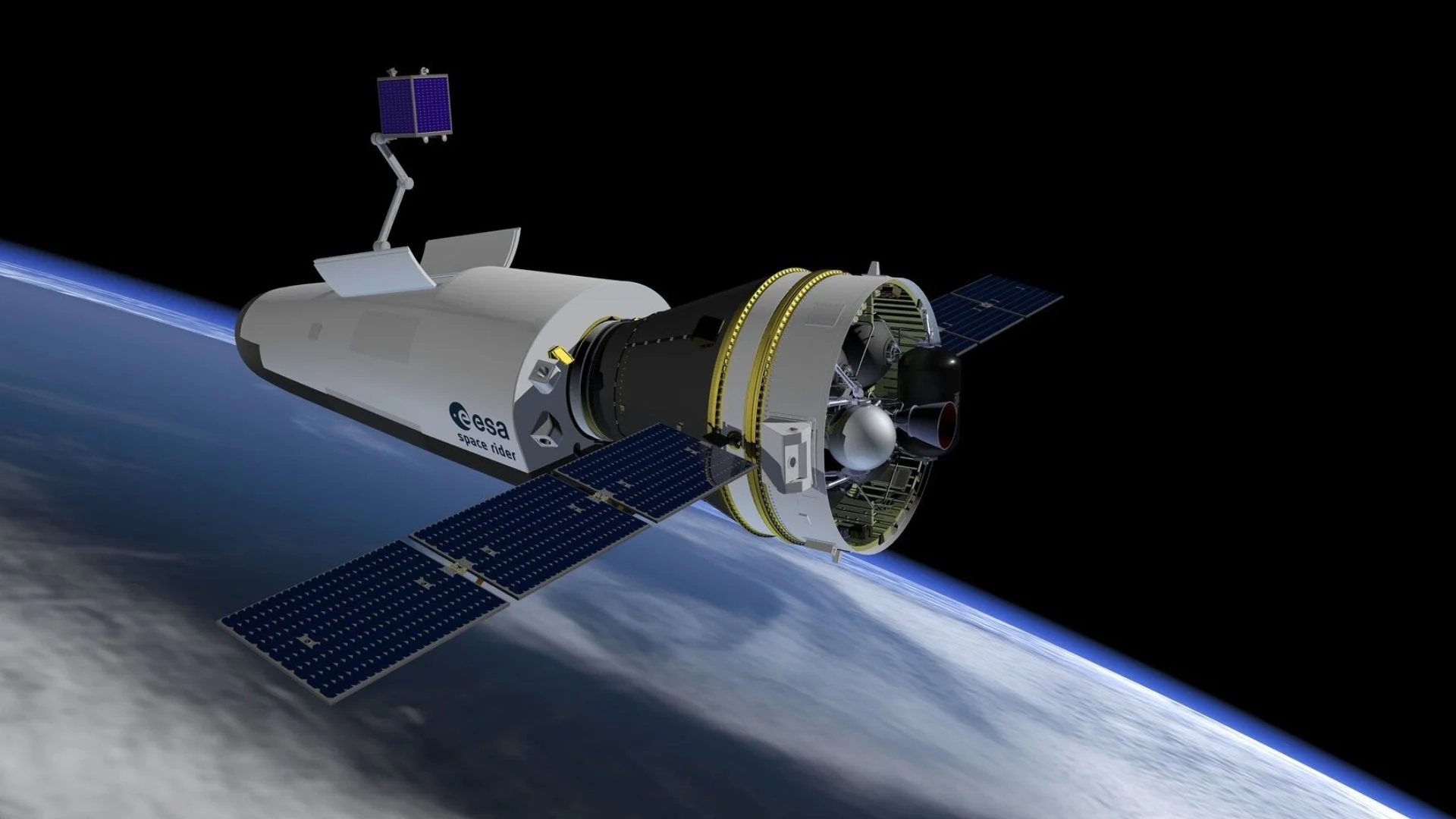
Space Rider is an uncrewed orbital vehicle designed to remain in low Earth orbit for nearly two months. During missions, it will carry scientific experiments, technology payloads, and research equipment in microgravity conditions. After completing its work in space, the spacecraft will return its cargo to Earth for further analysis.
READ ALSO: Russia Starts Nuclear-Capable Missile Tests Before Moscow Victory Day Parade
ESA is currently focusing on two of the spacecraft’s most demanding phases: atmospheric reentry and landing recovery. Engineers recently completed high-temperature testing of the vehicle’s thermal protection system. They also finalized a full-scale drop-test model that will soon perform guided landing trials in Italy.
Unlike traditional capsules that splash into oceans, Space Rider uses a lifting-body design without wings. The spacecraft will descend using a steerable parafoil system that guides it toward a runway-style landing. ESA says this method can improve landing accuracy and help speed up payload recovery after missions.
The landing test model is about the size of a minivan and includes the spacecraft’s onboard avionics. Its autonomous guidance system can control the parafoil during descent without human input. The system continuously reacts to wind conditions and flight changes while steering toward the landing zone.
ESA plans to conduct several helicopter drop tests later this year over the Salto di Quirra test range in Sardinia, Italy. During these trials, the model will be released from altitude to simulate the final descent stage. Although the tests will not recreate orbital reentry, they will validate the spacecraft’s landing and recovery capabilities.
Thermal Protection System Faces Extreme Heat
One of the biggest technical challenges for reusable spacecraft is surviving the intense heat generated during atmospheric reentry.
WATCH ALSO: India Tests Powerful Naval Anti-Ship Missile
To address this, ESA recently completed plasma wind tunnel tests on Space Rider’s thermal protection system. Engineers exposed spacecraft materials to temperatures of around 2,900 degrees Fahrenheit (1,600 degrees Celsius).
The tests took place at the Italian Aerospace Research Center (CIRA), which operates the world’s largest plasma wind tunnel facility. Engineers blasted the spacecraft components with superheated gas traveling at nearly 10 times the speed of sound. These conditions closely simulate the extreme environment the vehicle will encounter on its return from orbit.
Space Rider’s underside is protected by 21 special heat-resistant tiles and thermal control flaps. These components are built using ISiComp, a ceramic material developed jointly by CIRA and Petroceramics. The material is designed to withstand repeated exposure to extreme temperatures during multiple missions.
ESA also tested how the thermal protection system behaves when damaged. Engineers intentionally introduced defects into the material to simulate impacts from space debris or micrometeoroids. The damaged components were then exposed to reentry conditions to study how well the system performs during off-nominal situations.
The agency said the spacecraft prototype has performed strongly throughout the testing campaign. ESA Space Rider Space Segment Manager Aldo Scaccia said the vehicle is now visibly taking shape after years of development work. The successful tests bring ESA closer to demonstrating a reusable orbital platform built entirely within Europe.
READ ALSO: US Navy F/A-18 Super Hornet Disables Iranian Tanker With Cannon Fire in Gulf of Oman
Why Space Rider Matters
Space Rider is expected to play an important role in Europe’s growing space transportation sector. Reusable spacecraft can lower mission costs by allowing systems to fly multiple times rather than being discarded after a single mission. This approach has already transformed parts of the global launch industry and is becoming increasingly important for long-term space operations.
The spacecraft is designed to support a wide range of missions in low Earth orbit. Researchers will be able to conduct biological studies, materials testing, and technology demonstrations in microgravity conditions. Companies and institutions can also use the platform to validate new equipment before deploying it on larger space missions.
The project also strengthens Europe’s independent access to reusable space technologies. Several countries and private firms are currently developing reusable spacecraft systems for cargo transport, scientific missions, and future commercial operations. ESA’s work on Space Rider gives Europe its own reusable return vehicle capability within this rapidly expanding sector.
WATCH ALSO: DRDO Reveals Advanced Armoured Platform, Boosting India’s Defence Power
Another key advantage is faster payload recovery after landing. Traditional ocean splashdowns often require lengthy recovery operations and can expose experiments to saltwater or harsh environmental conditions. Space Rider’s guided runway-style landing system is designed to allow quicker access to scientific cargo and more controlled handling after touchdown.
ESA has not yet announced a final launch date for Space Rider’s first orbital mission. However, the latest tests show the spacecraft is steadily moving from development into operational preparation.
If upcoming landing trials succeed, Space Rider may soon become Europe’s first reusable spacecraft to complete a full mission from launch to controlled return.