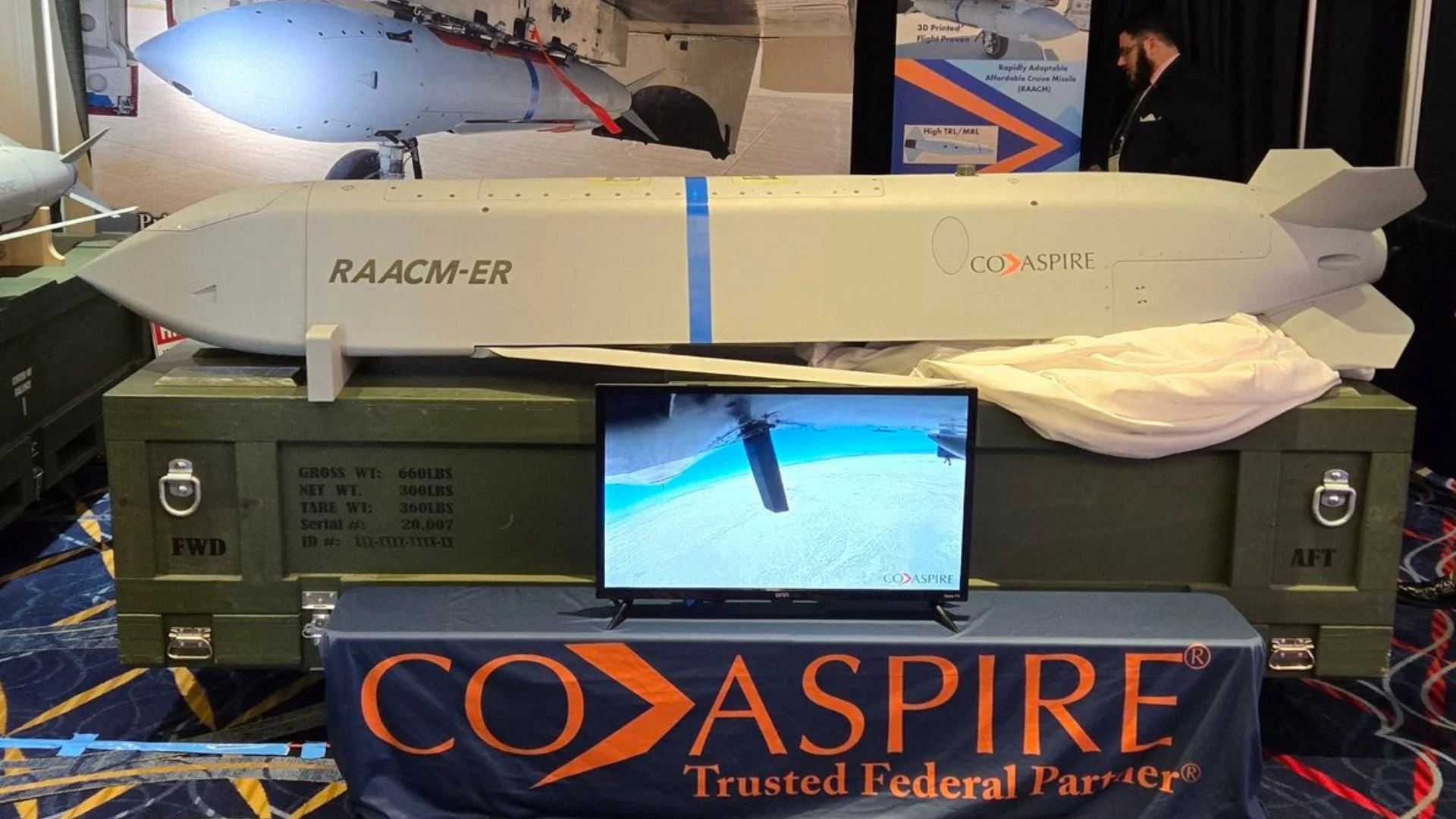
A newly unveiled long-range cruise missile, the RAACM-ER, is drawing global attention for its ability to travel over 1,000 nautical miles while keeping costs under control.
The weapon reflects a growing shift in military strategy, where affordability and large-scale production are becoming just as important as advanced capabilities.
The missile was unveiled by CoAspire at the Sea-Air-Space 2026 exposition near Washington, D.C. Its debut comes at a time when the US military is actively seeking affordable weapons that can be produced in large numbers and used in high-intensity conflicts.
The RAACM-ER is an extended-range version of the earlier Rapidly Adaptable Affordable Cruise Missile (RAACM). While the original version focused on modularity and cost savings, the new model takes those ideas further by significantly increasing range without making the system too expensive or complex.
READ ALSO: China’s Paper Antenna Cuts Costs by 95%, Rewriting 5G Warship Communications
CoAspire’s founder and CEO, Doug Denneny, explained that the original RAACM was designed to match the size of a standard 500-pound bomb. That choice made it easier to integrate with existing aircraft systems. However, the compact size also limited the missile’s range.
Denneny said his team wanted to go further. He explained that they used everything they learned from the original design to build a larger, more capable version. By using advanced manufacturing methods, especially 3D printing, they increased fuel capacity and improved efficiency without significantly raising costs.
RAACM-ER Expands Range While Keeping Costs Low
The result is a missile capable of traveling over 1,000 nautical miles. That is a significant figure, especially for a weapon of its size. In fact, only a few systems in the current US arsenal come close to that range in the anti-ship role.
WATCH ALSO: Apple launches iPhone 17 lineup with contoured edges, and thinner borders
One of those is the Tomahawk cruise missile, a well-known weapon used by the US Navy. While highly capable, each Tomahawk missile costs several million dollars. In contrast, the RAACM-ER focuses on affordability. It is not designed to match the highest-end stealth features of more expensive missiles, but it aims to deliver enough performance at a much lower cost.
This focus on cost is not accidental. Modern conflicts have shown that quantity matters just as much as quality. Weapons are often lost before reaching their targets, especially when facing strong air defenses. By producing more missiles at a lower price, militaries can increase their chances of success.
The RAACM-ER is designed with flexibility in mind. It can be launched from aircraft, ships, or ground-based systems. For surface launches, the missile includes an additional rocket booster that helps it exit its launch container before its main engine takes over.
Despite its name, the RAACM-ER is not just a modified version of the original missile. It is a new design from the ground up. Engineers reshaped the missile to improve fuel storage, survivability, and overall performance.
READ ALSO: Physicists Unveil Neutrino Laser Idea Using Exotic Quantum Matter States
Denneny emphasized that the design was driven by physics and practical needs rather than appearance. While some observers compare it to other cruise missiles like the JASSM, he pointed out that similar shapes often come from similar aerodynamic requirements.
Inside, however, the missile has its own unique systems. It uses GPS for navigation and includes a long-wave infrared sensor in the nose. This allows it to detect and track targets, including moving ones, rather than relying only on pre-programmed coordinates.
Another key feature is the use of commercial off-the-shelf components. This reduces dependence on specific suppliers and helps keep production steady and scalable. According to Denneny, the goal is to make a weapon that can be built quickly and in large numbers.
That goal aligns closely with the US Air Force’s recent efforts. Just days before the missile’s unveiling, the service launched market research for a program called the Family of Affordable Mass Missiles- Beyond Adversary’s Reach(FAMM-BAR).
WATCH ALSO: Humanoid robot plays table tennis like human beings
The program outlines clear requirements. It calls for missiles with a range of at least 1,000 nautical miles, speeds of at least 0.7 Mach, and the ability to receive updates during flight. It also emphasizes the need for large-scale production, with targets of over 1,000 units per year.
The RAACM-ER appears to meet many of these requirements. Its range fits the criteria, and its design supports multiple launch methods, including palletized delivery from cargo aircraft.
The focus on long-range anti-ship capability reflects a broader shift in military strategy. The US is placing more emphasis on countering maritime threats, particularly in the Indo-Pacific region. As naval power grows in that area, the ability to strike ships from long distances becomes increasingly important.
At the same time, recent conflicts have highlighted a major challenge: missile stockpiles can run out quickly. Sustaining large-scale operations requires not just advanced weapons, but also the ability to produce them in huge quantities.
This is where systems like the RAACM-ER come in. By balancing performance with cost, they offer a way to maintain firepower over longer periods.
The missile could also be used against land targets. Its long range allows it to strike from safer distances, reducing the risk to aircraft and crews. This is especially important as air defense systems continue to improve and extend their reach.
READ ALSO: China Achieves World First by Reviving 35kV Stabilizers, Rewiring Grid Stability
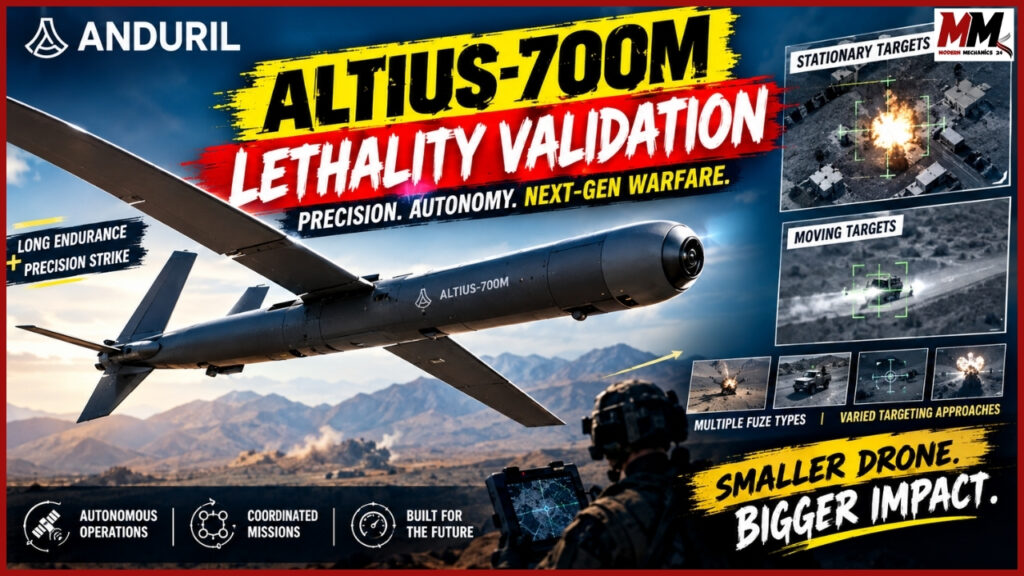
Other companies are also entering the low-cost missile space. Firms like Anduril, General Atomics, and Zone 5 Technologies are developing their own designs. Some have already begun testing, including air-launch trials from fighter jets.
Even so, the RAACM-ER has a strong position. The original RAACM is already in production and has completed flight tests. This gives CoAspire a head start in moving the new version toward operational use.
Denneny confirmed that flight testing for the RAACM-ER will begin soon. If successful, it could become a key player in future US and allied military operations.
With growing demand for affordable, long-range weapons, the timing of this missile’s arrival is notable. It reflects a clear shift in defense thinking, one that values scale, speed, and sustainability alongside raw performance. In that changing landscape, the RAACM-ER stands out not just for how far it can go, but for how many can be built and used when it matters most.