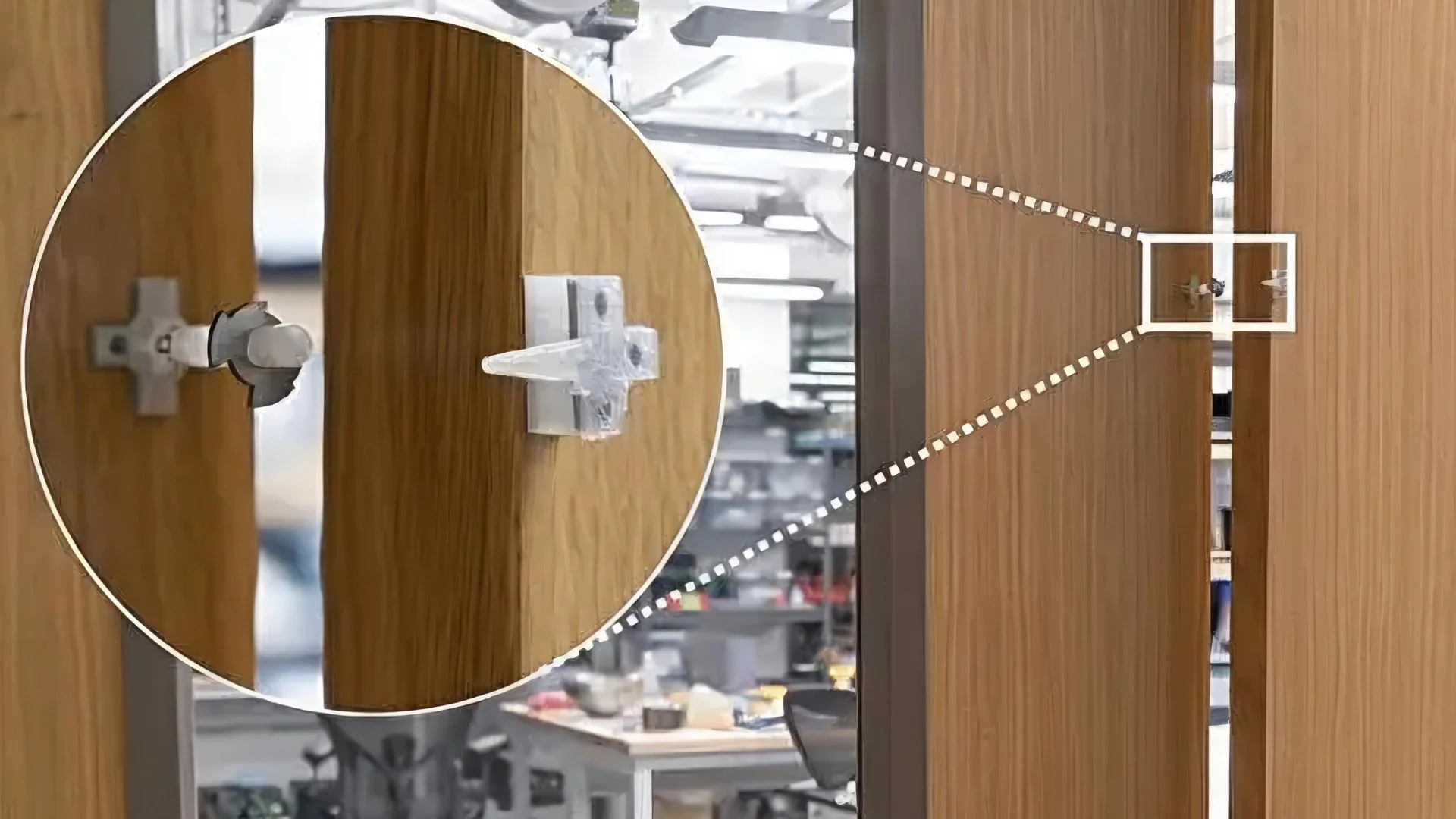
A team of researchers at Georgia Tech has designed tiny metal tags that can turn everyday objects into smart trackers without batteries.
These tags are smaller than a penny. They don’t need charging, wiring, or replacement parts. Yet they can detect actions like opening a door, pulling a drawer, or even lifting gym weights.
Each tag is mounted to a surface, such as a cabinet or door frame. A small tab is attached to the moving part. When the object moves, the tab hits the metal disk. That contact produces a quick ultrasonic sound, too high for humans to hear. A nearby wearable device picks up the sound and records the activity.
READ ALSO: Like Liquid Metal: Staple-Shaped Material Acts Solid, Then Falls Apart to Inspire Innovation
The shape of each tag is carefully designed. It looks like a small flat washer with a hole in the middle and cutouts around the edge. These details control the sound frequency it produces. Each design generates a unique signal, allowing the system to distinguish between different objects.
“Those unique fingerprints can be used for smart home sensing, or what we call activity recognition,” said Yibo Fu, a robotics Ph.D. student who led the project.
The research appears in the journal Proceedings of the ACM on Interactive, Mobile, Wearable and Ubiquitous Technologies.
Unlike most smart home devices, these tags do not rely on power. That makes them cheaper and easier to use. Each tag costs only a few cents.
The team says the tags can be used in many ways. They can track how often a faucet is used, detect when a toilet lid is opened, or monitor daily activity for elderly care. In fitness settings, they can count repetitions like squats or bench presses. Users can also press the tag’s button to log activities or start timers.
WATCH ALSO: Researchers from German have developed a diving robot that can easily collect underwater waste
Fu shared the concept in a short video online. It quickly gained attention, drawing over 1.6 million views and thousands of comments. Many viewers suggested new uses for the tags.
“One person mentioned using the tags in large archive systems,” Fu said. “When you pull out a box or store it, the motion triggers the tag, and you know exactly what changed.”
Others suggested using them to track recycling bins or manage large storage systems. The science behind the tags is based on vibration and wave behavior.
Bolei Deng, an expert in aerospace engineering, helped design the system. His team created simulation tools to shape the metal disks so they produce specific ultrasonic frequencies.
Their models generated nearly 1,300 possible tag designs. Each one can produce a different signal.
READ ALSO: Shell Waste Turns CO₂ Into Fuel at Record Efficiency Without Toxic Chemicals
“We can scale this easily,” Deng said. “We can design dozens or even thousands of unique tags because the ultrasound range is very wide.”
The system works in frequencies above 20 kilohertz, which is beyond human hearing..This also adds a layer of privacy. The signals do not travel far, usually less than a meter. That means only nearby devices can detect them.
“They stay local,” Deng said. “That makes the system naturally private.”
Another key feature is simplicity. The team avoided complex machine learning. Instead, they built a straightforward algorithm with fixed rules to identify each signal. This reduces the need for heavy processing and saves energy on the receiving device.
The project brings together experts from computing and engineering. Along with Fu and Deng, researchers Alexander Adams and Josiah Hester contributed to the work.
WATCH ALSO: World’s largest nuclear fusion research project ITER has reached a new milestone
“This has really been a collaboration between computing and engineering,” Fu said. “We needed both the physics and the computing to make it work.”
The result is a quiet, low-cost system that blends into daily life, turning ordinary objects into smart trackers without adding noise, power, or complexity.