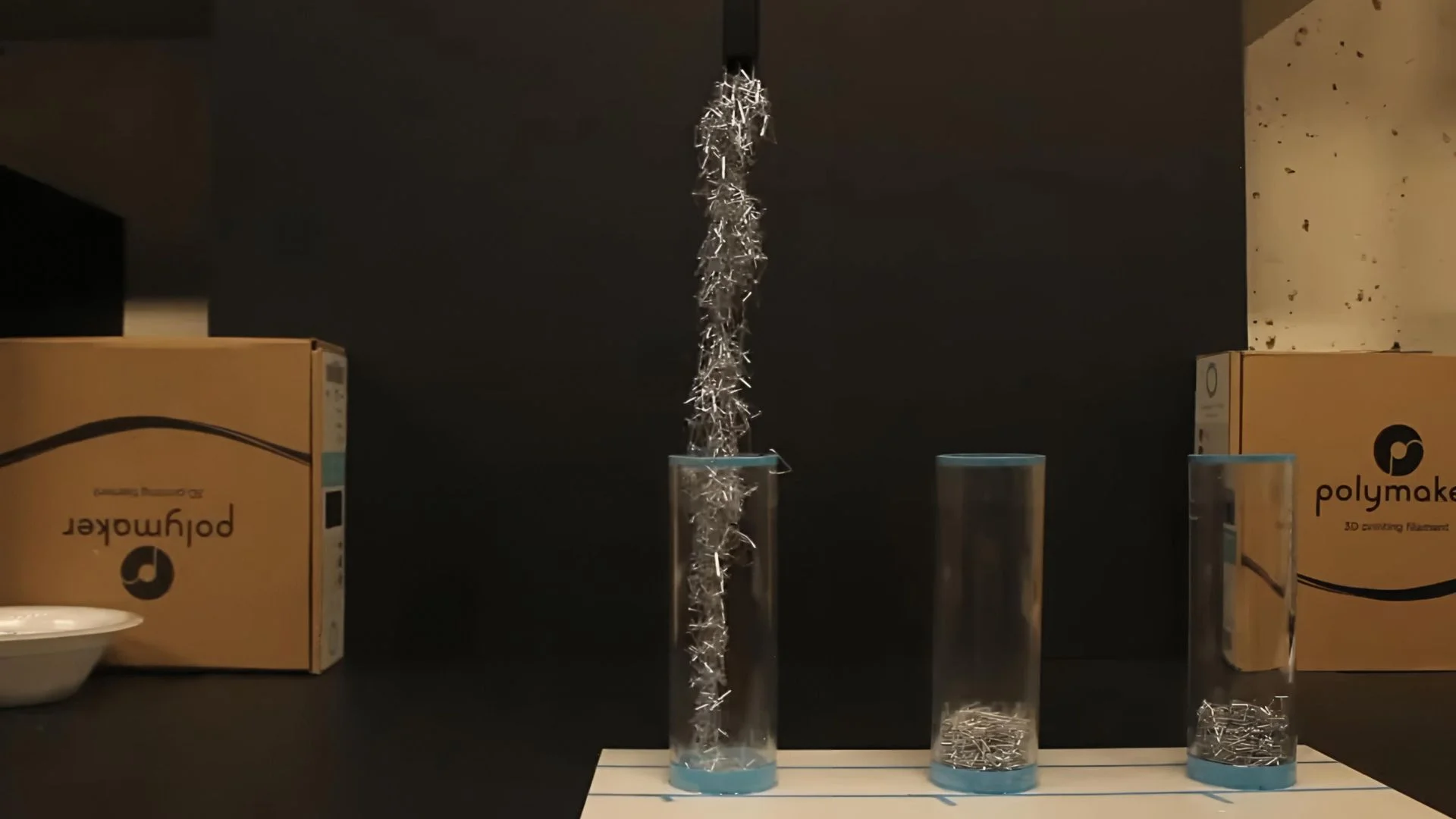
A tightly packed bundle of staples acts like a solid when pulled, but falls apart with vibration, an unusual behavior now inspiring scientists to design new materials.
A team of engineers and materials scientists at the University of Colorado Boulder is studying how such tangled structures behave.
Their work focuses on creating materials composed of small, interlocking particles that can switch between strong and flexible states. The idea is to build materials that can hold firm when needed and come apart when required.
The research is led by Professor Francois Barthelat from the Laboratory for Advanced Materials and Bioinspiration. He says the team has long been interested in how geometry shapes material behavior.
READ ALSO: US Locks 2027 Sentinel Test as Minuteman Era Ends, Nuclear Upgrade Speeds Up
“We have explored building blocks and geometry for many years,” Barthelat said. “Recently, we started focusing on interlocking and entangled particles, and we are excited about what we are seeing.”
The study, published in the Journal of Applied Physics, examines a concept called “entanglement.” This happens when particles twist and hook together, forming a strong network without the need for glue or bonding.
Nature already uses this principle in many ways. Bird nests are built from interwoven sticks and fibers. Bones combine hard minerals with soft proteins in a complex structure. These systems are strong, yet flexible, because of how their parts connect.
The challenge for scientists is to recreate this natural strength in man-made materials. According to the research team, the key lies in one factor: shape.
Ph.D. student Youhan Sohn explained that common materials, such as sand, do not naturally interlock. “Sand grains are smooth and rounded,” Sohn said. “They cannot hook into each other. But if we change the shape, we can completely change how the particles behave.”
WATCH ALSO: NASA rover discovered ancient microbial life signature on Mars
This idea led the team to run detailed computer simulations. They used Monte Carlo methods to test how different particle shapes interact. Their goal was to find a design that maximizes entanglement.
After testing many shapes, one design stood out. A simple two-legged particle, similar to a staple, performed best. These staple-like particles could easily hook together, forming a tight, stable structure.
The researchers then moved from simulations to real-world testing. They conducted pickup tests to observe how these particles behave in physical conditions.
The material formed by these particles showed a rare combination of properties. It was both strong and tough at the same time. In traditional materials, these qualities often do not go together.
“Our entangled material shows high strength and toughness together,” said Ph.D. student Saeed Pezeshki. “That is something we rarely see.”
Another striking feature of this material is how quickly it can assemble and break apart. By applying different levels of vibration, the researchers could control how tightly the particles locked together.
A gentle vibration helped the particles settle and interlock, thereby strengthening the structure. A stronger vibration caused the entire structure to loosen and fall apart.
READ ALSO: 25 Years Later, Gene Therapy Wins Oscars of Science for Restoring Vision
Barthelat described this behavior as unusual. “It is not a liquid, but it is not a solid either,” he said. “It sits somewhere in between, and that opens up new possibilities.”
This ability to switch states on demand could have wide-ranging applications. One area the team is exploring is sustainable construction. In the future, buildings or bridges could be made from such materials. Once they are no longer needed, they can be easily taken apart and reused.
Another possible use lies in robotics. The researchers believe these particles could help create systems where small robots connect to perform tasks and then separate afterward.
Pezeshki compared it to a swarm. “Small units could come together, do their work, and then disconnect,” he said.
Barthelat added a more imaginative comparison. He likened the idea to the liquid-metal character from Terminator 2, which can change shape and reform itself. While that example belongs to science fiction, the concept of adaptable materials is becoming more real.
The team is now moving to the next stage of their research. They are testing new particle designs with extra legs or protrusions. These shapes are inspired by plant burrs that stick to clothing and animal fur.
The goal is to create even stronger entanglement and improve the material’s performance. However, challenges remain. Scaling up production and reducing costs will be key steps before the technology can be widely used.
WATCH ALSO: Drum-shaped antenna reflector on NASA-ISRO NISAR satellite deployed
Despite these hurdles, the researchers remain optimistic. They believe their work is opening a new direction in material science, one that focuses on structure and interaction rather than chemical bonding alone.
Barthelat said the journey itself is exciting. “We are not fully sure where this will lead,” he said. “But we enjoy exploring it.”
He added that the idea may seem unusual at first. Most people do not think of staples as a source of strong materials. But a simple test can change that perception.
“Try breaking a bundle of staples,” he said. “You will see how strong it really is.”
However, the team continues to experiment, refine designs, and push the limits of what these entangled particles can do. What started as a simple observation may one day reshape how materials are built, used, and reused.