A team of Chinese researchers has introduced a new kind of antenna made from as simple a material as photo paper.
The innovation is designed for 5G communication on ships and promises to reduce costs sharply while maintaining solid performance.
The study, published in the Chinese Journal of Ship Research, was led by Yang Wendong from Liaoning Technical University.
The researchers focused on solving a key problem in maritime communication: how to deploy high-frequency 5G systems without the heavy costs and rigid materials used in traditional designs.
The focus of the work is a flexible millimeter-wave antenna built from glossy photo paper less than 0.3 millimeters thick. Instead of relying on expensive, rigid substrates typically used in high-end electronics, the team used low-cost paper and screen-printed copper paste to create the conductive layer.
READ ALSO: Dynetics Wins $617M IFPC Deal as US Army Moves to Full-Rate Air Defense Production
According to the researchers, the design reduces material costs by more than 95 percent compared to conventional microwave substrates. At the same time, the antenna remains lightweight, flexible, and even biodegradable, adding an environmental advantage to its economic appeal.
The antenna is built as a multiple-input multiple-output system, commonly known as MIMO. This design allows it to handle high data traffic, which is essential for modern 5G networks. It supports dual frequency bands at 28 GHz and 38 GHz, which are widely used in millimeter-wave communication.
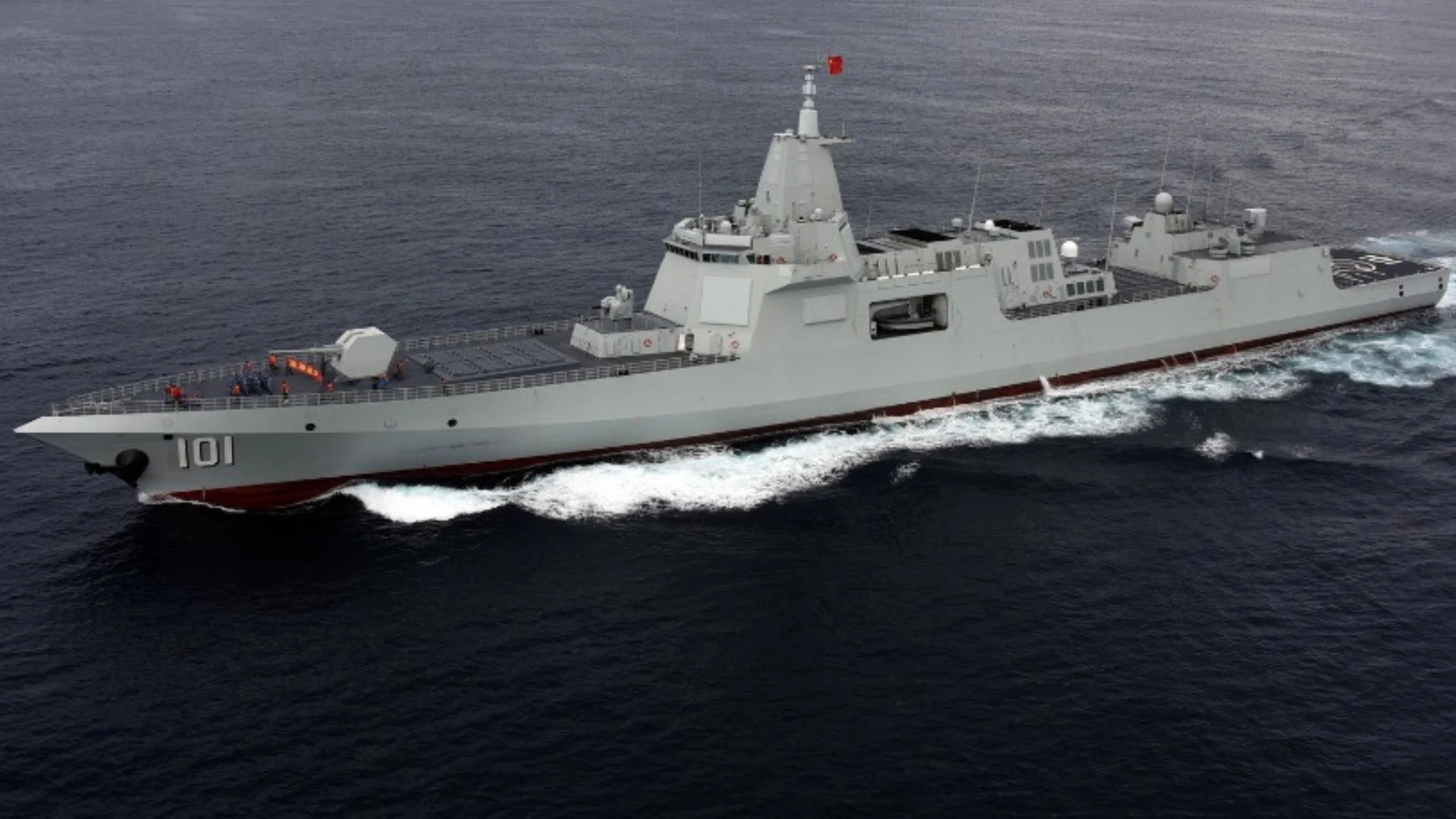
The team says the antenna is specifically engineered for the complex conditions found at sea. Ships present a challenging environment for wireless signals due to their metal structures, constant motion, and exposure to saltwater and humidity.
To address these issues, the researchers introduced a thin air gap into the design. This feature helps reduce signal interference caused by the ship’s metal body and stabilizes the antenna’s radiation pattern.
WATCH ALSO: A robot was recently kicked and violently dragged to test its abilities
They also added a protective coating, allowing the antenna to withstand moisture, salt spray, and repeated bending without losing performance.
The antenna achieved radiation efficiency of more than 80 percent, with peak gains of 4.3 and 3.8 dBi. These numbers indicate how effectively the antenna focuses and transmits signals.
The design also includes a cross-shaped decoupling structure that reduces interference between closely spaced antenna elements, achieving isolation levels exceeding −32 dB.
Despite these capabilities, the antenna remains compact. It measures just 25 millimeters by 43 millimetres. Its flexibility allows it to be applied directly onto curved or uneven surfaces, such as ship walls or pipes.
Unlike rigid antennas, which often struggle with such surfaces and can interfere with stealth designs, this version can be attached almost like a sticker.
The researchers describe the antenna as a low-cost, scalable last-mile solution for ship communication systems. This refers to the final stage of connectivity, in which signals must reach specific devices or areas on a vessel.
READ ALSO: CO₂ Drops, Manufacturing Doesn’t: Bio-Based Foam Cuts Emissions Without Process Changes
The development comes at a time when navies around the world are exploring ways to integrate 5G into their operations. High-speed communication is becoming essential for data transfer, coordination, and the deployment of advanced technologies onboard ships.
In the US, the focus has been on more advanced and expensive systems. The US Navy has been working on programs such as SEA2, which rely on low Earth orbit satellite networks. These systems involve significant investment.
For instance, consulting firm Booz Allen Hamilton received a contract worth US$99 million to deploy wireless networks across around 140 ships under the Military Sealift Command. In another case, the research and development cost for a single communication terminal reached US$6.29 million.
By comparison, a domestic Chinese project led by China Unicom achieved 5G indoor coverage for three vessels at a total cost of 57,000 yuan, or about 19,000 yuan per ship, excluding tax. While the technical scope of these projects differs, the contrast highlights the potential cost advantage of simpler solutions, such as the paper-based antenna.
The researchers believe their design strikes a practical balance between cost and performance. “By adopting a design with low-cost photo paper substrates, we have achieved a meaningful balance between performance and cost,” they wrote in the study.
Beyond naval use, the technology may find applications in other areas. The team suggests it could be used in uncrewed aerial vehicles, portable communication devices, smart warehouses, and Internet of Things systems.
However, the researchers also note that their work is still at an early stage. Most of the testing has been done in laboratory conditions. Real-world environments, especially at sea, present additional challenges that require further study.
WATCH ALSO: SpaceX rocket sends 11,000 pounds of scientific investigations, cargo to space station
“The experimental verification of the antenna is mainly conducted in a laboratory environment,” the team stated. They added that long-term reliability and performance under complex real-world conditions still need to be tested.
Even so, the idea of using paper as a base for advanced communication technology points to a shift in how such systems can be designed. By combining simple materials with smart engineering, the study shows that high-performance solutions do not always require expensive components.
As demand for faster and more efficient communication grows, especially in demanding environments like the open sea, innovations like this paper-based antenna may offer a new direction, one that is both practical and scalable.