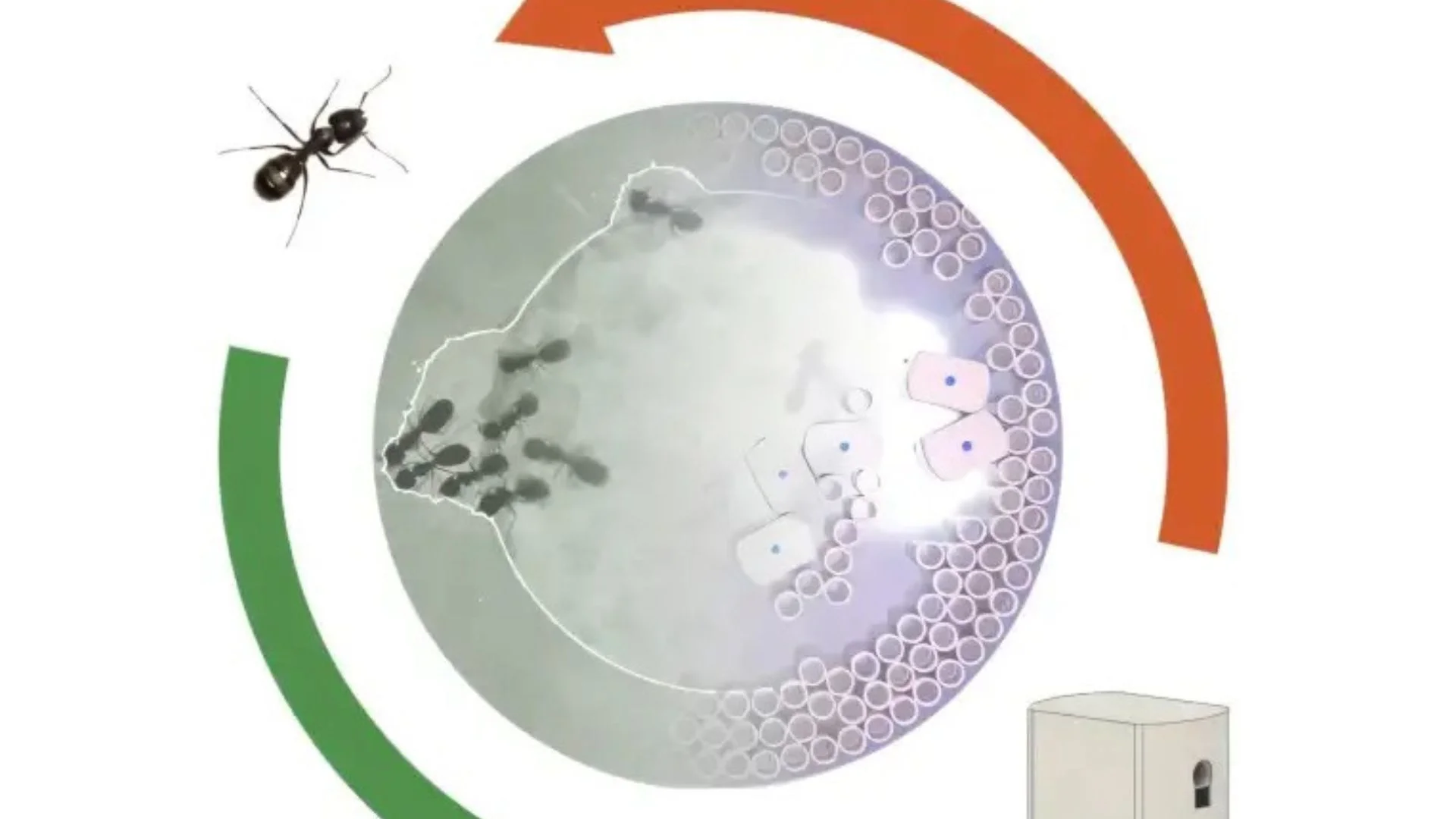
Inspired by ants that build complex, climate-controlled nests without a leader, scientists have created simple robots that can work together in a self-organized way.
Researchers at Harvard John A. Paulson School of Engineering and Applied Sciences (SEAS) and the Faculty of Arts and Sciences have developed a group of small robots that can organize themselves to build and dismantle structures.
These machines do not rely on a leader or a detailed plan. Instead, they respond to their surroundings and follow a few basic rules.
The study, published in PRX Life, shows how simple agents, whether insects or robots, can coordinate tasks through local interactions. The findings offer new ideas for building autonomous systems and understanding how collective behavior works in nature.
READ ALSO: USS Gerald R. Ford Returns to Red Sea, Carrier Move Signals Rising Stakes with Iran
The research team was led by Professor L. Mahadevan, whose work often explores how complex patterns emerge from simple physical processes. His team has long studied social insects and previously demonstrated how robots could mimic the digging and escape behavior of ants.
“Our new study shows how simple local rules can lead to complex task completion,” Mahadevan said. “These systems organize themselves, making them robust and adaptable.”
A key idea introduced in the study is the team’s ‘exbodied intelligence.’ This means that intelligence does not sit inside a single robot. Instead, it emerges from how the robots interact with each other and with their changing environment.
How Robots Work Together, Inspired by Ant
In the natural world, ants use a method called stigmergy. They leave chemical signals, known as pheromones, which guide other ants. Each ant reacts to these signals, creating a chain of actions that leads to organized behavior.
The researchers recreated this process using robots called RAnts. Instead of chemical signals, these robots respond to light-based signals, which the team calls photormones. These light fields act as digital versions of pheromones.
WATCH ALSO: Chinese company’s humanoid robot has mastered Webster flip, defies physics
Each robot senses changes in the light field around it. As it moves, it also leaves signals behind, creating a feedback loop. This loop allows the robots to communicate indirectly through their environment.
The robots follow a few simple rules. They move toward stronger signals, pick up building materials, and place them down when certain conditions are met. Even with these limited instructions, the robots show surprisingly advanced behavior.
They begin to cluster in certain areas, forming what scientists call nucleation sites. These are the starting points where structures begin to take shape. This process occurs due to a phenomenon known as trapping instability, in which robots temporarily get stuck in signal-rich zones.
As more robots gather in these areas, construction speeds up. Over time, this leads to the formation of organized structures made from building blocks.
One of the most interesting features of the system is its flexibility. The same group of robots can either build structures or take them apart.
The researchers found that this behavior depends on two key factors. The first is cooperation strength, which controls how strongly robots follow the signal gradients. The second is deposition rate, which determines whether robots add material or remove it.
READ ALSO: China’s Paper Antenna Cuts Costs by 95%, Rewriting 5G Warship Communications
By adjusting these parameters, the team could make the swarm switch between construction and dismantling. This ability mirrors how ant colonies adapt their behavior based on changing conditions.
The study also includes a theoretical model that explains how the system works. It examines how robot density, communication signals, and environmental changes interact over time. This model builds on earlier theories of biological aggregation but adds the complexity of a changing environment.
The research opens the door to many practical uses. Swarms of simple robots could one day be used in dangerous environments where human workers cannot go. They could help build structures in disaster zones, clean up hazardous waste, or even assist in space missions.
Because these robots do not depend on a central controller, they are less likely to fail as a group. If one robot stops working, the rest can continue without disruption.
WATCH ALSO: A South Korean humanoid robot has performed Michael Jackson’s Moonwalk, leaving all viewers stunned
The work also provides a new way to study animal behavior. By recreating biological systems in machines, scientists can test ideas and better understand how collective intelligence forms.
In the end, this research shows that complex outcomes do not always require complex instructions. Sometimes, a few simple rules and a shared environment are enough to create something remarkable.