As solar energy expands worldwide, dust and pollution on panels continue to reduce their efficiency, while traditional cleaning methods consume large amounts of water.
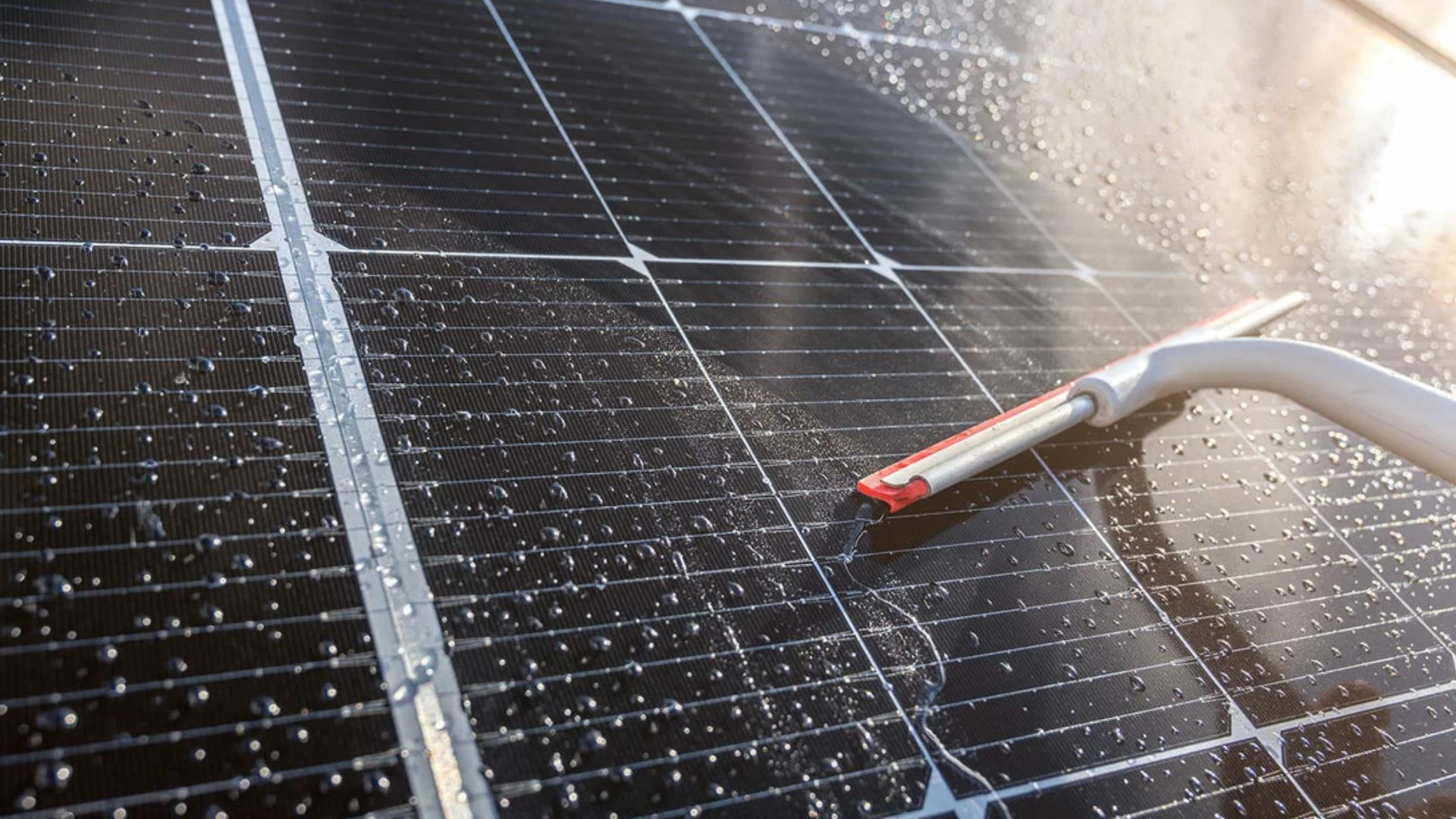
Now, researchers have introduced ‘liquid droplet mops,’ a new technique that uses controlled water droplets to clean panels more effectively while significantly cutting water use.
The research was led by Professor Steven Wang from the Department of Mechanical Engineering at City University of Hong Kong. The team also worked with Professor Omar Matar from Imperial College London. Their findings have been published in the journal Nature Sustainability.
Today, most solar panels are cleaned using high-pressure water jets. While these systems remove dirt, they require a massive amount of water.
READ ALSO: F-35s Turn Quarterbacks as Drone Swarms Redefine Marine Corps Air Combat
Globally, cleaning solar panels consumes more than 12 billion gallons of water every year. This is especially concerning in dry regions where solar farms are often located.
The researchers decided to rethink how cleaning works. Instead of using strong water jets, they studied how individual droplets behave when they hit a surface. What they found was surprising. A stronger force does not always mean better cleaning.
The team discovered that cleaning efficiency depends on the energy of each droplet in a non-linear way. In simple terms, droplets clean best when they hit the surface with moderate energy, neither too weak nor too strong. Too much force can actually reduce effectiveness.
WATCH ALSO: Engineers from Australia have introduced a spray that enhances the fire-resistance of clothing
Using this idea, the team developed the liquid droplet mop system. It carefully controls how droplets hit the panel surface. Each droplet spreads and then recoils, creating small forces that push and lift dust particles away.
This controlled motion allows the droplets to remove even heavy particles. The system can clean particles that are six to ten times denser than water. Tests showed that it can achieve up to 99.9% particle removal efficiency.
At the same time, the technology uses far less water than traditional methods. Compared to standard cleaning systems, it reduces water use by six to ten times. If applied globally, it could cut water consumption for solar panel cleaning by more than 80%.
The idea behind this innovation comes from nature. The researchers observed how surfaces like butterfly wings and plant leaves stay clean. When raindrops hit these surfaces, they naturally remove dirt. The team used this principle to design their cleaning system.
READ ALSO: China Fires Back-to-Back Rockets in 24 Hours, Scaling Space Internet Power Play
Professor Wang explained the importance of this approach. He said the goal is to save water while improving the performance of solar energy systems. He added that the technology can bring both environmental and economic benefits.
The team also tested the system under conditions similar to desert environments. These areas are important because many large solar farms are built there. However, they also face heavy dust accumulation.
Lo Wai-kin, a Ph.D. student involved in the project, described the testing process. The researchers used sand particles of different sizes to simulate real conditions. They found that droplets could gather and efficiently remove these particles.
During the tests, each droplet worked not just by impact but also by pulling particles together. This made it easier for the system to carry away dirt with minimal water. The process proved to be stable and highly effective across different conditions.
The system’s simplicity is one of its biggest strengths. It does not rely on complex machinery or large volumes of water. Instead, it uses a smart understanding of physics to deliver better results.
WATCH ALSO: Called Ascentia, the platform is developed by American company Collins Aerospace
This innovation arrives at an important time. The world is facing both a growing demand for clean energy and increasing water scarcity. Solutions that address both challenges are urgently needed.
By improving solar panel performance and reducing water use, the liquid droplet mop technology offers a practical path forward. It supports the expansion of solar energy while protecting valuable natural resources.
As the research moves toward real-world applications, it has the potential to transform how solar panels are maintained worldwide. It shows that sometimes, small changes like a single droplet can make a big difference.