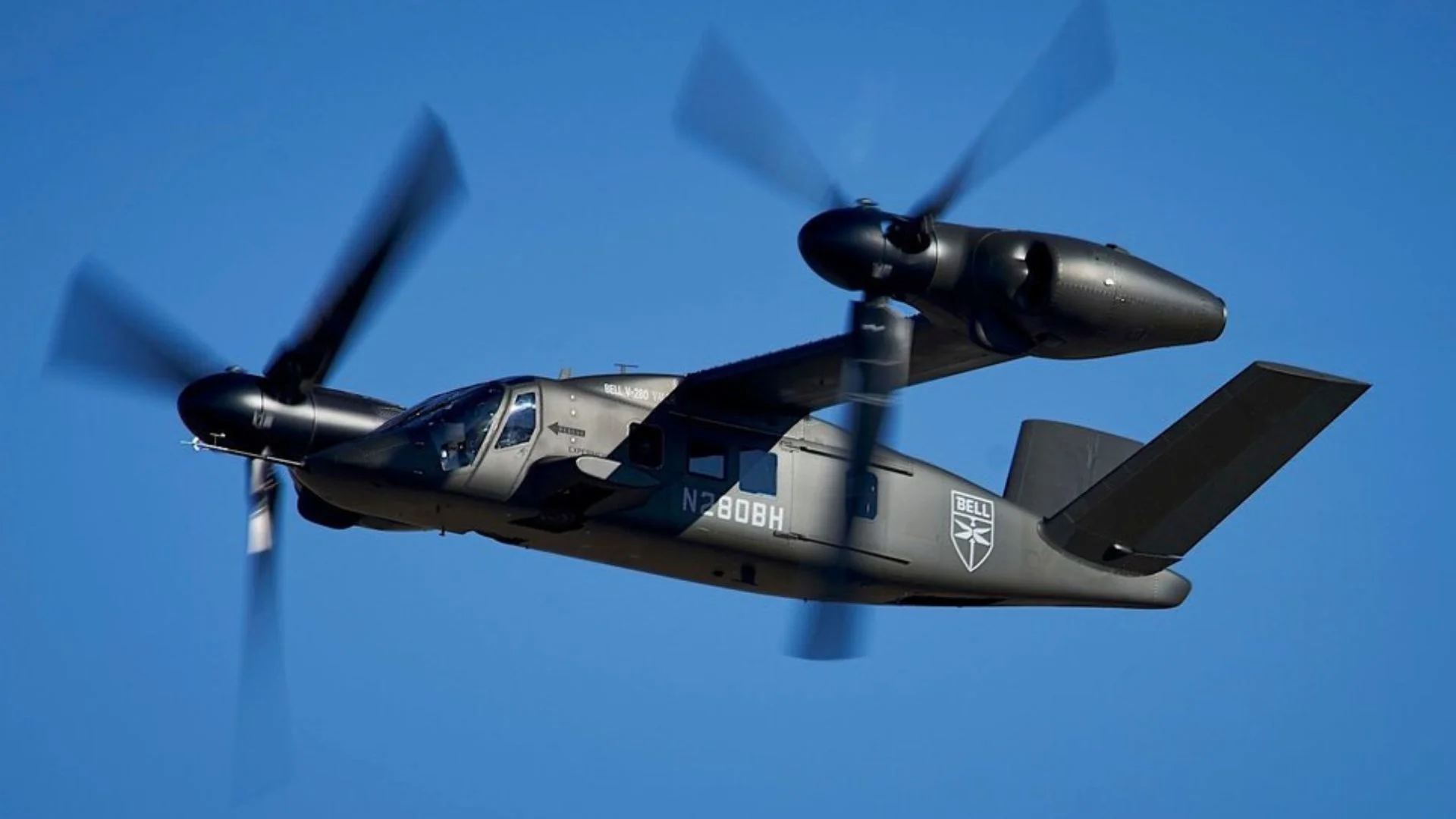
The US Marine Corps is stepping into a new phase of aviation thinking. At the center of that shift is Bell’s MV-75 tiltrotor concept, an aircraft that blends the reach of an airplane with the flexibility of a helicopter, now paired with serious strike power.
The concept, recently showcased at the Modern Day Marine conference, is not just another design study. It reflects a deeper rethink of how Marines want to fight in the years ahead, faster, farther, and with more options from a single platform.
This effort comes as the Corps looks beyond its current fleet, including the AH-1Z Viper and the UH-1Y Venom. Both have served as the backbone of Marine light attack aviation. Their replacement, however, may look very different.
READ ALSO: Northrop–Hanwha Shape AReS Rocket Booster for Long-Range Strike Edge
A Tiltrotor Built for Speed and Strike
The MV-75 traces its roots to the V-280 Valor, now evolving into the MV-75A Cheyenne II. What makes this platform stand out is its ability to shift seamlessly from vertical lift to high-speed forward flight.
For the Marines, Bell has pushed that concept further. The new configuration transforms the aircraft into a long-range strike asset, capable of carrying advanced weapons while maintaining the speed advantage of fixed-wing aircraft.
This combination directly addresses a growing need: covering vast distances across maritime environments without sacrificing firepower.
The defining feature of this concept is its integration with weapons. Mounted prominently is the Naval Strike Missile, a stealthy cruise missile designed for precision attacks against ships and coastal targets. Traditionally deployed from ships or ground launchers, its integration onto a tiltrotor changes how and where it can be used.
WATCH ALSO: United Launch Alliance’s Atlas V rocket delivers success for Amazon Leo
Alongside it are compact strike systems linked to programs like the Red Wolf. These smaller weapons are part of a new class of adaptable systems that can act as strike munitions, decoys, or electronic warfare tools.
Together, they represent a shift toward distributed firepower where a single aircraft can launch multiple types of effects across a wide battlespace.
MV-75: A Platform That Carries More Than Weapons
The MV-75 is designed for more than just missile carriage. It functions as a multi-role combat node. Stub wings allow it to carry proven systems like the AGM-114 Hellfire and APKWS II, supporting close-range engagements.
At the same time, it introduces deeper integration with unmanned systems. Launch tubes built into the aircraft can deploy loitering munitions such as the ALTIUS-700M. These systems can scout ahead, identify targets, or strike independently.
This layered approach, combining missiles, drones, and sensors, turns the aircraft into a flexible mission hub rather than a single-purpose platform.
Range and speed are where the MV-75 makes its strongest case. Unlike traditional helicopters, it operates efficiently in airplane mode, enabling it to travel quickly over long distances. Bell indicates that the aircraft can exceed 1,000 nautical miles in range with internal fuel alone.
This level of reach is essential for Marine operations, especially in the Indo-Pacific, where units must operate across dispersed islands and open ocean.
READ ALSO: Laser from Supercarrier USS George H.W. Bush: US Navy Tests Drone-Killer LOCUST
Bell’s Bill Hendricks noted that the design assumes weapons can be deployed while in forward flight. This enables rapid engagement without slowing down or repositioning, preserving both speed and survivability.
Precision, Awareness, and Close Combat Capability
While long-range strike is a major focus, the MV-75 retains close combat capabilities. A nose-mounted cannon similar to that used on the AH-1Z provides direct fire support. This ensures the aircraft can still operate effectively in traditional close air support roles.
Advanced sensors housed in a forward turret give the crew real-time awareness. These systems support targeting, surveillance, and mission coordination in complex environments. An aerial refueling probe further enhances endurance, allowing missions to extend well beyond standard limits.
The broader appeal of the MV-75 lies in consolidation. Rather than fielding separate aircraft for attack and utility roles, the Marines could rely on a single platform that performs both. This approach simplifies logistics and increases flexibility in the field.
However, this shift also raises questions. A larger, more capable aircraft may bring higher costs and new operational challenges. Balancing capability with practicality will be key as decisions move forward.
Part of the Marine Corps’ Future Vision
The MV-75 concept is closely tied to the Marine Corps’ Future Attack Strike initiative. This effort aims to define the next steps for Marine aviation.
WATCH ALSO: China’s new massive battle tank takes part in live-fire test
It also aligns with wider changes, including the transition away from legacy platforms like the AV-8B Harrier and older Hornets, with roles increasingly shifting toward systems like the F-35 Joint Strike Fighter.
Marine leadership has made it clear that no single path has been chosen. Manned aircraft, unmanned systems, and hybrid approaches are all under active consideration.
Though the MV-75 tiltrotor is still a concept, it brings together speed, range, and layered firepower in a single design. It reflects a move toward flexible, networked operations in which aircraft do more than just transport or attack; they connect to and control the fight.
For the Marine Corps, this is not just about replacing helicopters. It is about redefining how aviation supports operations across land and sea.
The MV-75 may not be the final answer. But it offers a sharp preview of where the future is heading and why the rules of aerial warfare are being rewritten.