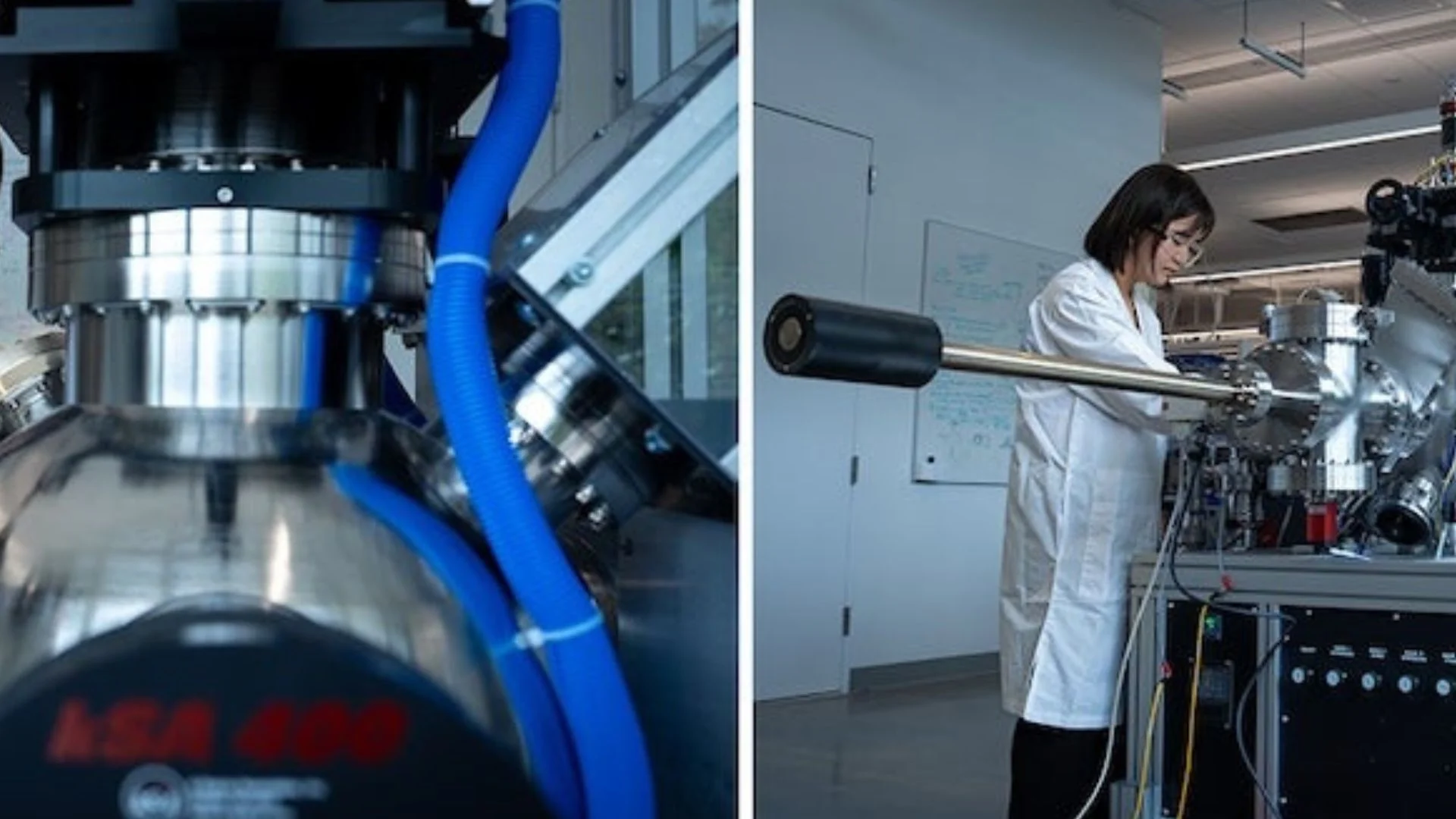
Scientists at Rice University have developed a new room-temperature multiferroic material that delivers a major performance boost and may significantly cut the energy needed for future computing.
Their work shows a sharp increase in both magnetic strength and the interaction between electric and magnetic properties. The findings were published in Proceedings of the National Academy of Sciences.
The team focused on bismuth ferrite, a material long studied for its ability to combine electric and magnetic behavior. To improve its performance, they mixed it with barium titanate and grew the material as a thin film on a surface that slightly distorts its crystal structure.
READ ALSO: Neanderthals’ Brains Weren’t to Blame for Their Demise 40,000 Years Ago
This careful combination of chemistry and structural strain produced a new form of the material with enhanced properties.
The new material showed a tenfold increase in magnetization and a hundredfold increase in magnetoelectric coupling compared to standard bismuth ferrite. These gains suggest a much stronger link between electric and magnetic behavior, which is key for advanced computing systems.
“Nobody had ever dialed both knobs, the strain and the chemistry at once,” said Lane Martin, who led the research. He explained that the team combined two different material systems to create a new structure with entirely new properties.
Modern computing relies on controlling the movement of electrons in silicon-based systems. While this approach has driven decades of progress, it is now approaching its efficiency limits. As computing demand rises, so does energy use.
WATCH ALSO: Boston Dynamics Atlas humanoid robot demonstrates remarkable mobility, balance
“Electronics today have an energy problem,” Martin said. He added that within the next decade, computing systems may consume a large share of global electricity, making current methods unsustainable.
Scientists are now exploring new ways to process information using not only electrons’ charge but also their spin, a magnetic property. This is where multiferroics come in. These materials have both electric polarization and magnetism, and the two can influence each other through magnetoelectric coupling.
This coupling allows an electric field to control magnetism or a magnetic field to control electric polarization. Such control can enable devices that combine memory and logic functions while using much less energy than current technologies.
“One class of materials studied for decades is multiferroics,” Martin said. He noted that their ability to combine different properties makes them especially useful for future electronics.
READ ALSO: Handle With Care: This Robot Gripper Picks Ripe Fruit by Touch Alone
However, finding a material that shows strong electric and magnetic behavior at room temperature has been a major challenge. Bismuth ferrite has been one of the best candidates, but its magnetism remains weak because its internal magnetic moments tend to cancel each other out.
The new study addresses this limitation. By adding nonmagnetic barium titanate and applying structural strain, the researchers achieved a surprising result. The material became more magnetic while retaining strong electrical properties.
“I did not expect such a large increase in magnetization,” said Tae Yeon Kim, the study’s first author. She explained that the unexpected results led her to double-check the data several times.
Measuring magnetism in thin films is complex, so Kim spent more than six months creating and testing samples. To confirm the findings, another researcher independently produced the material using the same method. The repeated success strengthened confidence in the results.
The project also involved collaboration with several institutions. The team used advanced tools, including synchrotron measurements at the Advanced Light Source at Lawrence Berkeley National Laboratory. Researchers from Bar-Ilan University, Drexel University, the Massachusetts Institute of Technology, Northeastern University, the University of California, Berkeley, the University of Pennsylvania, and the US Naval Research Laboratory contributed to understanding the material’s behavior.
WATCH ALSO: China Sets World Record with 700 km/h Maglev
Beyond the specific discovery, the research highlights a broader strategy for designing new materials. By combining chemical changes with controlled structural strain, scientists can create materials with entirely new and unexpected properties.
One of the most surprising findings was that adding a nonmagnetic component increased the material’s overall magnetism. This insight could guide future efforts in materials science and engineering.
The new multiferroic material is still in the early stages of research, but it offers a promising direction for low-energy computing. By combining electric and magnetic properties, future devices may overcome the limitations of today’s silicon-based systems.
As the demand for computing power continues to grow, innovations like this may play a key role in building more efficient and sustainable technologies.