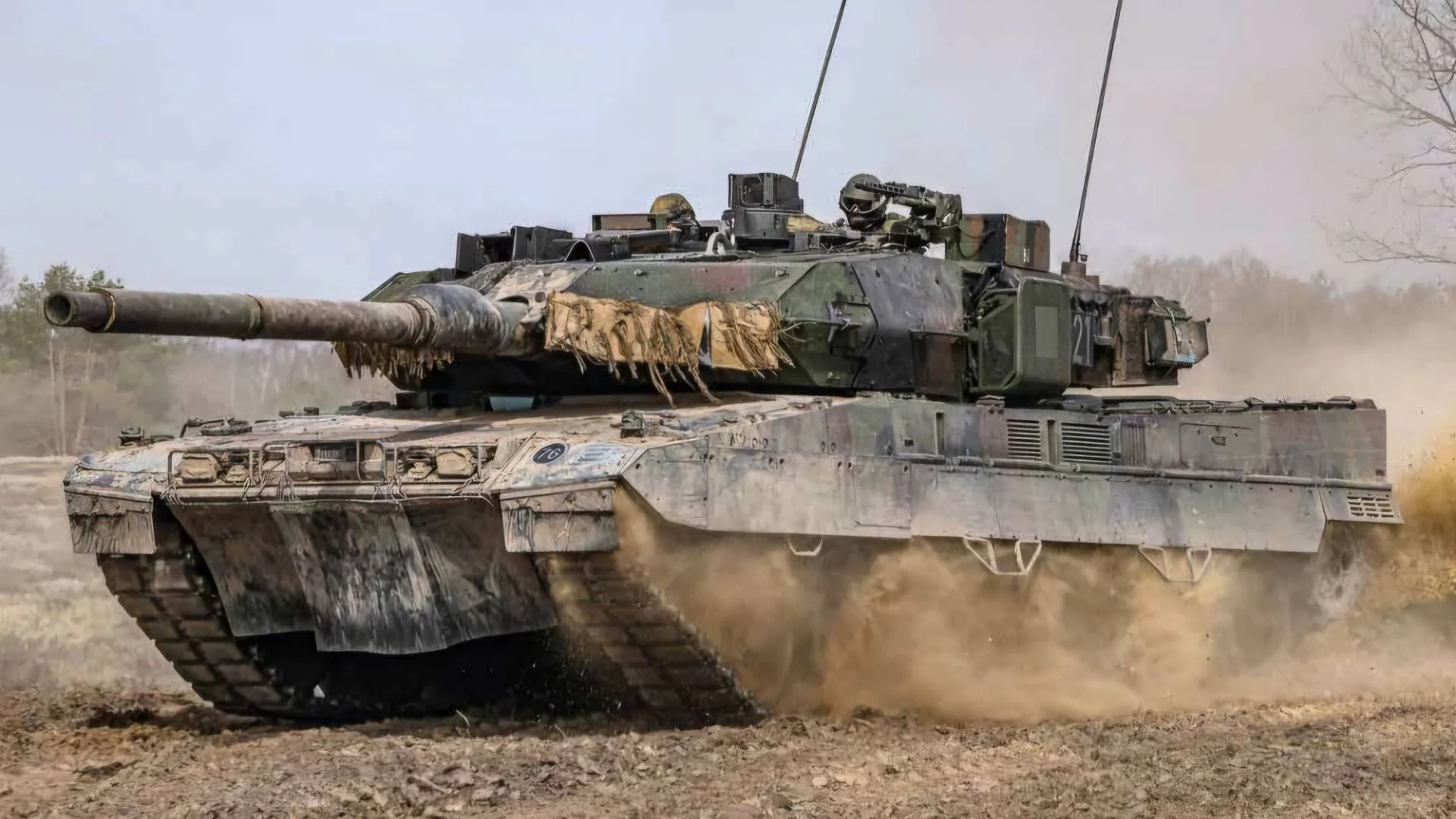
Germany has started delivering the latest Leopard 2A8 main battle tanks to Norway, marking a major step in Europe’s evolving defense landscape.
With this move, Norway became the first country outside Germany to operate the Leopard 2A8 variant. The development strengthens NATO’s military presence in the north at a time when Arctic security is gaining more attention.
The delivery confirms a long-planned procurement approved by the Norwegian parliament in 2023. The program is valued at around NOK 23-23.4 billion, or roughly €2 billion. It reflects Norway’s efforts to modernize its army and prepare for high-intensity conflict.
The tanks were produced in Germany and transported by road to the port before being loaded onto the ferry Color Fantasy. From there, they were shipped to Oslo using heavy transport routes designed to handle vehicles weighing nearly 69 tons.
READ ALSO: Nuclear Power Bank: China’s 10 MW Truck-Mounted Reactor Eyes AI Energy Boom
After arrival, the tanks are scheduled to move to Rena Camp. A formal presentation is planned for April 30, 2026, with officials from Norway’s Ministry of Defense in attendance.
Norway’s full order includes 54 Leopard 2A8NOR tanks. Deliveries will continue from 2026 through 2028. This marks the transition from production to active deployment within the Norwegian Army.
The contract was signed in February 2023 with KNDS Germany as the main contractor. The original plan focused on the Leopard 2A7NO configuration, but later changes led to adopting the more advanced Leopard 2A8NOR standard. There is also an option for additional tanks, although it has not been used as of April 2026.
The production process is shared between Germany and Norway. A total of 37 tanks will be assembled locally by Ritek in Levanger, while 17 units will be delivered fully built from Germany.
Several Norwegian companies are playing key roles. Kongsberg is responsible for the electronic systems and integration. Teleplan Globe provides navigation systems. Nammo ensures a steady supply of ammunition. This setup allows Norway to maintain greater control over maintenance, upgrades, and long-term support, rather than relying fully on foreign suppliers.
WATCH ALSO: US conducts powerful and deadly strike against ISIS terrorists in Northwest Nigeria
The Leopard 2A8NOR is not just about firepower. Its biggest change lies in its digital architecture. At the core is a system developed by Kongsberg, known as ICS or CORTEX. This system manages how data moves within the tank and connects it to other military units.
The tank also includes the FACNAV navigation system and the NorBMS battlefield management system. These create a fully integrated C4ISR network at the vehicle level. This means the tank can share data in real time with other tanks, artillery units, drones, and even aircraft. It allows faster decision-making and coordinated attacks across multiple domains.
The Leopard 2A8NOR comes with a fully digital fire control system. It allows accurate firing even while the tank is moving. The system uses thermal imaging for both the gunner and commander. It also includes a laser rangefinder and a ballistic computer that adjusts for weather and environmental factors in real time.
The tank can engage targets at distances of 4 to 5 kilometers. It can also mark targets with a laser and send coordinates instantly to other units. This enables one unit to detect a target while another carries out the strike. This level of coordination reduces the time between detection and engagement, improving battlefield efficiency.
READ ALSO: China Achieves World First by Reviving 35kV Stabilizers, Rewiring Grid Stability
Protection is another key feature of the Leopard 2A8NOR. The tank uses modular composite armor that can be upgraded or replaced as needed.
The design focuses on protecting the front but also includes reinforced sides and improved roof protection. This helps defend against both kinetic and explosive threats.
In addition, the tank is equipped with the EuroTrophy active protection system. This system uses radar to detect incoming threats such as missiles or rocket-propelled grenades. It then launches countermeasures to stop them before impact. This layered protection approach is designed to deal with modern threats, including drones and anti-tank weapons.
The main weapon is the 120 mm Rheinmetall L55A1 smoothbore cannon. It can fire different types of NATO ammunition, including armor-piercing and programmable high-explosive rounds. The gun is built to handle higher pressure, improving its performance and range. It can effectively hit targets beyond 4 kilometers.
The tank is powered by the MTU MB 873 Ka-501 engine, producing around 1,500 horsepower. It uses a Renk transmission system and maintains strong mobility despite its nearly 69-ton weight. It also retains capabilities such as river crossing, making it suitable for various terrains. Norwegian adjustments primarily focus on improving performance in cold weather.
WATCH ALSO: China commissions world’s largest open-sea offshore solar photovoltaic project
The new tanks will replace Norway’s older Leopard 2A4NO fleet, which has been in service since the early 2000s. Most of the Leopard 2A8NOR tanks will be assigned to Brigade Nord. Units will be deployed across northern Norway, especially in the Troms region.
At Rena, 15 tanks will be stationed. Thirteen will go to the Telemark Battalion, while two will be used for training. Operational readiness is expected to begin in 2027, with full deployment in northern units by 2028.
This delivery marks more than just a military upgrade. It reflects a broader shift in NATO’s focus toward the Arctic and northern Europe. With rising tensions involving Russia, countries like Norway are investing in advanced systems that combine firepower, protection, and digital connectivity.
The Leopard 2A8NOR represents this new approach. It is not just a tank; it is part of a connected battlefield where information moves as fast as firepower. Norway’s entry as the first foreign operator signals that this next-generation platform is now moving beyond Germany and into wider NATO use.