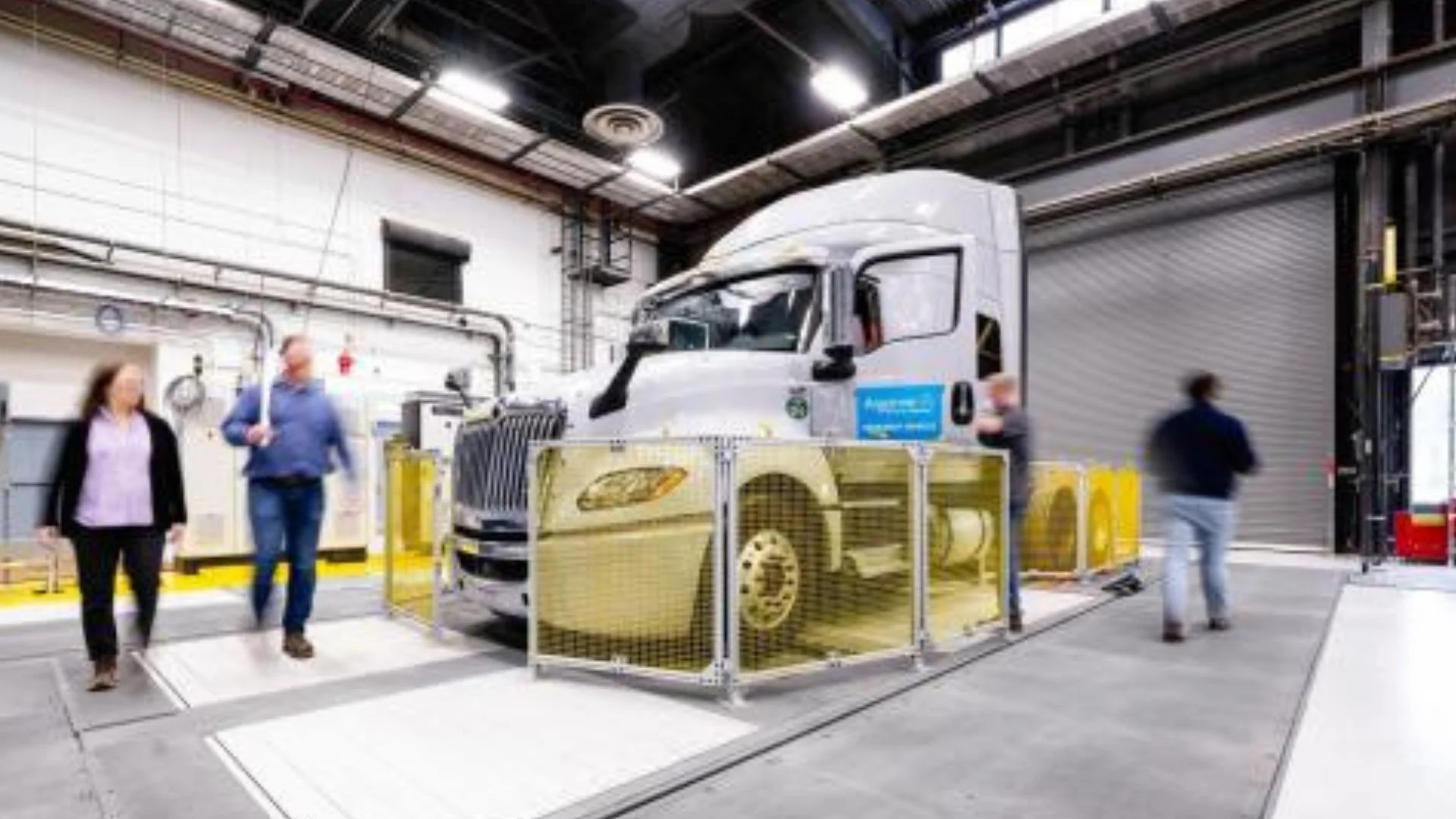
The Argonne National Laboratory has launched a first-of-its-kind national testing facility to accelerate the development of next-generation heavy-duty vehicles.
Backed by the US Department of Energy, the new Heavy-Duty Dynamometer Test Facility aims to accelerate truck innovation, making it faster, safer, and more cost-effective.
The facility is built to support manufacturers and fleet operators who are facing rising challenges. Developing modern trucks is no longer simple. Companies must now test new propulsion systems, fuels, automation, and connected technologies. At the same time, they must deal with strict regulations, high costs, and tight deadlines.
At the heart of the facility is a powerful dynamometer. This system simulates real driving conditions by applying forces to a vehicle’s wheels, just as on actual roads. The goal is to test trucks in a controlled setting while still capturing real-world performance.
READ ALSO: This New MV-75 Tiltrotor Packs Cruise Missiles And Signals a Marine Aviation Reset
What makes this facility unique is how it combines multiple capabilities in one place. It allows full-vehicle testing alongside real-time simulation and corridor-level analysis. This means researchers can study not just a single truck, but how it performs across an entire freight route.
The system also uses advanced energy measurement tools and an automated ‘Anything-in-the-Loop’ workflow. This approach connects simulation and physical testing, allowing engineers to quickly test ideas, refine them, and test again.
The facility is funded through the DOE’s Transportation Technologies Office and is expected to bring major benefits to the freight industry. Shortening development timelines reduces both technical and financial risks linked to new technologies.
Even small improvements can have a big impact. A gain of just 2% to 3% in freight efficiency can save hundreds of millions of dollars over ten years. As these improvements spread across the national fleet, the savings grow even larger.
Claus Daniel, an associate laboratory director at Argonne, highlighted the project’s importance. He said medium- and heavy-duty trucks drive the economy and added that the facility delivers the reliable testing needed to bring new technologies to market and lower transportation costs.
WATCH ALSO: Rolls-Royce tests world’s first high-speed marine engine powered by methanol
The testing center brings together a wide range of advanced tools. It includes a high-performance heavy-duty chassis dynamometer paired with virtual traffic systems, vehicle connectivity platforms, and real-time simulation tools.
Researchers can study everything from propulsion systems and alternative fuels to automation and connectivity technologies. The system allows testing under repeatable conditions, ensuring consistent, reliable results.
The facility supports a wide range of vehicles, including Class 3 to Class 8 trucks. It can handle test weights from 10,001 to 82,000 pounds. It also supports various drivetrain layouts, including rear-wheel drive, front-wheel drive, and all-wheel drive.
A key component is the Burke Porter Model 4701 dynamometer. It features a 4×2 configuration with four rollers and two centrally placed electric machines. This setup provides flexibility and precise control during testing.
The facility is located within Argonne’s Transportation Complex. This strategic location enables it to leverage existing infrastructure while remaining close to other advanced research labs.
It is also designed to grow. Its electrical, mechanical, and data systems can be expanded to support future technologies, including new propulsion systems and higher levels of automation.
Industry partners are encouraged to take part. Companies can work with researchers to test early-stage technologies, develop testing methods, and shape how new freight solutions are validated nationwide. Flexible collaboration options are available for joint research and development projects.
READ ALSO: Binder Fuses Materials Mid-Print for Seamless 3D Parts in Industrial Use
This new testing hub represents a major step toward improving the efficiency and reliability of freight transport in the US. By combining real-world testing with advanced simulation, it gives companies the tools they need to innovate faster and with greater confidence.
As the freight sector continues to evolve, facilities like this will play a key role in ensuring that new technologies are not only developed quickly but also tested thoroughly before reaching the road.