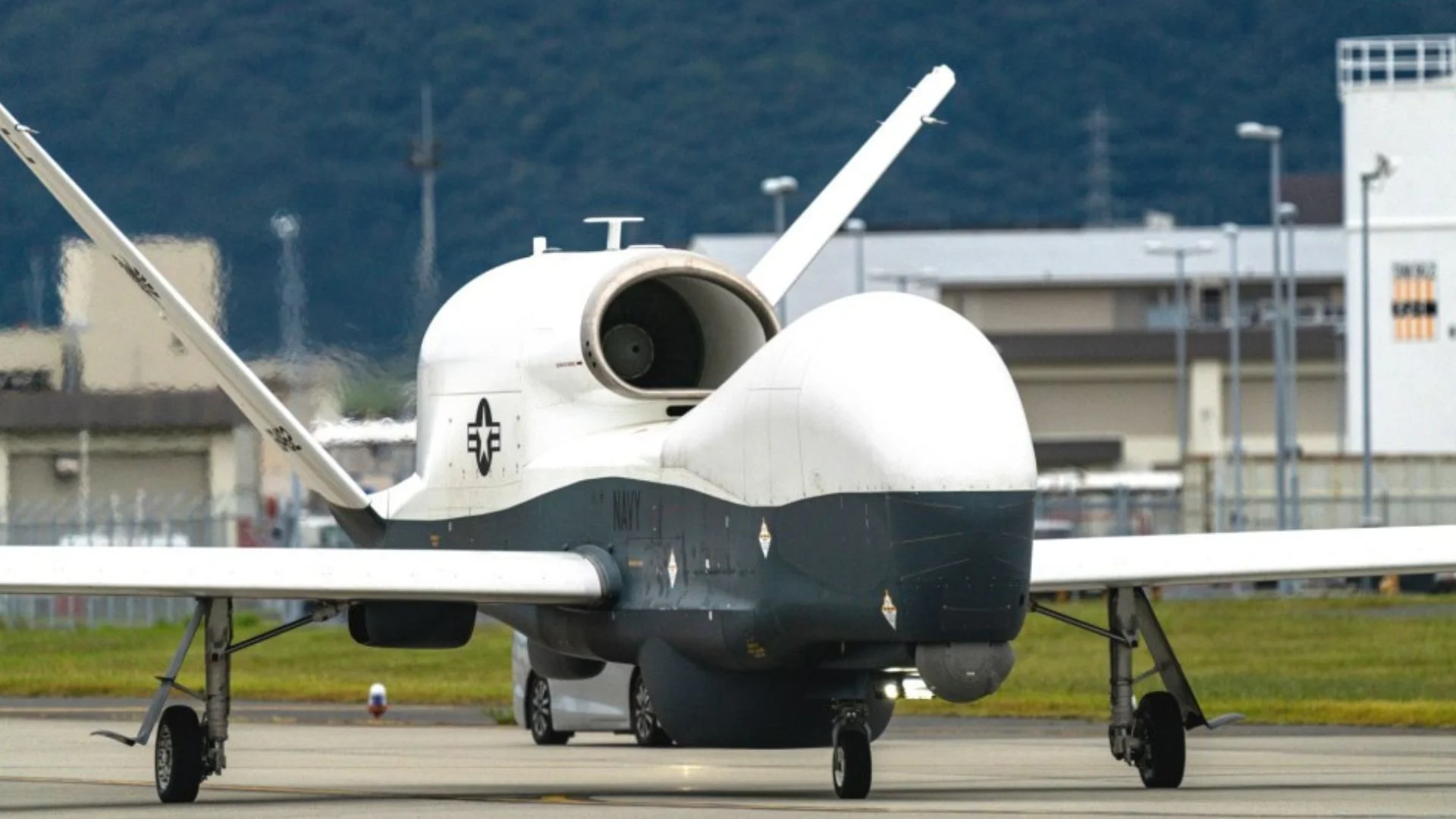
The US Navy has officially confirmed that one of its high-end surveillance drones, the MQ-4C Triton, crashed on April 9 during a mission over the Persian Gulf.
The aircraft suddenly disappeared from public flight-tracking systems, sparking speculation about its fate for days. Now, the Navy has acknowledged the incident, but many key details remain unclear.
According to a newly released mishap summary from the Naval Safety Command, the drone crash has been classified as a “Class A mishap.” This is the most serious category and includes incidents that involve damages exceeding $2 million, loss of life, or permanent injury. In this case, the Navy confirmed that no personnel were injured.
The report entry was brief but direct: “MQ-4C crashed, no injury to personnel,” with the exact location withheld for operational security reasons.
READ ALSO: Squire WIG Drone’s Low-Altitude 40-Knot Flight Signals New Way To Move And Fight
The Triton drone is a highly valuable asset. Each unit costs more than $238 million, making the loss significant. As of 2025, the Navy had 20 such drones in service, with plans to expand the fleet further.
The aircraft was last seen flying over international airspace in the Persian Gulf. It had reportedly completed a surveillance mission and was heading back toward its base at Naval Air Station Sigonella in Italy when something went wrong.
Flight-tracking data showed a sudden, dramatic drop in altitude. The drone fell from around 50,000 feet to below 10,000 feet in a short span of time. Shortly before disappearing, it transmitted emergency signals.
The drone’s transponder first broadcast the code “7700,” which indicates a general in-flight emergency. Earlier, there were also reports that it had sent out a “7400” code, which typically signals a loss of communication between the drone and its ground controllers.
However, these codes do not reveal the exact nature of the problem. They only confirmed that something serious had occurred on board.
WATCH ALSO: EHang’s next-gen autonomous eVTOL completes first public flight
The exact crash location is still unknown. While the drone was flying toward Iran, there is no evidence it entered Iranian territory. The Navy has not shared any information about whether recovery operations are underway. This uncertainty raises concerns about the sensitive technology onboard the drone.
The MQ-4C Triton is packed with advanced surveillance systems. It carries a powerful active electronically scanned array (AESA) radar, high-resolution electro-optical and infrared cameras, and electronic intelligence systems designed to gather signals from the environment.
These systems allow the drone to monitor vast ocean areas for long periods. They are especially useful for tracking ships, monitoring choke points such as the Strait of Hormuz, and collecting intelligence without detection.
The drone is built by Northrop Grumman and is based on the RQ-4 Global Hawk design. However, the Triton is specially modified for long-duration maritime missions, making it a key tool in naval surveillance operations.
In recent years, the Navy and Northrop Grumman have also been working to upgrade their intelligence-gathering capabilities, particularly their signals intelligence systems. If any of these systems are recovered by an adversary, it could pose a serious intelligence risk. Even partial recovery of the wreckage could provide valuable insights into US surveillance technology.
READ ALSO: KAIST Robot That Sees Terrain And Chooses Its Own Path Conquers Obstacles With Ease
While there is no indication that the drone was brought down by hostile action, the situation remains sensitive. In the past, similar incidents have led to geopolitical tensions.
In 2019, Iran shot down a US Navy RQ-4 Broad Area Maritime Surveillance Demonstrator drone over the Gulf of Oman. The wreckage was later displayed publicly, turning the incident into a propaganda moment.
The Triton is a more advanced version of that earlier drone, which adds to concerns about the potential recovery of its components. The crash also comes at a tense time in the region. The Persian Gulf and the Strait of Hormuz remain key waterways for global oil shipments. The US military has been actively monitoring the area amid a fragile ceasefire with Iran.
Triton drones are considered essential for maintaining situational awareness in this region. They provide real-time intelligence and help ensure the safe flow of maritime traffic through these strategic routes.
WATCH ALSO: China commissions world’s largest open-sea offshore solar photovoltaic project
Another MQ-4C Triton was tracked flying a routine mission over the Persian Gulf shortly after the crash. This was the first such flight visible on tracking systems since April 9.
This gap in activity suggests a temporary pause in operations following the incident. The Navy has not confirmed whether this pause was directly related to the crash. It has also not provided further details about what caused the drone to fail mid-flight.
For now, the crash remains a mystery. What caused the sudden loss of altitude? Was it a technical failure, a communication breakdown, or something else entirely? Until more information is released, the loss of the MQ-4C Triton raises more questions than answers.