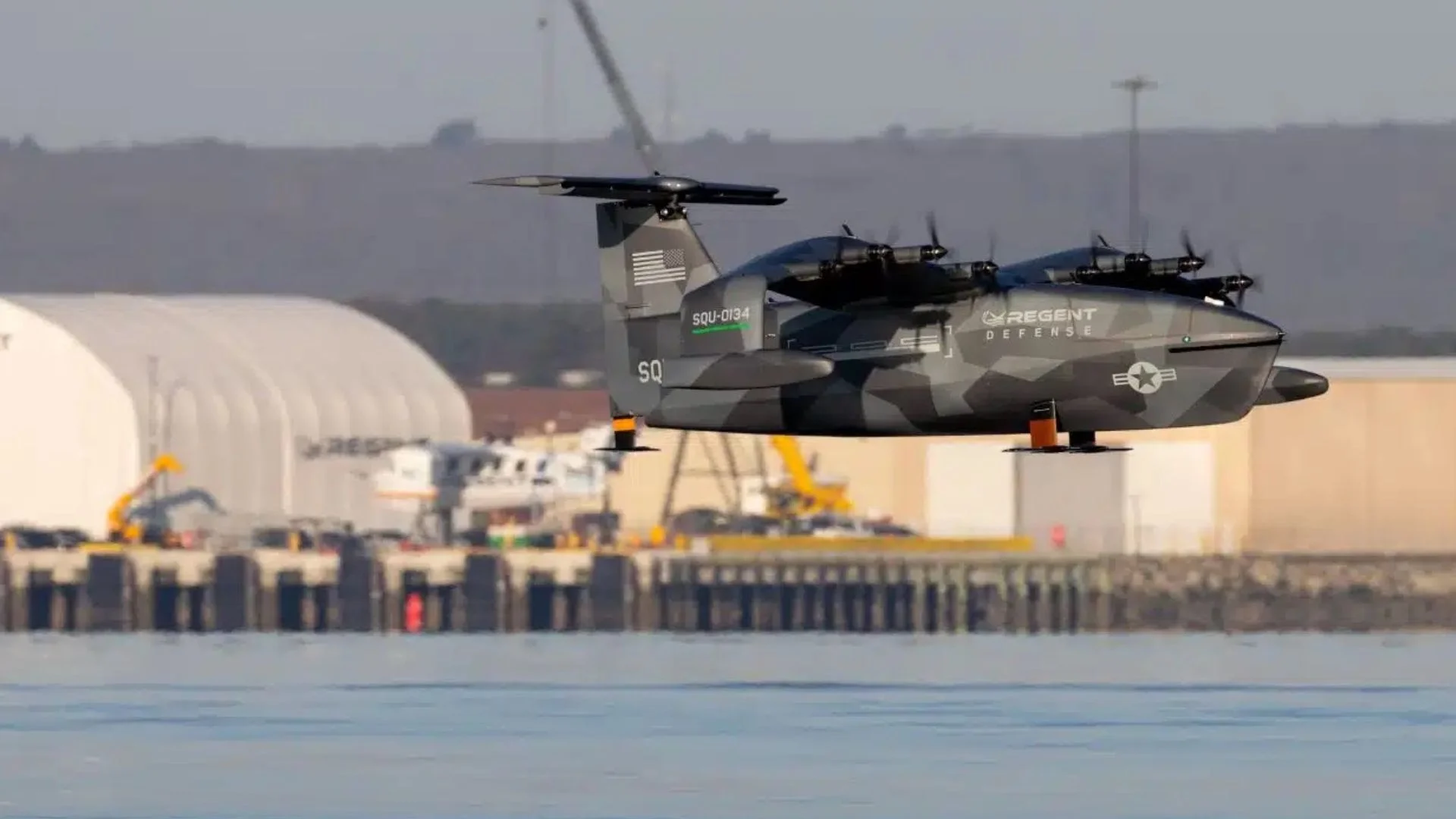
The Regent Squire, a Wing-in-Ground (WIG) effect drone, has completed its first test flight as a scale model.
While still early in development, this aircraft is already drawing attention from the US Marine Corps, which is closely watching its progress.
The Squire is not just another drone. It is being presented as the world’s first ‘Unmanned Surface and Aerial Vehicle’ (USA-V). This means it can operate both on water and in the air, combining the features of ships and aircraft into a single platform.
Regent says the Squire is designed for multiple missions. These include intelligence, surveillance, and reconnaissance (ISR), logistics, transport, and combat search and rescue (CSAR). It may also support counter-narcotics missions and anti-submarine warfare.
READ ALSO: THAAD Kill Vehicle Found Intact in Syria: What Secrets Did It Leave Behind?
Squire: A Different Way To Fly
What makes the Squire unique is how it flies. It uses the wing-in-ground effect, a concept that has existed for decades but has rarely succeeded in military use.
Instead of flying high like traditional aircraft, the Squire stays very close to the water. It travels at an altitude of about one wingspan above the surface. At this height, the air becomes denser and creates a cushion beneath the wings. This increases lift and reduces drag.
This effect allows the drone to move faster and more efficiently while using less energy. It also avoids the need for long runways, making it useful in remote or contested areas.
Before taking off, the Squire uses hydrofoils to rise above the water. Once it reaches the right speed, it transitions smoothly into flight. After becoming airborne, the hydrofoils retract.
The first test flight took place in Narragansett Bay, Rhode Island. A scale model of the Squire demonstrated all three stages of operation.
WATCH ALSO: Wing expanding drone delivery to additional Walmart stores in US city
It started by floating on the water. Then it moved into hydrofoiling mode, gliding above the surface. Finally, it lifted off and flew at low altitude.
According to the company, the drone reached speeds of up to 40 knots during the test. Two support boats followed the aircraft as it completed its flight. Though the distance covered was not disclosed, the demonstration proved that the concept works in real-world conditions.
The full-scale Squire is expected to carry a payload of up to 50 pounds. It will have a range of around 100 nautical miles and a top speed of about 80 knots.
Inside, the drone includes a flexible payload bay. The compartment measures 14 inches long, 12 inches high, and 14 inches wide. This gives a total internal volume of about 2,400 cubic inches.
The company says this space can carry logistics supplies, ISR equipment, or mission-specific cargo. It has also designed the system so that a small team can quickly reconfigure the payload.
“We are designing the payload interfaces so that a two-person crew with minimal training can reconfigure it as mission needs change,” the company said.
Why The Military Is Interested
The interest from the US Marine Corps Warfighting Laboratory is not surprising. The military is preparing for future conflicts that may occur across vast ocean regions, especially in the Pacific.
In such scenarios, forces are expected to be widely spread out. Many units may operate from remote islands or areas without proper infrastructure.
READ ALSO: IIT Gandhinagar Simplifies Flexible Robot Control with Low Computation
Traditional aircraft and ships may struggle to support these operations. They are often expensive, require established bases, and can be vulnerable to enemy attacks.
The Squire offers a different approach. It can move quickly over water, stay low to avoid detection, and operate without runways. This makes it useful for delivering supplies, gathering intelligence, or rescuing personnel in difficult environments.
A Broader Push For WIG Technology
The Squire is part of a larger US military effort to explore WIG technology. The Marine Corps Warfighting Lab has received additional funding to study hydrofoiling WIG systems.
This is not the first time the military has looked at such designs. In the past, the Defense Advanced Research Projects Agency launched the Liberty Lifter X-plane program. The goal was to build a massive transport aircraft using the same principle.
However, the program faced major challenges and was eventually canceled. Manufacturing difficulties and technical issues made it harder than expected.
“About 70% of programs don’t meet their metrics,” said Stephen Winchell, director at DARPA. He explained that moving cargo quickly across large areas remains a difficult problem.
Despite the setback, DARPA continues to work with industry partners. It aims to apply lessons learned from the project to future systems.
Wing-in-ground effect vehicles are not new. The Soviet Union developed several large WIG craft, known as ekranoplans, during the Cold War.
These vehicles showed promise but never became widely used. Operational challenges and limited flexibility held them back.
In recent years, other countries have also explored similar ideas. China has revealed its own WIG craft, which appears similar in scale to its AG600 amphibious aircraft. However, its current status remains unclear. This history shows that while the concept is attractive, turning it into a reliable military system is not easy.
WATCH ALSO: Buildroid AI expanding simulation-first robotic platform to multiple US sites
The Squire is still in its early stages. It is not yet an official military program. However, more tests are planned in the coming months.
The company aims to showcase the drone at Silent Swarm 26, a two-week event focused on emerging technologies. A full-scale test flight is also planned for later this summer.
Matthew Koch from the Marine Corps Warfighting Lab said more details will be shared after these demonstrations.
“If the technology proves itself during Silent Swarm and the full-size flight, I will explain how the Marines plan to use it in the Pacific,” he said.
There are also signs of interest from the broader defense leadership. In February, US War Secretary Pete Hegseth visited Regent’s headquarters. During the visit, he emphasized the need for new ideas and faster innovation.
“We want capabilities that drive what we field, not the way it has always been done,” he said. He added that commanders are ready to adopt new solutions if they can quickly fill critical gaps.
READ ALSO: Spain’s Indra Unlocks Ka-Band for Submarines, Changing Naval Communication
This kind of support could help accelerate the development of the Squire if it proves successful.
However, the Squire remains an experimental platform. But its early success has placed it on the radar of military planners. The need for fast, flexible, and survivable transport systems is growing. Especially in a future where conflicts may span vast ocean regions.
Squire’s combination of speed, efficiency, and low-altitude flight sets it apart for emerging maritime needs, but real-world proof of reliability, scalability, and performance is essential.
If successful, Squire could transform maritime operations, blending airborne speed with surface proximity. The industry is watching to see if it can truly deliver on its promise.