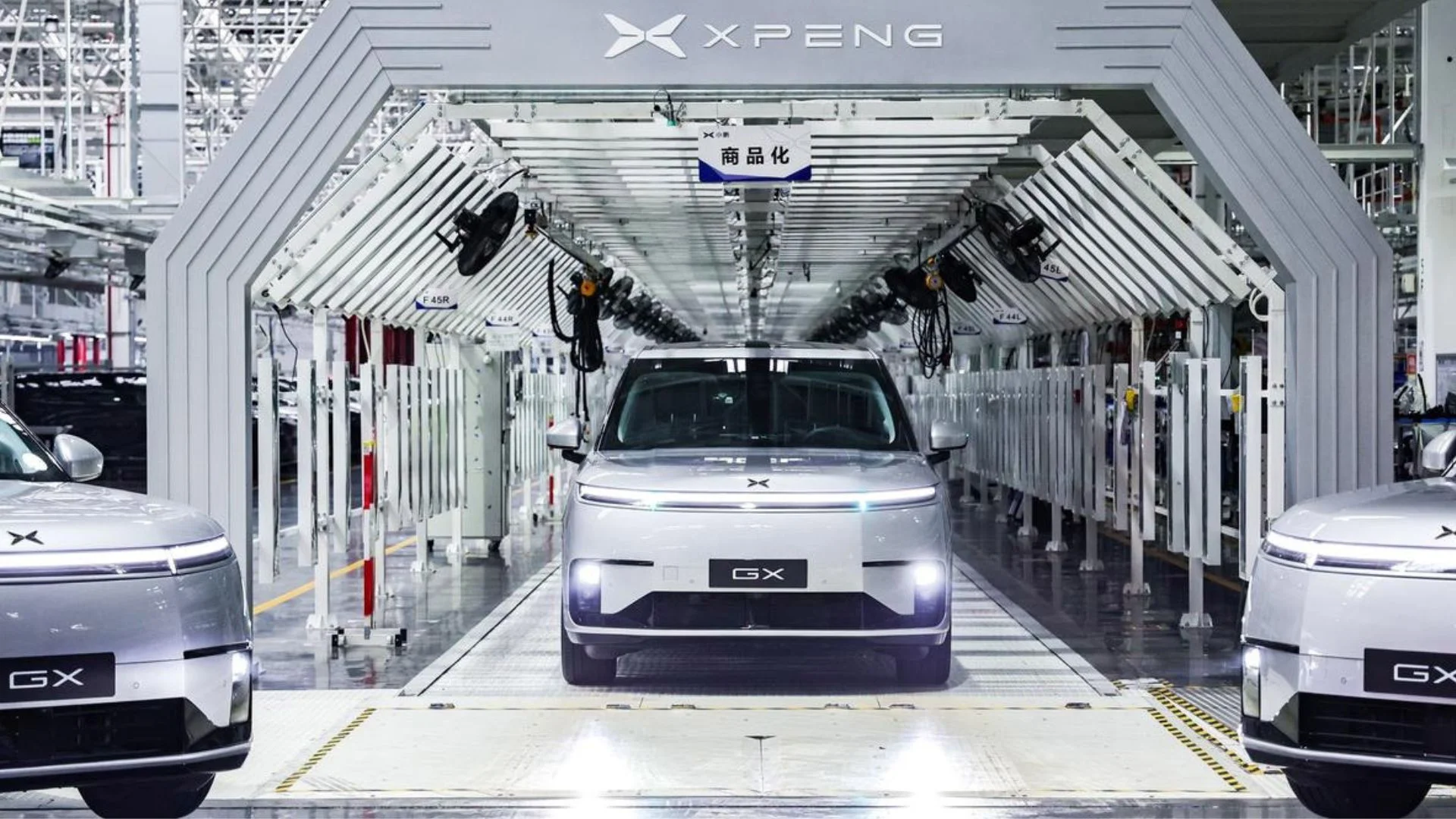
Chinese EV maker XPeng has started mass production of its first robotaxi designed for public road use.
The autonomous vehicle was built at the company’s Guangzhou production facility and uses XPeng’s latest AI driving system. It is based on the GX platform that already supports one of XPeng’s consumer SUVs.
The launch marks a major step in China’s race to expand self-driving transport services.
The robotaxi uses four high-performance chips to process driving data in real time. The system delivers 3,000 teraoperations per second, powering XPeng’s VLA 2.0 artificial intelligence model. The company said the vehicle can react to road conditions in less than 80 milliseconds.
XPeng Robotaxi Drops LiDAR for AI Driving System
Unlike many self-driving vehicles, XPeng’s robotaxi does not depend on expensive LiDAR sensors. Instead, it uses cameras to monitor the environment and understand traffic conditions. The system also works without relying heavily on pre-loaded high-definition road maps.
XPeng said the updated software performs far better than earlier versions. The company reported faster decision-making and smoother ride quality during testing. It also claimed the vehicle handles difficult traffic situations with fewer human takeovers.
READ ALSO: Four Out of Five Defence Decision Makers Put AI First
Safety remains a top priority for the project. XPeng built the robotaxi with a six-layer backup system covering key components such as steering, braking, and computing. The vehicle also uses Bosch drive-by-wire steering technology designed for fully autonomous operation.
Using the same platform for both robotaxis and consumer SUVs helps reduce manufacturing costs. XPeng expects production costs to stay below 200,000 yuan per vehicle. Lower pricing could help the company expand robotaxi services more quickly across Chinese cities.
Smart Cabin and Public Road Testing Plans
Inside the vehicle, XPeng designed the cabin to focus on passenger comfort and automation. The robotaxi includes privacy glass and adjustable seats inspired by premium vehicle designs. Rear entertainment displays allow passengers to watch videos during trips.
Most functions inside the cabin are controlled through voice commands. Riders can change lighting, temperature, and other settings without using physical buttons. XPeng also plans to offer five-seat, six-seat, and seven-seat versions of the vehicle.
The company received approval in January to test its Level 4 autonomous driving technology on public roads in Guangzhou. Level 4 systems can handle driving tasks independently in certain conditions without human control. In March, XPeng created a dedicated robotaxi division to accelerate development and deployment.
XPeng plans to launch its first public test program during the second half of 2026. Early services will include a safety driver inside the vehicle to monitor operations and collect data. The company expects fully driverless operations to begin in 2027.
WATCH ALSO: United Launch Alliance’s Atlas V rocket delivers success for Amazon Leo
XPeng is also opening parts of its software platform to outside developers. Amap, backed by Alibaba Group, has already partnered with the project for ride-hailing and route-planning services. The partnership gives XPeng access to Amap’s large user base across China.
China’s autonomous vehicle market is turning competitive as companies push to commercialize robotaxi services. XPeng’s move into factory-scale production shows how automakers are shifting from small pilot projects toward broader deployment. The success of these early services could shape the future of urban transportation and AI-powered mobility in the coming years.