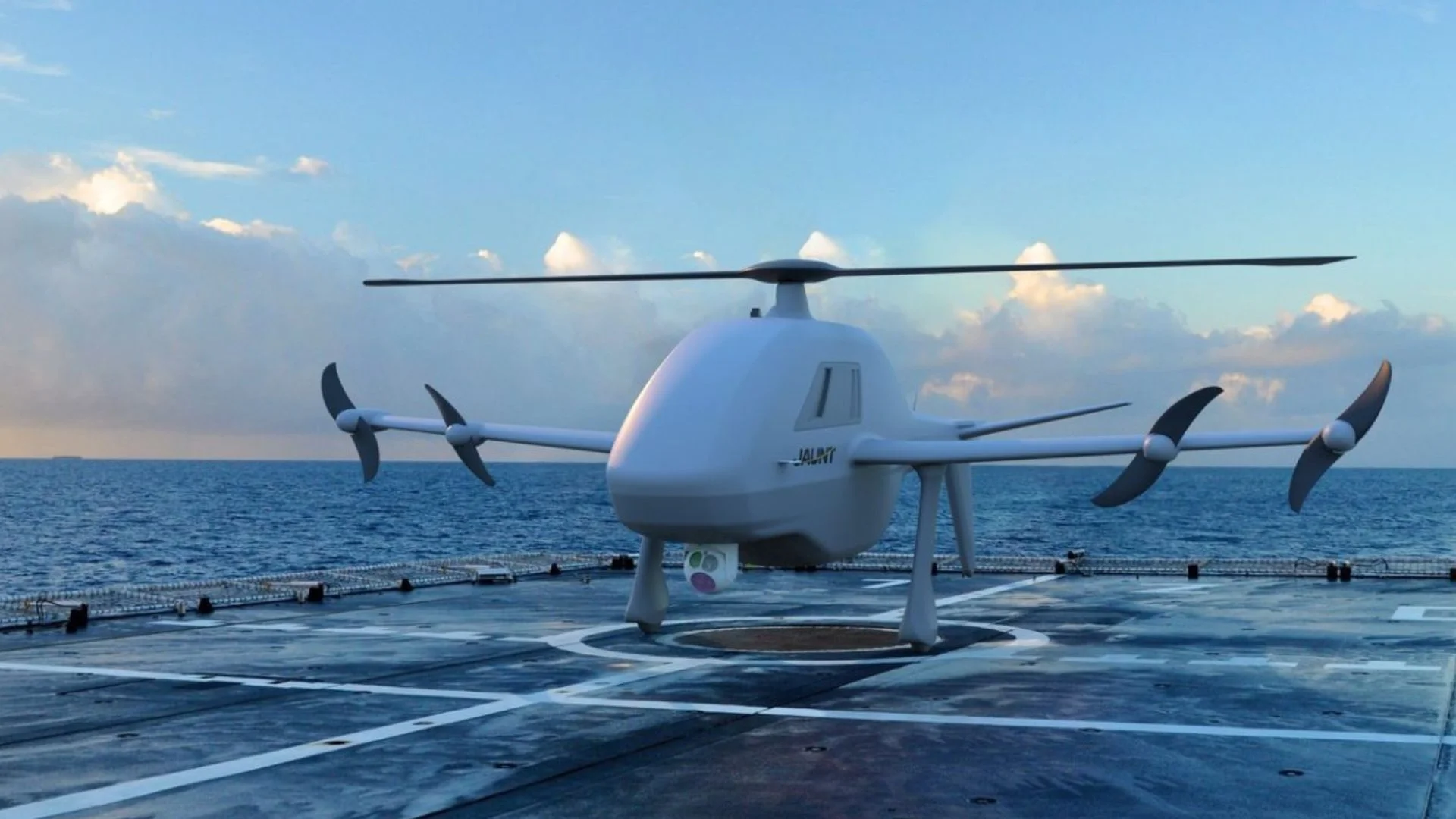
AIRO Group and its air mobility division, Jaunt Air Mobility, introduced two new dual-use aircraft at the Xponential/MDEX conference.
The company revealed the JC250 cargo aircraft and the JX250 intelligence, surveillance, and reconnaissance variant. Both aircraft feature vertical takeoff and landing capability and hybrid-electric propulsion.
The company designed the aircraft for military, government, and commercial operations. Executives said the platform focuses on missions where traditional aircraft or ground vehicles face limitations. The drones are being developed and manufactured in Canada.
AIRO expects the aircraft’s first flight before the end of the year. Certification work will follow after early testing begins. The company also plans to make the platform compatible with the US military’s Blue UAS program.
AIRO Unveils Hybrid VTOL
Company executives said hybrid propulsion is one of the aircraft’s key strengths. The system combines electric motors with an internal combustion engine. This setup allows the aircraft to travel long distances while also generating onboard power.
READ ALSO: Europe Unites Under ATM Master Plan for Smarter, Cleaner Airspace
John Uczekaj, President and COO of AIRO, said the hybrid system improves operational versatility in remote areas. He explained that operators cannot always depend on the charging infrastructure during military or rural missions. The fuel-powered engine helps recharge the aircraft while extending the flight range.
The company estimates the aircraft’s normal operating range at around 300 to 500 nautical miles. AIRO also said the range can stretch to nearly 1,000 nautical miles under certain operating conditions. That range is significantly higher than that of many electric-only VTOL aircraft currently under development.
Slowed Rotor Technology Improves Endurance
A major feature of the aircraft is AIRO’s patented slowed-rotor design. The system uses a large rotor for vertical takeoff and landing like a helicopter. Once airborne, the rotor slows down during forward flight to improve efficiency.
AIRO executives explained that traditional helicopters consume significant power while flying forward. Helicopter rotors are highly effective for vertical lift but less efficient for long-distance travel. The slowed-rotor system reduces that problem by allowing the rotor to act more like a fixed wing during cruise flight.
Martin Peryea, AIRO’s senior vice president and general manager of electric air mobility, said the design increases endurance during ISR missions.
According to him, the JX250 can remain airborne for 15 to 18 hours during surveillance operations. He added that no current VTOL aircraft combines vertical lift with that level of endurance.
READ ALSO: Chinese Geologists Discover Third 1,000-Tonne Gold Belt in Sacred Kunlun Mountains
The ISR version displayed at the conference carried a surveillance camera mounted underneath the aircraft. The cargo version uses a removable pod attached below the fuselage. This design allows operators to switch between cargo delivery and surveillance roles more easily.
The aircraft can operate without traditional runways, which is important for military and remote-area operations. Vertical takeoff capability allows the drone to land closer to frontline units or isolated communities. That reduces dependence on airports and prepared landing strips.
The platform also supports operations in difficult terrain or disaster-hit areas. Emergency response teams can use it to move supplies, medical equipment, or communications systems. Commercial operators can also use the aircraft for cargo delivery in regions with weak transport infrastructure.
AIRO said the aircraft mainly targets the middle-mile logistics segment. In military operations, this refers to the transport of supplies between large supply hubs and forward-deployed forces. That area is often difficult to support because roads are vulnerable, and helicopters are limited in number.
Military planners want autonomous and unmanned systems to reduce personnel risks. Cargo drones can deliver supplies without exposing crews to hostile conditions. Hybrid VTOL systems also offer lower operating costs compared to many traditional helicopters.
The growing global focus on autonomous logistics has increased the interest in VTOL aircraft. Governments and defense companies have invested in systems that combine long-range with flexible landing capability. Hybrid propulsion is becoming an important option, because it reduces dependence on charging stations.
Commercial industries are also exploring hybrid electric aircraft for regional delivery operations. Remote communities, mining sites, offshore platforms and medical services often experience transport delays due to poor infrastructure. Aircraft that can land vertically while carrying cargo offer a feasible solution to these problems.
WATCH ALSO: China commissions world’s largest 80,000-ton aircraft carrier that has electromagnetic catapults
The new AIRO aircraft enters a contested market where several aerospace companies are developing electric and hybrid VTOL systems. However, endurance and operational range remain major challenges in the sector. The company believes that its slowed-rotor technology gives it an advantage in both areas.
The development indicates a wider shift toward flexible air mobility systems for both civilian and defense use. As military forces and commercial operators demand faster, more reliable transport, hybrid VTOL aircraft are becoming important. AIRO’s upcoming flight tests will now determine how the platform performs in real-world operations.