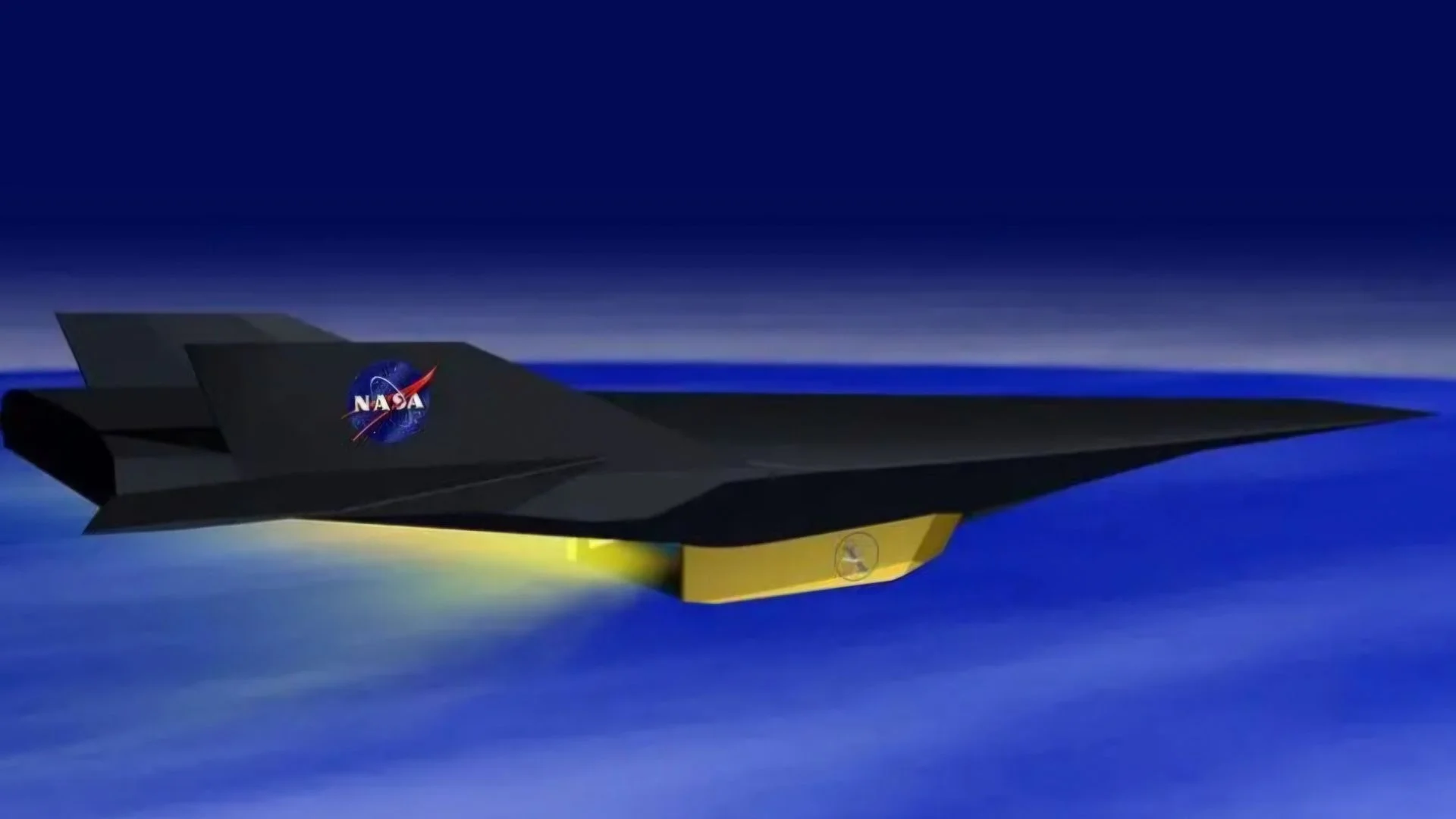
Hypersonic flight is moving closer to becoming a reality as scientists develop aircraft capable of traveling faster than Mach 5, or five times the speed of sound.
Researchers at the University of Central Florida are studying advanced propulsion systems, heat-resistant materials, and airflow behavior to support future hypersonic travel.
The goal is to create aircraft capable of speeds ranging from Mach 6 to Mach 17. At those speeds, a flight from New York to Los Angeles could take less than 15 minutes instead of nearly six hours.
Scientists say hypersonic technology has the potential to transform commercial travel, defense operations, and space missions.
Hypersonic speed begins at around 3,800 miles per hour at sea level, while some experimental systems are targeting speeds above 13,000 miles per hour. Modern passenger planes and even advanced fighter jets operate far below that range today.
Researchers are now working on engines that can operate under the extreme pressure and heat generated during hypersonic flight. Teams are also testing lightweight materials that can withstand temperatures up to several thousand degrees Fahrenheit.
Scientists believe that combining propulsion, materials science, and advanced computer modeling is key to making practical hypersonic travel possible.
READ ALSO: Ancient Aussie Fly Rewrites Evolution’s Map: 150-Million-Year-Old Fossil Challenges Where Life Began
The impact of this technology extends far beyond passenger travel. Emergency supplies could move across continents within minutes. Military systems and satellite launches could also operate more quickly and flexibly.
Why Hypersonic Speed Creates Extreme Challenges
Travelling at supersonic speed changes how air behaves around a vehicle. The air compresses heavily and reaches extremly high temperatures. In some cases, airflow can even turn into plasma, disrupting communication systems.
These conditions generate strong shock waves around the aircraft. Shock waves are sudden changes in pressure and temperature caused by objects moving faster than the sound speed. At supersonic speeds they become much stronger and more dangerous.
Researchers say even tiny objects can become major threats during flight. Michael Kinzel explained that a small raindrop hitting a vehicle travelling at Mach 8 can generate forces equivalent to the mass of an elephant. That impact produces pressure waves that slowly damage surfaces over time.
The thin layer of air in contact with the aircraft also becomes unstable at extreme speeds. Scientists call this the boundary layer. Changes in this layer directly affect engine performance and heat levels across the vehicle.
Heat is one of the biggest problems in hypersonic flight. Unlike traditional aircraft, most of the heat does not come from the engine itself. Instead, it forms as the aircraft compresses air in front of it during flight.
Temperatures in some parts of the aircraft can reach 3,500 to 5,000 degrees Fahrenheit. Those temperatures are hot enough to weaken or destroy many common aerospace materials. This means engineers must design vehicles that withstand both high speed and high heat simultaneously.
WATCH ALSO: ISRO successfully conducts test of main parachutes for Gaganyan Crew module
Researchers at UCF’s Composite Materials and Structures Laboratory are studying advanced ceramic and carbon-based materials. These materials are engineered to remain strong while remaining lightweight. Weight is important because heavier aircraft need more energy to fly.
Cooling systems are equally important in hypersonic design. Scientists are studying ways to move heat away from the aircraft’s hottest sections before structural damage occurs. Some researchers are testing supercritical carbon dioxide systems that circulate cooling fluid through sensitive areas.
Engines, Control Systems and Future Impact
Traditional jet engines are not designed for hypersonic flight. Most engines slow the incoming air before combustion. At hypersonic speeds, slowing the air creates too much heat and drag.
To solve this problem, engineers are developing scramjets. These engines allow air to stay supersonic while fuel burns inside the engine. That process creates a major challenge because fuel must ignite and release energy within milliseconds.
Researchers are also exploring detonation-based propulsion systems. Instead of steady combustion, these engines use controlled explosions to generate thrust. Scientists believe this method can produce higher efficiency at extreme speeds.
Kareem Ahmed and his team are developing a hypersonic detonation rocket engine at UCF. Their work focuses on stabilizing detonations long enough to create continuous thrust. Experiments at the HyperREACT facility have already extended these reactions beyond the millisecond range.
Keeping a hypersonic vehicle stable is another major challenge. At these speeds, airflow, heat, materials, and propulsion systems all influence one another. A small problem in one area can quickly affect the entire aircraft.
Researchers studying structural fatigue are examining how constant vibration damages materials over time. Repeated stress can slowly weaken aircraft structures until failure occurs. Engineers must balance durability with low weight to maintain performance.
Some teams are testing origami inspired structural designs to reduce mass while maintaining strength. These folded spatial formations help to distribute stress more efficiently. Lightweight designs are important, because hypersonic systems already face high thermal and airfoil loads.
Testing these technologies is extremely difficult and expensive. Standard wind tunnels cannot reproduce the temperatures and pressures experienced during hypersonic flight. Specialized facilities are required to simulate these environments for short periods.
UCF researchers use the High-Hypersonic Enthalpy Facility(HiHYPER) to study airflow and material behavior under extreme conditions. These tests provide limited snapshots rather than full flight simulations. Scientists combine those experiments with advanced computer models to improve predictions.
READ ALSO: Chinese Scientists Decode How Snow Controls Permafrost on the ‘Roof of the World’
Computational fluid dynamics has become an essential tool in hypersonic research. These simulations help scientists study airflow, shock waves, and combustion behavior before building physical systems. Researchers say simulations save time and reduce development costs, but real-world testing remains necessary.
Governments and aerospace companies around the world are dedicating significant funds to hypersonic technology. Interest has grown because of its potential military, commercial and space applications. Faster transportation systems could eventually reshape logistics, emergency response and global connectivity.
Commercial hypersonic passenger travel is still years from regular operation. Many technical obstacles remain unsolved, especially in materials, cooling and propulsion stability. Safety, infrastructure and operating costs will also play major roles in determining when these aircraft enter service.
Still, researchers believe progress is accelerating as multiple fields of science move forward together. Advances in propulsion, heat-resistant materials, and computational modeling are steadily raising the speed limits.
The race toward practical hypersonic travel is now becoming one of the most important engineering challenges in modern aerospace development.