Researchers from several leading US institutions have developed a new transformer insulation material made from natural wood.
The material combines strong electrical insulation with improved heat management and mechanical strength. Their findings were published in the journal Science Advances.
The project was led by researchers at Yale University along with collaborators from the University of Maryland, the University of Texas at Austin, Brookhaven National Laboratory, the USDA Forest Products Laboratory, and Rensselaer Polytechnic Institute.
The team focused on solving one of the most common causes of transformer failure. Insulation breakdown remains a major challenge for power systems worldwide.
Power transformers are essential components of electricity grids. They help efficiently transmit electricity from power plants to homes, businesses, and industries. Many transformers currently operating in the US are more than 25 years old and are approaching the end of their expected service life.
Growing electricity demand is putting additional pressure on these systems. Data centers, electric vehicles, and renewable energy projects are all increasing power consumption. Utilities are seeking technologies that can improve transformer performance without requiring a complete redesign.
How New Wood-Based Insulation Works
Most large transformers today use oil-impregnated Kraft insulation paper. This technology has existed since the late nineteenth century. It consists of cellulose paper soaked in insulating oil.
READ ALSO: NASA’s Pegasus Rover Set to Drive Artemis Astronauts Across the Moon’s South Pole
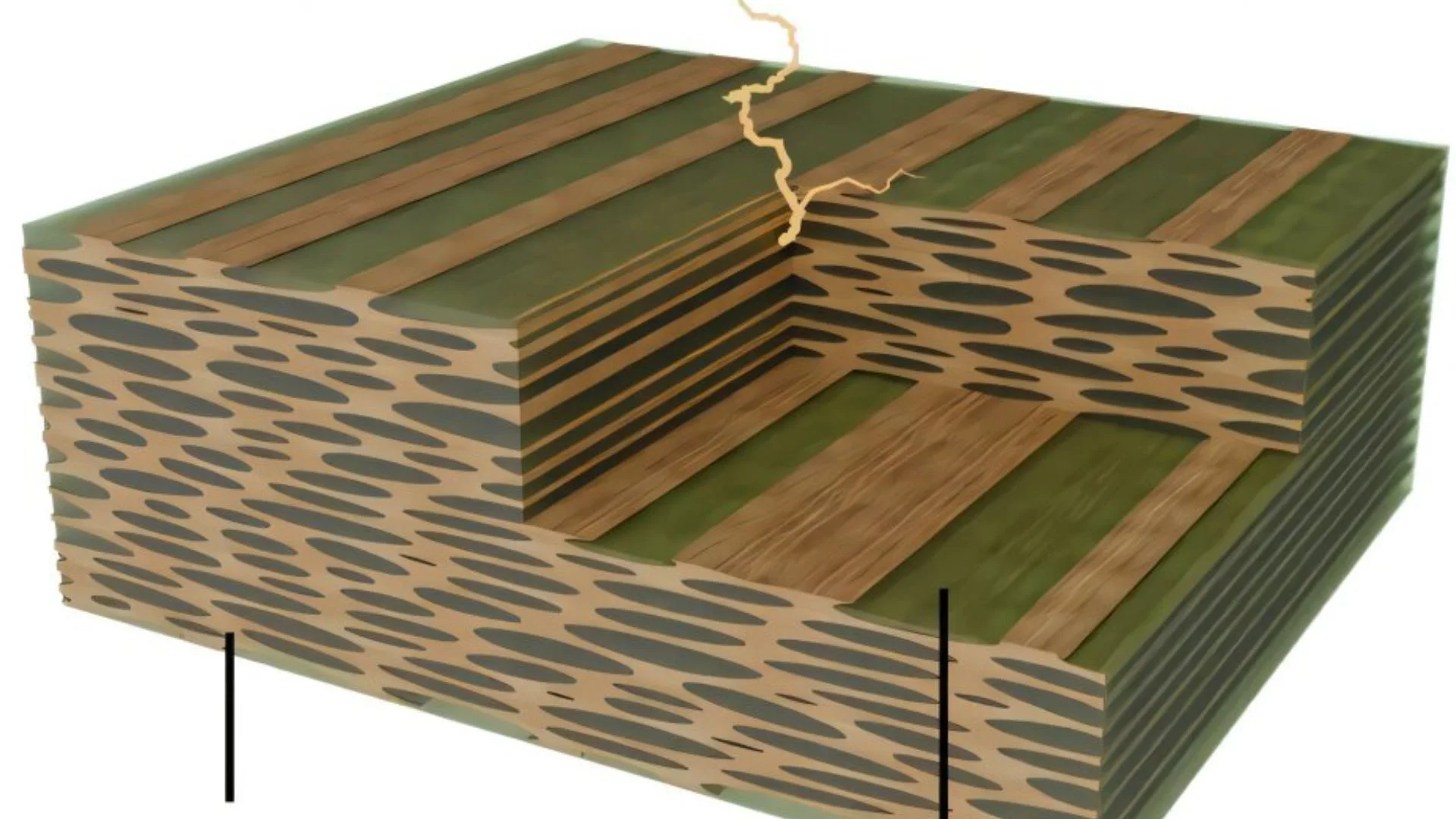
The problem is that oil provides lower electrical resistance than cellulose fibers. Inside conventional insulation, oil forms interconnected pathways. These pathways can facilitate the spread of electrical failures through the material.
The research team chose a different approach. Instead of paper pulp, they started with natural wood veneer, which already has an organized internal structure. This natural arrangement became the foundation for the new insulation design.
Researchers first used a mild alkaline treatment to remove some lignin and hemicellulose from the wood. These are natural compounds found inside plant cell walls. The treated wood was then soaked in insulating oil and compressed under high pressure.
This process created a material called oil-impregnated densified wood(ODW). During compression, the larger channels inside the wood became much smaller. The result was a network of isolated nano-sized oil channels surrounded by dense cellulose walls.
These tiny channels prevent electrical breakdown from traveling continuously through the material. In simple terms, the insulation blocks the spread of electrical failures more effectively than conventional designs. This gives ODW much stronger insulating performance.
Yale University researcher Liangbing Hu said the work transforms wood’s natural structure into a carefully engineered insulation architecture. He explained that the design can help modernize aging electrical infrastructure. The approach uses renewable materials while improving performance.
Better Cooling and Longer Equipment Life
The benefits of ODW extend beyond electrical insulation. The material also performs better under physical stress and transfers heat more efficiently. These characteristics are important because transformers generate significant heat during operation.
READ ALSO: Chinese Researchers Improve Robot Joint Ball Screw Manufacturing for Next-Gen Humanoid Robots
Tests showed that ODW has a tensile strength 3.5 times greater than high-density conventional insulation paper. Stronger insulation can better withstand the mechanical forces generated inside transformer windings. This reduces the risk of damage during long-term operation.
The material also demonstrated 1.6 times higher thermal conductivity through its thickness. Better heat transfer allows transformers to release heat more effectively. Lower operating temperatures help slow material degradation and improve equipment lifespan.
Researchers conducted accelerated-aging tests at 150 degrees Celsius for 6 weeks. After testing, ODW retained more than 70 percent of its original tensile strength. Even after aging, its strength remained higher than that of conventional insulation materials.
To evaluate real-world performance, the team built a planar transformer using ODW as its insulation enclosure. The prototype was compared with a transformer using standard plastic insulation. Under operating conditions, the ODW version ran about 10 degrees Celsius cooler.
Lower temperatures are important because heat is one of the main factors that shortens transformer life. Cooler operation can reduce maintenance requirements and improve reliability. This can help utilities avoid costly outages and equipment replacements.
The researchers also emphasized the practicality of manufacturing the material. The process is compatible with industry-standard roll-to-roll production methods. Different wood species, including basswood and balsa, can also be used as raw materials.
WATCH ALSO: Engineers from Australia have introduced a spray that enhances the fire-resistance of clothing
The technology may find applications beyond traditional oil-filled transformers. Researchers believe the same design principles can be applied to dry-type transformers, electric motors, and printed circuit boards. In these systems, aligned nanochannels can improve insulation performance while maintaining efficient heat flow.
The new nanoengineered wood insulation offers a scalable and environmentally friendly solution. Future adoption of the technology could help utilities build longer-lasting transformers capable of supporting growing energy demands for decades to come.