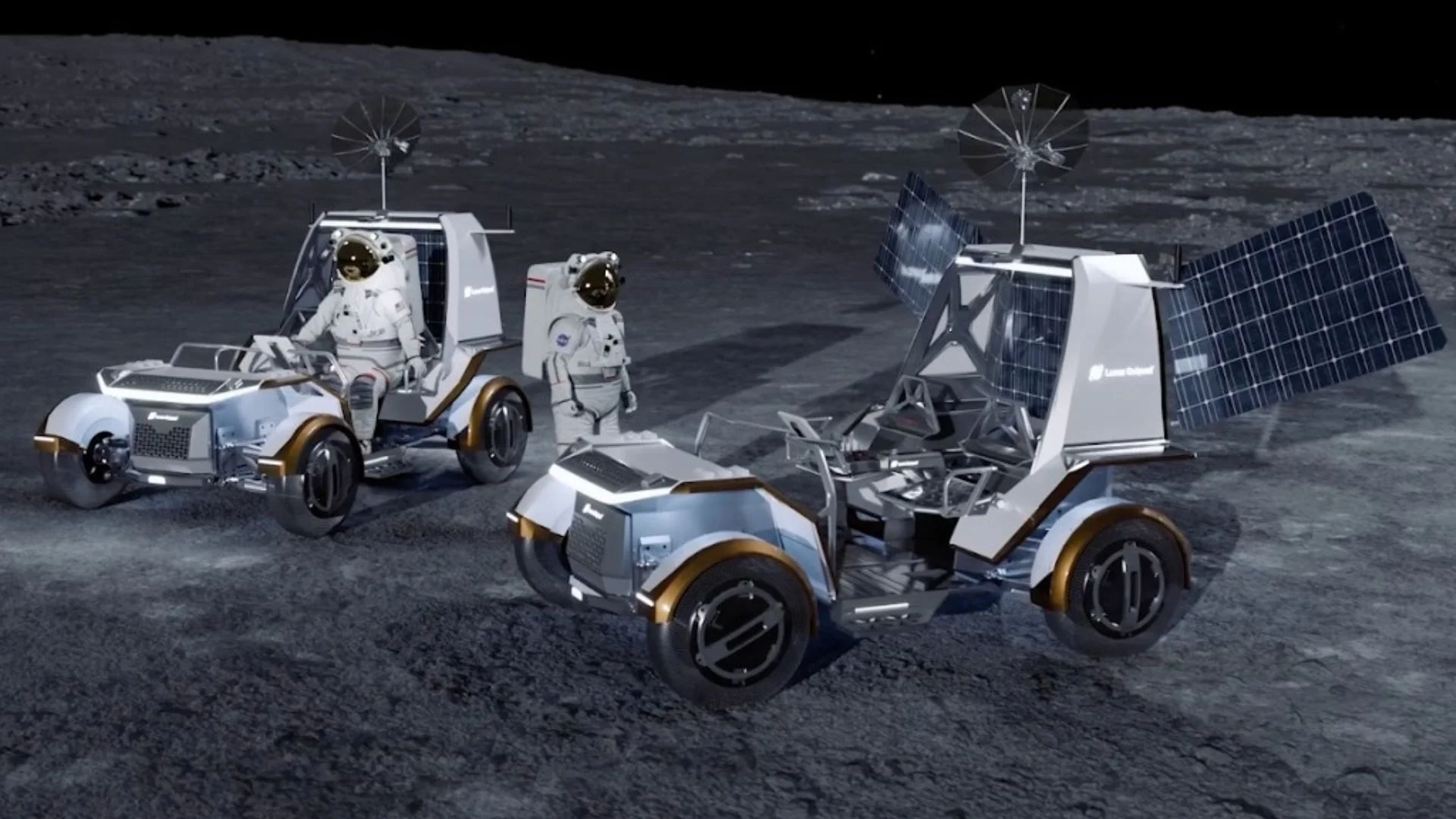
NASA is preparing for a new era of lunar exploration with the Pegasus rover. The vehicle is being developed by Lunar Outpost as part of the agency’s Lunar Terrain Vehicle Services program.
Pegasus is designed to carry astronauts across the Moon’s challenging south polar region. The rover is expected to begin supporting Artemis missions around 2028.
The Moon’s south pole has become a major focus for exploration. Scientists believe the region contains water ice trapped inside permanently shadowed craters.
That ice could play an important role in future lunar missions. It can potentially be used for drinking water, oxygen production, and rocket fuel.
To support these goals, NASA needs vehicles that can travel farther and operate longer than previous lunar rovers. Pegasus was designed specifically to meet those demands.
Lunar Outpost received a contract worth up to $220 million to develop the flight-ready vehicle. The company is working alongside several industry partners to complete the project.
READ ALSO: Thales and KNDS France Unveil RAPIDFire Land: New Ground-Based Variant of 40mm Naval Defence System
Lunar Outpost’s Pegasus Rover
Pegasus is based on lessons learned from Lunar Outpost’s earlier Eagle rover concept. Engineers created a smaller, lighter design while maintaining key performance capabilities.
The rover features a compact layout that stays within NASA’s launch constraints. Two astronauts can sit side by side with a clear view of the terrain ahead.
Its design also makes entering and exiting the vehicle easier. This is important when astronauts are wearing bulky spacesuits.
While the rover resembles the Apollo-era lunar vehicle in some ways, its capabilities are far more advanced. Modern electronics, navigation systems, and autonomous functions significantly expand what astronauts can accomplish.
One of Pegasus’ most notable features is its operating range. Lunar Outpost says the rover can travel up to 900 kilometers on a single battery system under planned mission conditions.
The vehicle is also designed to remain operational for up to one year after reaching the lunar surface. That endurance allows it to support multiple missions and tasks.
Pegasus has a top speed of about 15 kilometers per hour. Although that speed sounds modest, it is suitable for the Moon’s rugged and uneven terrain.
The lunar surface contains loose dust, steep slopes, and countless impact craters. Safe navigation is often more important than high speed.
Power comes from advanced battery technology derived from General Motors’ electric vehicle systems. These batteries have been adapted to survive the harsh environment of space.
The lunar environment presents unique challenges. There is no atmosphere, temperatures vary dramatically, and equipment must operate reliably for extended periods.
General Motors is one of several companies supporting the project. Tire manufacturer Goodyear contributed specialized lunar tires designed to handle abrasive lunar soil.
READ ALSO: Liquid crystal structures key to organic solar cell performance, study finds
Engineering company Leidos is also involved in the program. Its role includes systems engineering and integration support.
Autonomy, Flexibility for Moon Bases
Pegasus is being built with multiple operating modes. Astronauts can drive the rover directly during exploration activities.
The vehicle can also navigate autonomously across mapped terrain. This reduces workload for astronauts and increases mission efficiency.
Mission teams on Earth can take control when needed. Remote operation provides additional flexibility during scientific investigations and logistical tasks.
These capabilities are expected to become increasingly important as lunar operations grow more complex. Future missions will involve science, construction, resource exploration, and infrastructure development.
Thermal management is another critical feature of the rover. Temperatures near the lunar south pole can vary dramatically depending on location and sunlight exposure.
Some sunlit areas can become extremely hot. Nearby permanently shadowed regions remain among the coldest places in the solar system.
Pegasus includes automated temperature-control systems to protect batteries, electronics, and mechanical components. These systems operate whether astronauts are onboard or not.
The rover’s development builds on years of testing by Lunar Outpost. Earlier programs included the Mobile Autonomous Prospecting Platform and Explorer-class rover projects.
Engineers produced multiple full-scale prototypes during development. They also conducted simulations and human-in-the-loop testing to evaluate vehicle performance.
After extensive testing, the design was refined to meet strict mass and volume requirements. The company plans to deliver a flight-ready version to NASA by November 2027.
WATCH ALSO: Chinese company’s humanoid robot has mastered Webster flip, defies physics
Once deployed on the Moon, Pegasus will support a wide range of activities. Astronauts can use it to search for water ice, transport equipment, and conduct scientific experiments.
The rover will also help prepare locations for future infrastructure. These efforts are considered essential for establishing a sustainable human presence on the Moon.
Pegasus represents a major step beyond the capabilities of the Apollo lunar rover used more than five decades ago. Its combination of long-range mobility, autonomy, and year-long endurance aligns with NASA’s broader plans for long-term lunar exploration.
As Artemis missions move closer to establishing a permanent foothold at the Moon’s south pole, Pegasus is set to become a key tool for exploration, science, and the construction of future lunar habitats.