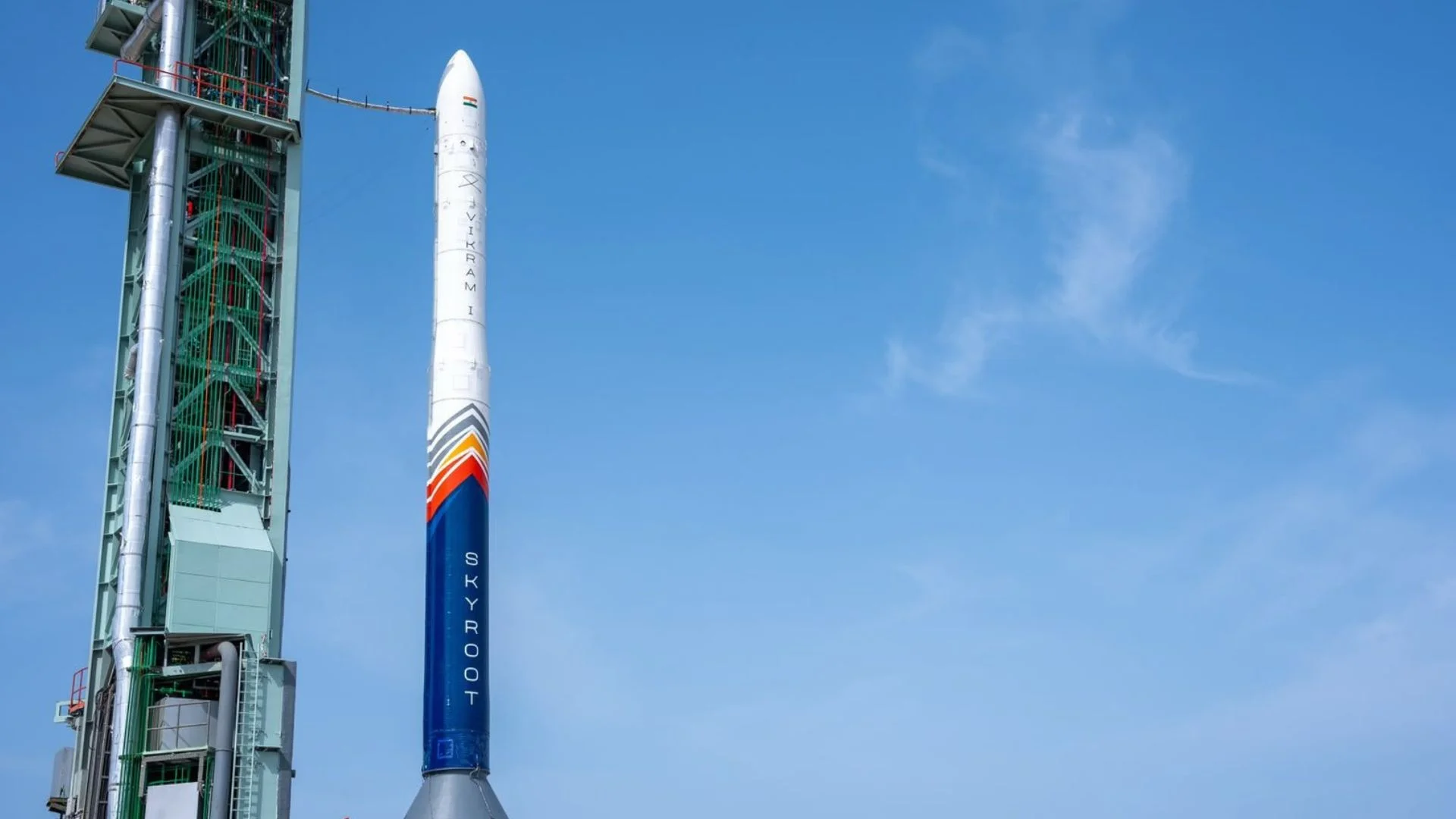
India marked a defining moment in its space journey on Saturday as Skyroot Aerospace successfully launched Vikram-1, the country’s first privately developed orbital rocket.
The mission placed multiple payloads into low Earth orbit, making Skyroot the first Indian private company to achieve an orbital launch.
The successful mission places India among a small group of nations where private companies have independently developed and launched orbital rockets. Until now, only the US and China had demonstrated similar private orbital launch capabilities.
The rocket lifted off from the Satish Dhawan Space Centre in Sriharikota at 12:05 p.m. IST under Mission Aagaman. About 17 minutes later, mission controllers confirmed that the vehicle had completed all planned objectives and successfully deployed its payloads.
Vikram-1: Built for Orbit
Vikram-1 is a four-stage launch vehicle designed to carry small satellites into low Earth orbit. The rocket stands about seven stories tall and can deliver payloads weighing up to 350 kilograms into orbit around Earth.
The vehicle uses an all-carbon composite structure to reduce weight while maintaining strength. It also combines reliable solid-fuel boosters with a 3D-printed liquid engine, reflecting the increasing use of advanced manufacturing technologies in India’s private space industry.
READ ALSO: NASA’s New Space Refueling Test Brings Moon and Mars Missions One Step Closer to Reality
Unlike suborbital rockets that briefly enter space before returning, orbital rockets place satellites into a stable orbit around Earth. These satellites support communication networks, navigation systems, weather monitoring, Earth observation and scientific research.
The launch also marked the first orbital mission for Skyroot Aerospace, a Hyderabad-based startup founded in 2018. The company had earlier created history in 2022 by launching Vikram-S, India’s first privately built rocket to reach space on a suborbital mission.
Payloads Reach Space
Mission Aagaman carried several customer payloads that were deployed into a 450-kilometer orbit. These included Skyroot’s SCOPE satellite, a technology demonstration payload from Germany’s DCUBED, Grahaa Space’s Solaras S3 nanosatellite pathfinder and Cosmoserve Space’s Embrace robotic arm designed to capture space debris.
Skyroot’s SCOPE satellite will collect flight data to evaluate the rocket’s performance during the mission. The information will help engineers refine future launches and improve the company’s launch systems.
The mission also carried two symbolic payloads celebrating India’s scientific achievements. One was “Cosmic Bloom,” a floral artwork created by Cosmos Diamonds, while the other was an 18-karat gold micro-rocket featuring tiny sculptures of C. V. Raman, Vikram Sarabhai and A. P. Abdul Kalam, each smaller than a grain of rice.
Skyroot Co-founder and Chief Executive Officer Pawan Kumar Chandana said demand for satellite-enabled services continues to grow worldwide. He said the company aims to meet the growing demand for dedicated small-satellite launch services through Vikram-1.
Reforms Fuel Growth
The success of Vikram-1 reflects wider changes in India’s space sector over the past few years. The Indian Space Policy 2023 opened the entire space value chain to private companies, allowing them to build satellites, develop launch vehicles and provide commercial space services.
The Indian National Space Promotion and Authorization Center (IN-SPACe) serves as the country’s single-window regulator for private space activities. It authorizes missions, provides access to ISRO facilities and technologies, and creates a predictable regulatory framework for non-government companies.
Government initiatives have also encouraged investment in the sector through dedicated funding programs. These include a ₹1,000 crore venture capital fund, a ₹500 crore Technology Adoption Fund and the IN-SPACe Seed Fund Scheme, which provides grants of up to ₹1 crore for eligible startups and small enterprises.
The impact of these reforms is becoming increasingly visible across the industry. India had only one space startup in 2014, but the number has now grown to more than 400, creating a rapidly expanding ecosystem of companies developing launch systems, satellites and space-based technologies.
READ ALSO: TU Berlin’s SpaceBox Battery Project Aims to Transform Satellite Power Storage
The government has also liberalized foreign direct investment rules to attract global capital and technology. Automatic investment is now permitted up to specified limits across satellite manufacturing, launch vehicles, spaceports and related space infrastructure.
India’s commercial space ambitions have also expanded through NewSpace India Limited, ISRO’s commercial arm. The organization has strengthened commercial launch services, transferred technologies to industry and launched more than 140 satellites for domestic and international customers.
Earlier milestones demonstrated the steady rise of India’s private space sector. These include Skyroot’s Vikram-S mission in 2022, Agnikul Cosmos’ launch from India’s first private launch pad in 2024, and the transfer of Small Satellite Launch Vehicle technology to Hindustan Aeronautics Limited in 2026.
Industry leaders described Vikram-1 as an important step for India’s commercial space ambitions. Indian Space Association Director General Lt. Gen. A.K. Bhatt said the mission demonstrated that Indian private industry is now capable of executing complete space missions from development to launch.
India’s space economy is currently valued at about $8.4 billion and is expected to expand significantly over the coming years. Government estimates project that the sector will reach $40-45 billion by 2030 and around $100 billion by 2040 through continued policy support, private investment, and international collaboration.
The successful launch of Vikram-1 represents more than the maiden flight of a new rocket. It signals that India’s private space industry has moved from demonstration missions to operational orbital launches, opening new opportunities for satellite deployment, commercial space services and global partnerships in the years ahead.