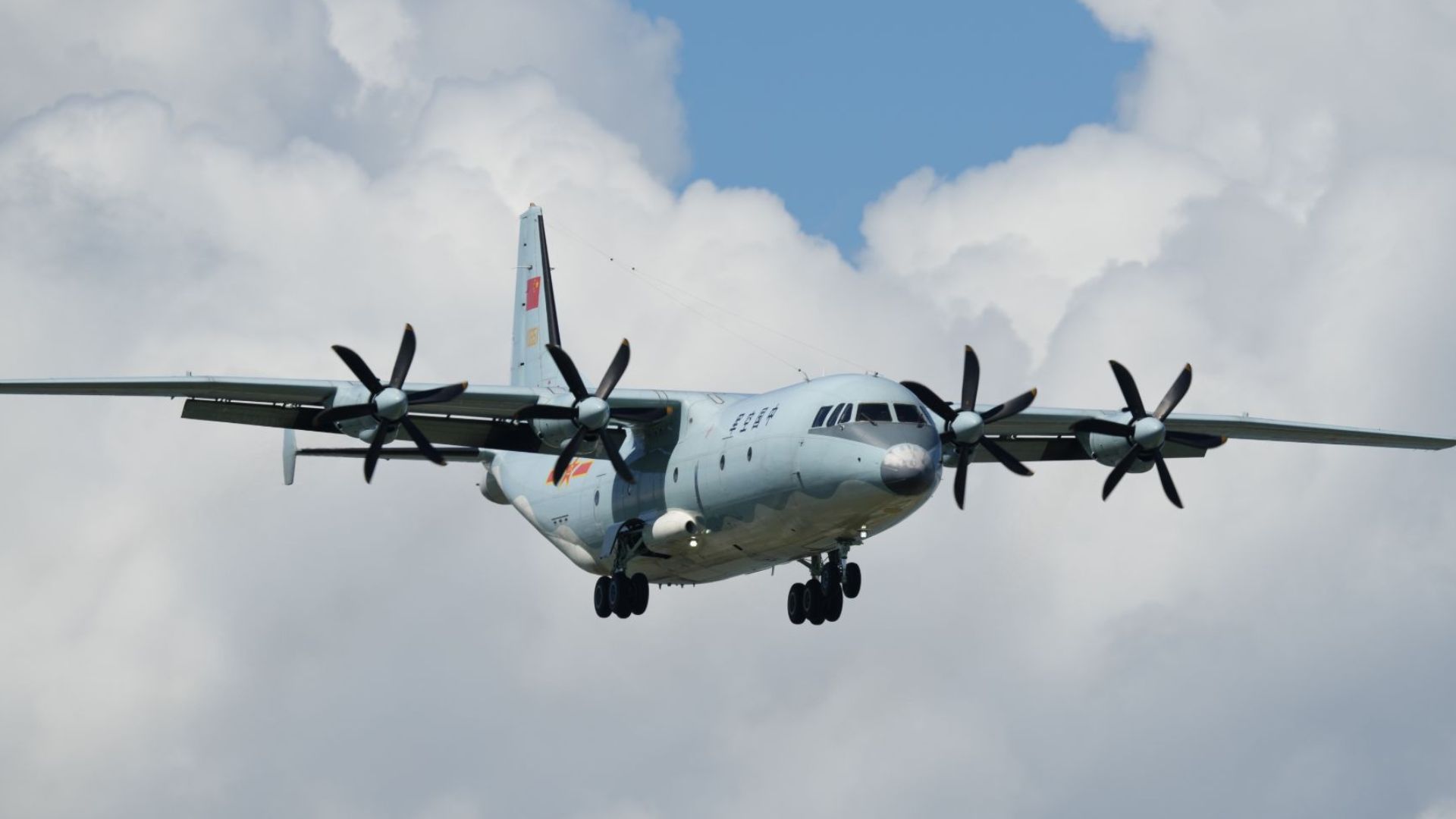
China has begun operational training with its upgraded Y-9 anti-submarine patrol aircraft, only months after the aircraft made its public debut during the 2025 Victory Day military parade.
Official images released by the Chinese People’s Liberation Army (PLA) show the aircraft taking part in anti-submarine exercises over the South China Sea. The drills also featured an enhanced version of the aircraft, which appeared in public for the first time.
The exercises were organized by a naval aviation unit under the PLA Southern Theater Command. According to official Chinese military reports, the training focused on locating and tracking submarines under realistic combat conditions. The activity also included coordinated operations with other military units.
Y-9 Anti-Submarine Aircraft Advances
Photos released by China Military Online showed the standard Y-9 anti-submarine patrol aircraft participating in flight training. Another set of images published by the South Sea Fleet revealed a newer version with visible design changes. Military observers noted that the upgraded aircraft carries a redesigned radar system beneath its nose.
Chinese military expert Zhang Junshe said the new radar uses active phased-array technology. This type of radar scans larger areas, tracks more targets at the same time, and detects objects from greater distances than older systems. These improvements can help crews identify potential submarine threats more quickly.
The aircraft also features a redesigned magnetic anomaly detector(MAD), mounted at the rear. A MAD detects small changes in the Earth’s magnetic field caused by large metal objects such as submarines. The updated sensor is smaller, easier to maintain, and is expected to improve detection performance while reducing interference from the aircraft itself.
Another important feature is the large number of sonobuoys carried inside the aircraft. Sonobuoys are small, floating sensors dropped into the sea to detect submarine movements beneath the water. Officials said the aircraft can deploy around 100 sonobuoys during a single mission, creating a wide underwater listening network spanning several dozen kilometers.
READ ALSO: Constellation Invests in Blue Energy to Speed Up Small Modular Nuclear Power Deployment
Operational Training Begins
The South Sea Fleet said the recent exercise focused on search-and-attack missions against submarines. Commanders avoided fixed battle plans to make the drills more realistic. Aircrews had to respond to changing situations without relying on pre-planned tactics.
Training scenarios included simulated electronic interference and equipment failures. Pilots were required to assess each situation, make independent decisions, and complete their assigned missions. The exercises also covered both daytime and nighttime operations.
Both the older Y-8 and the newer Y-9 anti-submarine patrol aircraft took part in the drills. Using both aircraft allowed crews to compare capabilities while improving coordination during joint operations. The training also helped strengthen overall maritime patrol readiness.
Zhang said the upgraded Y-9 has now entered operational training and has achieved an initial combat capability. According to him, the aircraft has reached the stage where it can carry out basic submarine detection and attack missions. Continued exercises are expected to further improve its effectiveness.
Growing Maritime Focus
The South China Sea presents unique challenges for anti-submarine operations. Many areas exceed 1,000 meters in depth, making underwater targets much harder to locate than in shallower waters such as the East China Sea or Yellow Sea. These difficult conditions require aircraft with more advanced sensors and longer endurance.
Compared with the earlier Y-8 platform, the Y-9 offers greater range, a larger combat radius, and increased endurance. It can stay in the air longer while carrying more equipment and mission systems. These improvements allow it to patrol wider areas during extended operations.
The Y-9 is based on a transport aircraft platform that China has adapted for several specialized military roles. Different versions perform electronic reconnaissance, radar jamming, airborne early warning, and maritime patrol missions. This shared platform simplifies maintenance while allowing different aircraft to perform specialized tasks.
READ ALSO: Raytheon’s NGSRI Missile Passes Key Test, Set to Replace US Army’s Stinger System
Part Of Expansion
The Y-9 anti-submarine patrol aircraft first appeared publicly during China’s Victory Day military parade on September 3, 2025. It flew alongside the Y-9 electronic reconnaissance aircraft, the Y-9 radar jamming aircraft, and six J-16 fighter jets. Chinese state media described these aircraft as new additions to the country’s growing fleet of special mission aircraft.
State news agency Xinhua identified the Y-9 anti-submarine aircraft as a domestically developed platform equipped with multiple search systems. It said the aircraft plays an important role in monitoring maritime and aerial activity while supporting naval operations. Chinese officials also described it as an important asset for responding to security situations at sea.
CCTV quoted formation member Jiang Tianhao as saying that the Y-9 platform has matured into a versatile base for several special mission aircraft.
He added that different mission variants have been developed to meet the demands of modern military operations. The expanding Y-9 family reflects China’s continued investment in specialized airborne capabilities.
The latest exercises show that the upgraded Y-9 is moving from public display to active military service. As operational training continues, the aircraft is expected to play a larger role in China’s maritime surveillance and anti-submarine operations across strategically important waters.