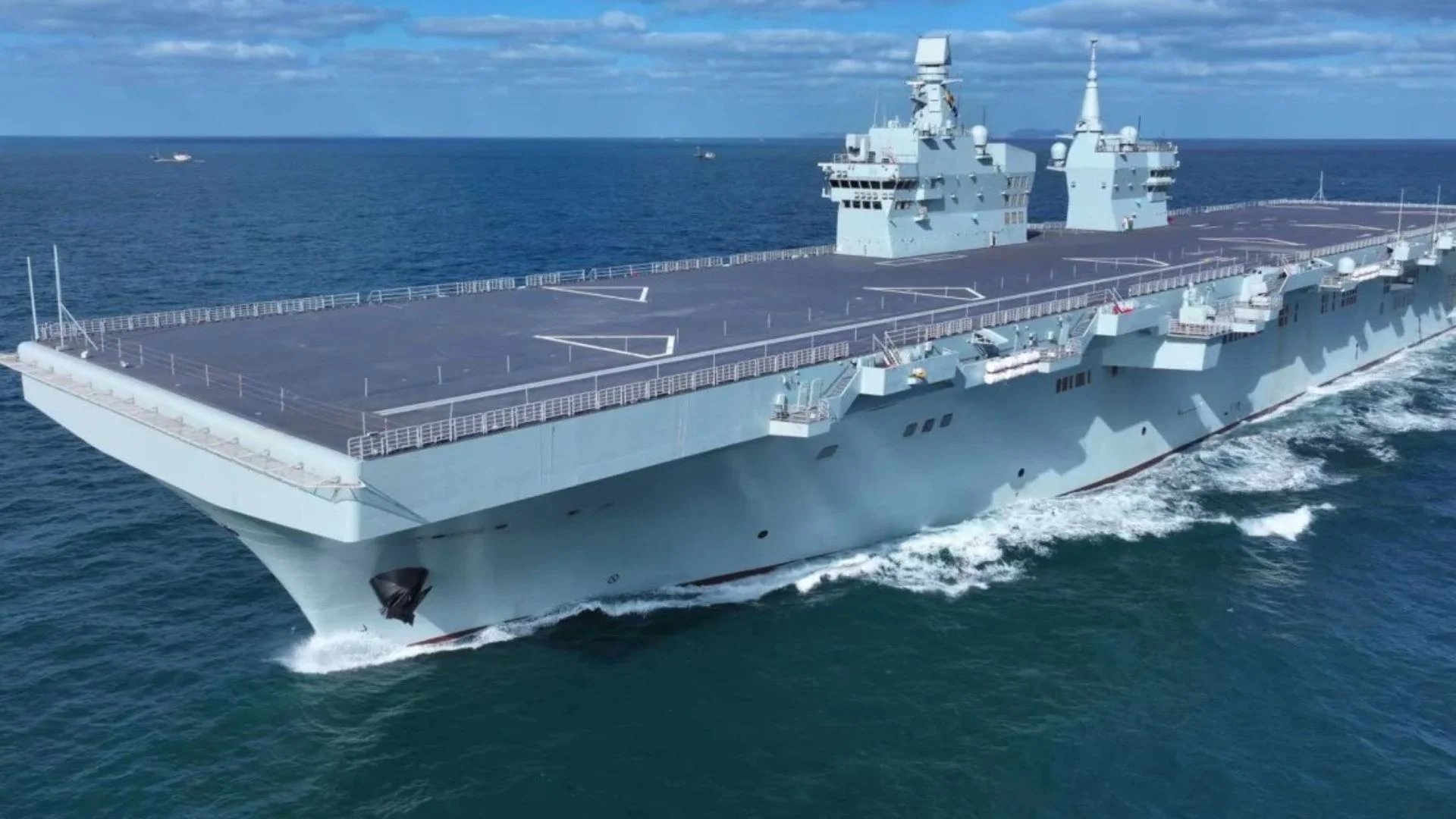
China has moved closer to introducing a new generation of amphibious assault ships with the Type 076 Sichuan, a vessel designed to operate fixed-wing combat drones using carrier-style launch and recovery systems.
Recent images of the warship provide the clearest indication yet that the People’s Liberation Army Navy (PLAN) is preparing to commission a ship that combines traditional amphibious warfare with advanced unmanned aviation.
Unlike existing amphibious assault ships that mainly rely on helicopters or short-takeoff aircraft, the Type 076 introduces catapult-assisted takeoffs and landings. This design allows the ship to launch heavier and longer-range unmanned aircraft while continuing to support amphibious missions with landing craft and marine forces.
The new vessel represents a significant shift in China’s naval strategy. Instead of separating aircraft carrier operations from amphibious missions, the Type 076 combines both capabilities on a single platform, offering greater operational flexibility during future maritime deployments.
Type 076: A Naval Milestone
The most notable feature of the Type 076 is its electromagnetic aircraft launch system(EMALS). This advanced launch technology uses electricity instead of steam to accelerate aircraft along the flight deck before take-off.
WATCH ALSO: High-pressure monster gun can make 40-ton military vehicle more lethal on battlefields
Until recently, EMALS technology was limited to large aircraft carriers because it requires massive electrical power and complex engineering. China previously introduced an operational EMALS aboard its Type 003 aircraft carrier Fujian, making it only the second country after the US to field the system.
The addition of EMALS to an amphibious assault ship marks a major design change. It allows the vessel to launch fixed-wing unmanned aircraft that are larger, heavier, and capable of carrying more fuel or equipment than drones launched using conventional methods.
Recent images also show that the ship is equipped with arresting gear on its angled flight deck. These cables help aircraft stop safely after landing, confirming that the ship is designed not only to launch drones but also to recover them repeatedly during sustained operations.
Together, the catapult and arresting gear create the Catapult Assisted Take-Off But Arrested Recovery(CATOBAR) system. This is the same operating method used by many large aircraft carriers, but no amphibious assault ship currently in service combines this capability with amphibious operations.
EMALS offers several practical advantages over traditional steam-powered catapults. It provides smoother acceleration, reduces stress on aircraft structures, and allows launch power to be adjusted based on the aircraft’s weight.
These benefits are especially useful for unmanned aircraft because they often have lighter airframes than manned fighters. Designers can therefore focus more on endurance, payload, and mission equipment rather than strengthening the aircraft for harsher launches.
Focus on Unmanned Aviation
Chinese officials have not confirmed which aircraft will operate from the Type 076. However, defence analysts believe the ship may eventually carry the GJ-11 Sharp Sword stealth unmanned combat aerial vehicle or similar carrier-capable drones currently under development.
READ ALSO: RTX Brings AI to Pratt & Whitney Engine Inspections for Faster and Smarter Aircraft Maintenance
Stealth combat drones are designed to reduce their radar visibility while carrying out a variety of missions. These include intelligence gathering, surveillance, electronic warfare, suppression of enemy air defences, anti-ship attacks, and precision strikes against land targets.
Compared with helicopters, fixed-wing drones can fly much farther and remain airborne for longer periods. Analysts estimate that such aircraft may extend surveillance and strike coverage to more than 1,000 kilometers from the ship, significantly increasing the operational reach of an amphibious task force.
The use of unmanned aircraft also reduces risks to human pilots during dangerous missions. Drones can remain on station for extended periods without concerns about pilot fatigue, allowing commanders to maintain continuous surveillance or conduct repeated operations over contested areas.
The Type 076 also features a twin-island design, another notable element of its layout. Similar to the British Royal Navy’s Queen Elizabeth-class aircraft carriers, this arrangement separates navigation functions from aviation control, improving flight deck management while providing additional redundancy if one command centre is damaged.
Most assessments estimate that the ship displaces around 50,000 tonnes when fully loaded. This makes it significantly larger than China’s existing Type 075 amphibious assault ships, with the additional space likely to support larger power-generation systems, aviation fuel storage, maintenance facilities, and ammunition reserves.
Despite its aviation focus, the vessel retains a well deck capable of launching landing craft, armoured vehicles, and marine units. This means the ship can conduct amphibious landings while simultaneously supporting long-range drone operations from its flight deck.
Global Fleet Comparison
The closest equivalent in the US is the America-class amphibious assault ship. Ships in this class, including USS America, USS Tripoli, and USS Bougainville, primarily operate F-35B Lightning II fighters, MV-22 Osprey tiltrotor aircraft, CH-53K heavy-lift helicopters, and AH-1Z attack helicopters.
READ ALSO: US Army MV-75 Cheyenne Gets RTX Systems That Redefine Long-Range Air Assault Missions
The America class uses Short Take-Off and Vertical Landing, or STOVL, operations instead of catapult launches. While this allows advanced aircraft like the F-35B to operate from amphibious ships, it does not support conventional catapult-launched fixed-wing aircraft or carrier-style drone recovery.
The F-35B remains one of the world’s most capable combat aircraft, combining stealth, advanced sensors, electronic warfare systems, and air-to-air combat capability in a single platform. However, each aircraft requires highly trained pilots and represents a significant financial investment.
China appears to be following a different operational model by placing greater emphasis on unmanned systems. Operating more drones enables longer surveillance missions, repeated strike operations, and greater operational endurance without the physical limitations associated with human pilots.
Among NATO countries, no amphibious assault ship currently combines electromagnetic catapults with arresting gear for routine fixed-wing combat drone operations. Several navies operate advanced amphibious vessels, but their aviation concepts remain different from China’s new design.
Italy’s Trieste landing helicopter dock, commissioned in 2024, operates F-35B fighters using STOVL procedures while supporting amphibious missions. However, it does not include catapult launch systems or arresting gear for conventional fixed-wing aircraft.
Spain’s Juan Carlos I and Australia’s Canberra-class landing helicopter docks also rely on ski-jump-assisted STOVL operations. These ships remain focused on helicopter missions, amphibious landings, and limited fixed-wing aviation rather than sustained drone campaigns.
Turkey’s TCG Anadolu has attracted international attention for integrating indigenous unmanned aircraft such as the Bayraktar TB3 and the future Kızılelma combat drone. However, these aircraft are designed for short take-off operations and do not require carrier-style catapults or arresting systems.
France’s Mistral-class amphibious assault ships continue to prioritise helicopters, command-and-control missions, humanitarian assistance, and disaster relief operations. As a result, China’s Type 076 introduces a capability that currently has no direct equivalent among NATO amphibious assault ships.
Regional Security Implications
The arrival of the Type 076 highlights China’s broader effort to expand both the size and capability of its navy. Rather than simply increasing the number of warships, the PLAN is introducing new operational concepts that combine multiple military roles on a single platform.
Deploying unmanned aircraft across amphibious task groups may reduce dependence on traditional aircraft carriers for certain missions. It also allows reconnaissance and strike assets to operate from multiple locations rather than concentrating all aviation resources aboard a single carrier.
READ ALSO: BMW Deploys Figure 03 Humanoid Robot to Power AI-Driven Factory Logistics at Spartanburg
Such an approach may be particularly useful during operations near Taiwan or in the South China Sea. Multiple ships working together could establish overlapping surveillance networks, monitor naval activity, locate coastal missile positions, and support electronic warfare before manned aircraft begin operations.
The Type 076 would likely operate alongside Type 075 amphibious assault ships, Type 055 guided missile destroyers, and China’s growing aircraft carrier fleet. This combination would give commanders a broader range of options for surveillance, amphibious landings, air support, and maritime security operations.
The introduction of carrier-style drone operations aboard an amphibious assault ship also reflects the growing role of autonomous systems in modern naval warfare. As more countries invest in advanced unmanned aircraft, future warship designs may increasingly integrate drones as a core part of their combat capability.
China’s Type 076 represents an important step in that direction by bringing together amphibious assault functions and sustained unmanned aviation on a single vessel. Its operational service will be closely watched by naval planners worldwide as it shapes future approaches to maritime power projection and next-generation naval warfare.