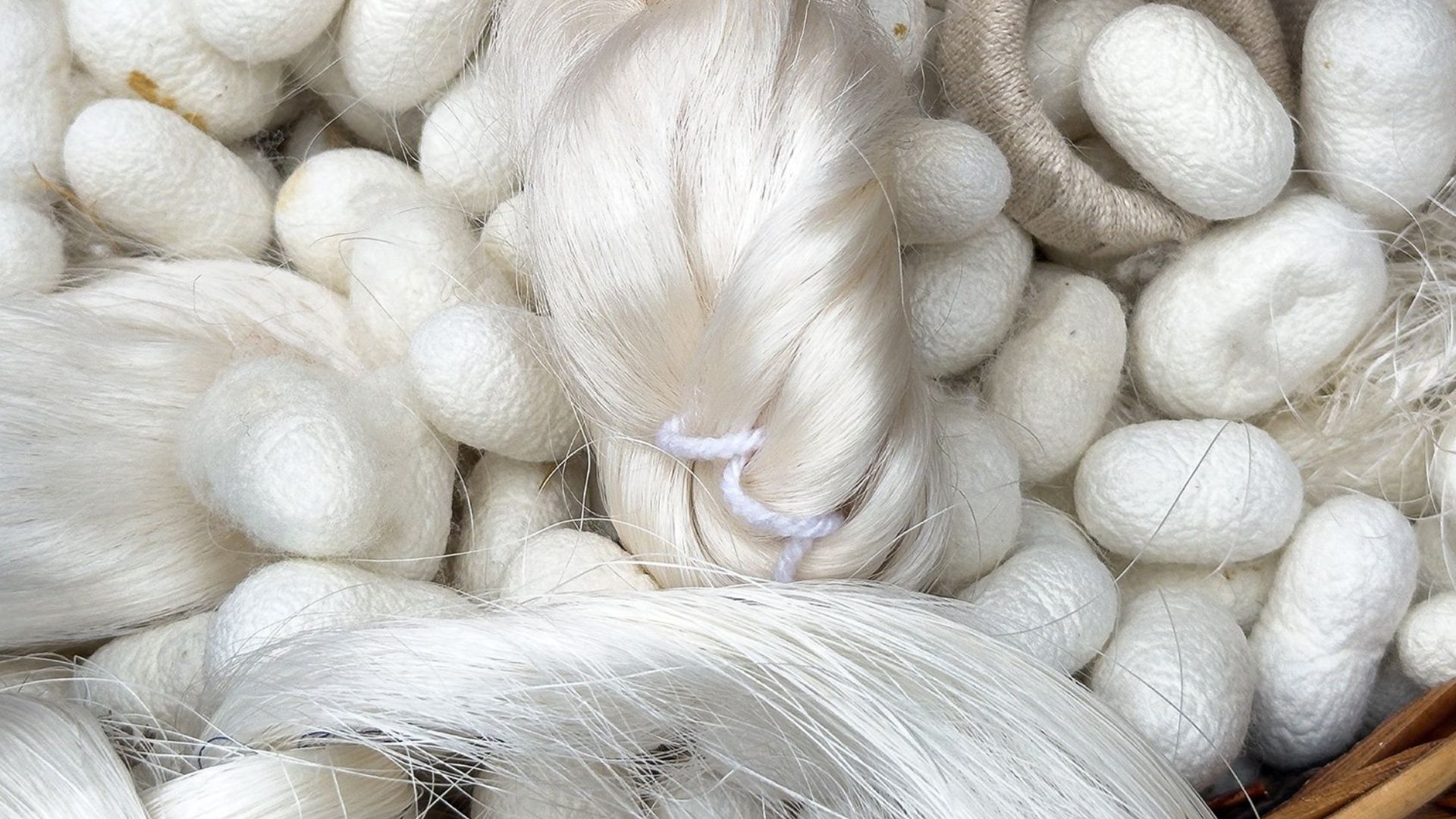
Researchers at Tohoku University have developed a new type of super silk that remains stronger and keeps its shape even after repeated exposure to moisture.
Instead of changing the silk after it is produced, the team improved it by adjusting the diet of silkworms before they spun their cocoons. The findings were published in the Journal of Industrial Textiles on June 25, 2026.
Silk has been valued for more than 4,000 years because it is lightweight, durable, soft, and naturally compatible with the human body. These qualities have made it useful not only in clothing but also in medical products and advanced materials. However, ordinary silk often shrinks and loses its original shape after repeated wetting and drying.
The research team focused on addressing this long-standing limitation with a simple, environmentally friendly approach. They added plant-based cellulose nanofibers(CNFs), to the feed given to silkworms. These tiny fibers are made from plant cellulose and are known for being both light and extremely strong.
READ ALSO: Polymer Cold Spray Repairs Composite Damage in 30 Minutes, Restoring Up to 80% Strength Fast
Simple Feed Change
The results showed major improvements in the silk produced by the silkworms. The new silk recorded about 50 percent higher tensile strength, meaning it could withstand greater pulling force before breaking. It also showed less than one-quarter of the shrinkage seen in conventional silk after repeated wetting and drying.
The researchers found that these benefits remained even after the silk fibers were spun into yarn and woven into fabric. This was an important finding because many material improvements disappear during textile manufacturing. The study confirmed that the stronger properties carried through to finished textile products.
Many existing methods for strengthening silk rely on chemical treatments or complex manufacturing steps. Those approaches can increase production costs and create environmental concerns. By comparison, adding cellulose nanofibers to silkworm feed offers a much simpler and more sustainable production method.
READ ALSO: SLAC Scientists Advance Scalable Quantum Dot Qubits to Power Future Quantum Chips
Super Silk Wider Industrial Benefits
Associate Professor Hiroki Kurita of Tohoku University said the goal was to improve silk while preserving its natural strengths. He explained that the team was pleased to see that changing the silkworms’ diet produced silk that remained stronger and more stable in wet conditions. He added that the approach may support the development of next-generation functional textiles.
READ ALSO: Green Rail Revolution: India’s First Indigenous Hydrogen Train Hits the Tracks
Silk is already used in many industries beyond fashion because of its unique natural properties. In healthcare, it serves as a surgical suture and a biomaterial that helps support wound healing. Stronger and more stable silk may improve the performance and durability of these products over time.
The researchers had expected stronger individual silk fibers based on earlier studies. They were less certain that the improvements would remain after spinning and weaving into fabric. The new results confirmed that the enhanced characteristics survived the entire textile production process.
Future Textile Applications
The research highlights how small changes at the earliest stage of silk production can improve the final material without major changes to manufacturing. This makes the technology easier to adopt than methods requiring new equipment or chemical processing. It also supports efforts to make textile production more environmentally responsible.
READ ALSO: Caltech Team Cools Radioactive Radium Molecules to Unlock Physics Beyond Standard Model
As demand for high-performance and sustainable materials grows, stronger natural silk may find wider use across multiple industries. The combination of improved durability, reduced shrinkage, and environmentally friendly production offers manufacturers new possibilities. Continued research may help bring this enhanced silk into commercial products that perform better in everyday and specialized applications.