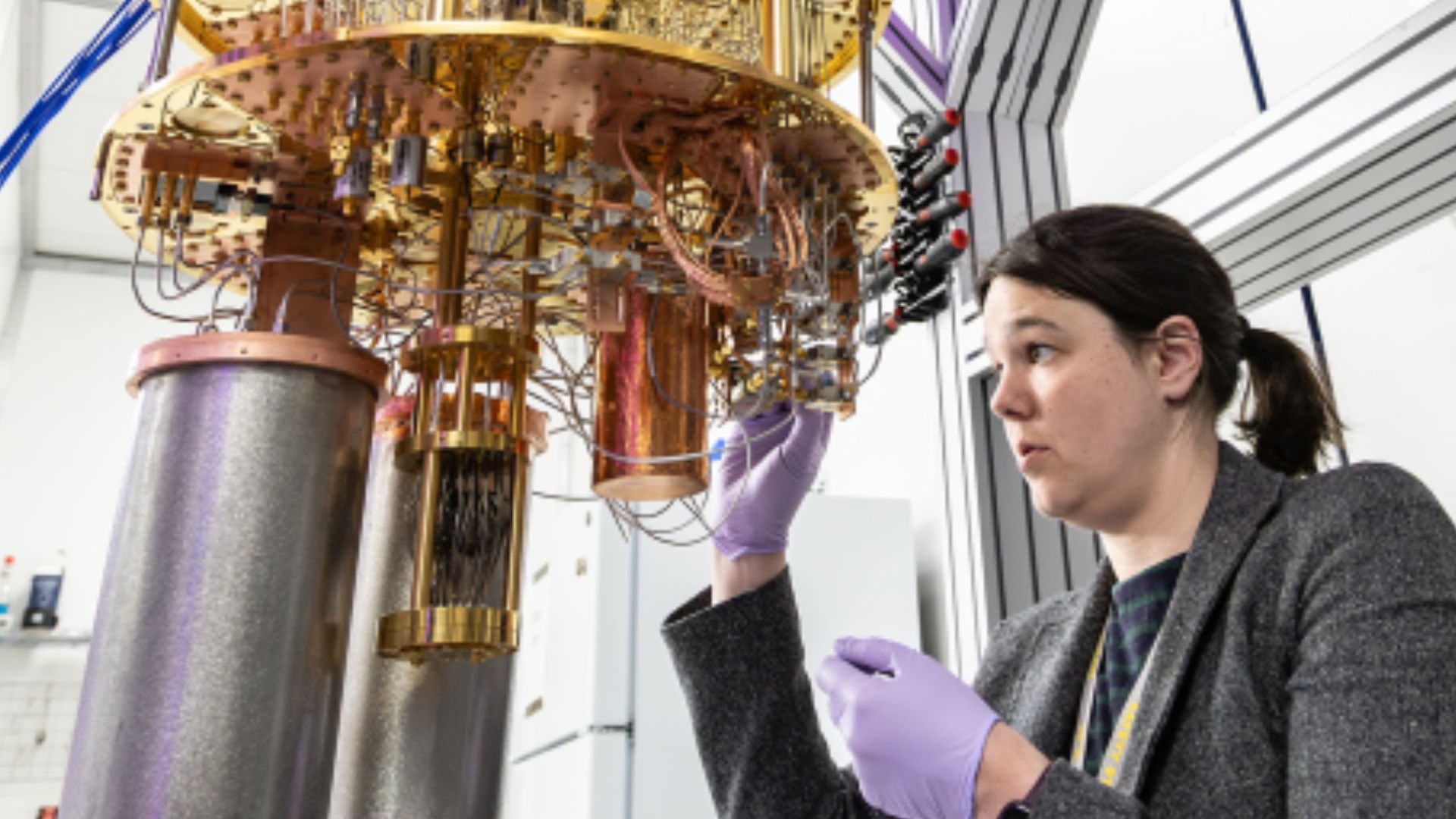
Scientists at the US Department of Energy’s SLAC National Accelerator Laboratory are working on a new generation of scalable quantum dot qubits designed for future quantum computers.
The research is led by SLAC scientist Shannon Harvey, who is also part of Q-NEXT, a national quantum information science research center led by Argonne National Laboratory. The effort aims to make quantum hardware easier to manufacture while improving its stability and performance.
Quantum computing has attracted global attention because it promises to solve certain problems much faster than today’s computers. Researchers believe these systems could support drug discovery, improve secure communications, strengthen financial security, and accelerate scientific research. Building reliable quantum hardware remains one of the biggest challenges before those benefits become widely available.
Unlike traditional computer bits that store either a zero or a one, quantum bits, or qubits, can exist in multiple states at the same time. This unique property allows quantum computers to process information in fundamentally different ways. Scientists around the world are exploring different technologies to build stable and practical qubits.
Understanding Quantum Dots
Harvey focuses on a type of qubit known as a quantum dot. A quantum dot is created by trapping an electron inside an extremely tiny space that is even smaller than the electron’s natural wavelength. This confinement changes how the electron behaves and gives researchers precise control over its energy levels.
The controlled energy levels allow scientists to store and manipulate quantum information with greater precision. One way to understand this process is to imagine placing a moving object inside a very small box, where its motion is tightly controlled. That controlled behavior forms the basis for creating a usable quantum bit.
Quantum dots offer an important advantage over several competing qubit technologies. They can be manufactured using methods that are similar to those already used in the semiconductor industry. This makes them attractive for producing large numbers of qubits on a single computer chip.
Harvey said the biggest strength of quantum dot qubits is their scalability. Researchers aim to place millions or even billions of these tiny devices onto chips roughly the size of a drink coaster. Such dense integration is essential for building practical quantum computers capable of handling complex calculations.
Quantum Dots Face Noise
Scaling quantum dots creates another challenge that researchers must overcome. Packing large numbers of qubits close together introduces unwanted electrical and environmental disturbances known as noise. These disturbances interfere with the delicate quantum signals that qubits rely on to operate correctly.
Harvey explained that fluctuations caused by noise make it difficult to maintain precise control over a qubit’s energy. When researchers lose that control, they also lose confidence in the information stored inside the qubit. As a result, the qubit becomes less useful for performing reliable quantum calculations.
Reducing noise has therefore become one of the central goals of Harvey’s research. Her team studies how different materials, chip designs, and operating conditions affect qubit stability. Every improvement brings quantum hardware one step closer to reliable large-scale computing.
READ ALSO: 1X’s Neo Robot Gets Washable, Tactile Hands That Sense Touch Like Humans
The work extends beyond simply reducing unwanted interference. Scientists also investigate how quantum dots connect with surrounding electronic components without introducing additional disturbances. Finding the right balance between performance and stability remains a major engineering challenge.
Researchers also examine the temperatures at which quantum dots perform best. Quantum systems generally operate at extremely low temperatures because heat can disturb fragile quantum states. Determining the ideal operating environment is critical for future commercial quantum processors.
Another area of study involves deciding how far apart quantum dots should be placed on a chip. If they are too close together, they may interfere with one another. If they are too far apart, sharing information efficiently becomes more difficult.
Software also plays an important role in quantum hardware development. Scientists need advanced control systems that precisely manage millions of qubits operating simultaneously. Hardware and software therefore evolve together throughout the research process.
Collaborative Research Effort
Harvey’s work combines expertise from several scientific disciplines. Materials science, engineering, computer science, and physics all contribute to the design of better quantum devices. This multidisciplinary approach allows researchers to solve problems from different perspectives.
The research takes place through Q-NEXT, one of the US Department of Energy’s National Quantum Information Science Research Centers. The program brings together scientists from national laboratories, universities, and industry partners. Its goal is to develop technologies that enable quantum information to be transmitted efficiently over long distances.
At SLAC, Harvey works in the Millikelvin Facility, where researchers perform experiments at extremely low temperatures. The building also hosts scientists studying entirely different areas of physics, including cosmology. This environment encourages frequent collaboration across scientific fields.
Harvey said working alongside cosmologists has helped her recognize similarities between different types of scientific experiments. Although the research goals differ, many technical challenges overlap. Sharing ideas across disciplines often leads to creative solutions.
She described the national laboratory environment as more collaborative than many traditional academic settings. Researchers with different specialties regularly exchange ideas and techniques. That culture helps accelerate scientific progress across multiple fields.
Part of SLAC’s quantum research is carried out in partnership with Stanford University. Harvey completed her postdoctoral research there under physicist David Schuster, another Q-NEXT collaborator. The partnership strengthens connections between university researchers and national laboratory scientists.
Journey Into Quantum
Harvey’s interest in science developed later than many researchers. As a child, she preferred reading novels and initially had little interest in scientific subjects. Although she enjoyed mathematics, she wanted a stronger connection between numbers and the real world.
That perspective changed during her undergraduate studies at Cornell University. Physics provided a way to answer many of her questions about how the world works. She said she quickly became fascinated by experimental physics.
Harvey later earned her doctoral degree from Harvard University before continuing her research career at Stanford. During her postdoctoral work, she witnessed rapid advances across quantum technology. Equipment that once required months of construction had become commercially available.
She said those improvements demonstrated how quickly the field was progressing. Faster access to advanced research tools allows scientists to spend more time exploring new scientific questions instead of building laboratory equipment. The pace of innovation continues to increase across the global quantum research community.
Governments and technology companies worldwide are investing heavily in quantum science. Reliable quantum hardware is considered one of the essential building blocks needed before practical quantum computers become widely available. Research programs such as Q-NEXT are designed to address those remaining technical barriers.
Quantum technologies are expected to influence many areas beyond computing itself. The same tools being developed today are also advancing atomic physics, condensed matter physics, and precision measurement technologies. Many scientists believe these improvements will support discoveries across several research fields.
Harvey remains focused on improving scalable quantum dot qubits while expanding the understanding of quantum systems.
As researchers continue to reduce noise, refine chip designs, and improve manufacturing techniques, quantum computers move closer to becoming practical scientific and industrial tools. The progress made at SLAC and through Q-NEXT highlights the growing momentum behind efforts to build reliable quantum technologies for future generations.