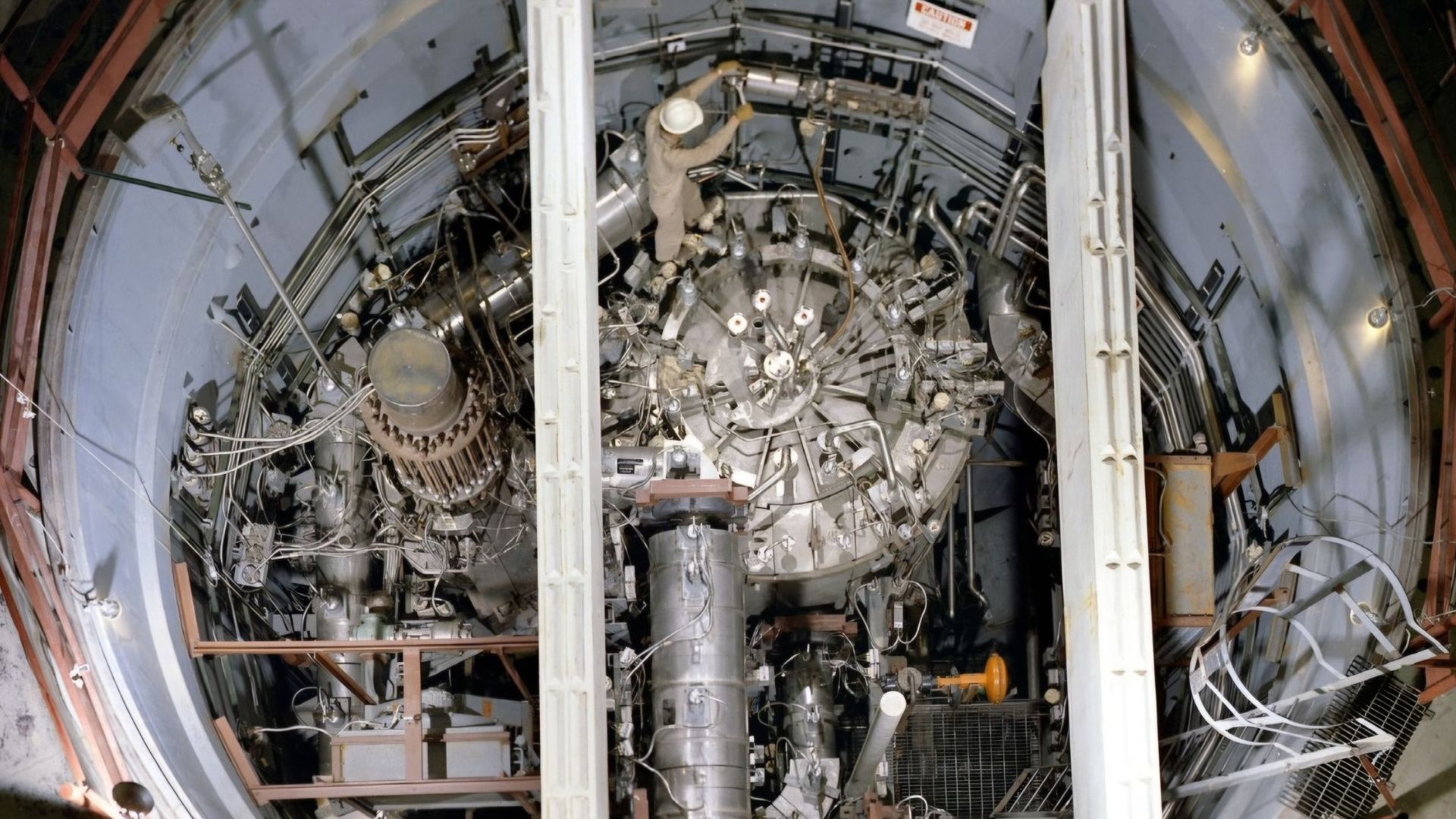
Scientists at Penn State have discovered that the atomic structure of metal alloys plays a major role in how quickly corrosion spreads in molten salt nuclear reactors.
The study shows that even metals with the same chemical composition can behave very differently depending on their internal atomic structure. The research appears online ahead of its publication in the August issue of Corrosion Science.
The team used advanced computer simulations to examine how molten salts interact with reactor metals at the atomic level. Their results showed that certain atomic arrangements create connected pathways that allow corrosion to move much faster through the material.
The findings provide new insight into one of the biggest material challenges facing advanced nuclear reactor designs.
Molten salt reactors are attracting attention because they promise higher efficiency and improved safety compared to many traditional nuclear reactors. Instead of using water to cool solid fuel rods, these systems use molten salt that can also carry dissolved nuclear fuel. This design simplifies reactor operation while allowing fuel and waste to circulate continuously.
Traditional nuclear reactors rely on tightly packed uranium fuel rods placed inside large pools of water. The water removes heat from the fuel while producing steam that drives electricity-generating turbines. Many commercial reactors around the world use this approach because it has been proven over decades of operation.
Higher Heat Challenge
Molten salt reactors operate under very different conditions than water-cooled reactors. Internal temperatures can rise above 800 degrees Celsius, or about 1,500 degrees Fahrenheit, creating an extremely demanding environment for structural materials. While molten salts remain chemically stable at these temperatures, they gradually attack the metal components that contain the reactor.
Researchers said corrosion remains one of the biggest obstacles to making these reactors practical on a large scale. If structural materials degrade too quickly, reactor safety, reliability, and maintenance costs become major concerns. Finding metals that resist corrosion for long periods is therefore essential for future reactor deployment.
Miaomiao Jin, assistant professor of nuclear engineering at Penn State and co-author of the study, said maintaining material stability remains a major challenge.
Jin said many factors influence corrosion, including operating temperature, the chemical makeup of molten salts, and the microscopic structure of the metal itself. Understanding how these factors interact is necessary to improve reactor materials.
Previous studies had already shown that molten salts react strongly with nickel-chromium alloys, commonly called nichrome. These heat-resistant alloys are widely used because they perform well under high temperatures. However, researchers noticed that identical alloys sometimes experienced very different levels of corrosion without a clear explanation.
Simulations Reveal Pathways
To investigate the mystery, the research team built detailed atomic-scale simulations using Penn State’s ROAR supercomputer. These simulations recreated the behavior of FLiNaK molten salt interacting with nichrome under reactor conditions. FLiNaK is a mixture of fluoride salts that researchers commonly use when studying molten salt reactor technology.
READ ALSO: Ukraine Deploys Armed Ground Robot from Drone Boat in World-First Combat Attack
The simulations focused on chromium because it plays a major role in corrosion. Researchers also examined how mechanical stress and different surface orientations affected corrosion. Earlier studies had linked these factors to material degradation, but important questions remained unanswered.
Hamdy Arkoub, a nuclear engineering doctoral candidate and co-corresponding author of the paper, said laboratory experiments become extremely difficult under such harsh reactor conditions.
High temperatures and radiation limit scientists’ ability to directly observe corrosion as it develops. Computer modeling helps fill those knowledge gaps by recreating reactions that are difficult to measure experimentally.
The team then turned its attention to atomic ordering inside the alloy. Normally, chromium atoms are spread randomly throughout the metal. Special heat treatment processes can reorganize those atoms into more ordered patterns, changing how they connect with one another inside the material.
Atomic Structure Fuels Corrosion
Researchers studied several forms of atomic ordering to understand their effect on corrosion. Short-range ordering creates small clusters of connected atoms, while long-range ordering forms larger networks extending across the material. These internal arrangements influence how atoms move and interact during chemical reactions.
The simulations revealed that long-range ordering creates continuous pathways that act like highways for corrosion. These pathways allow chemical reactions to travel rapidly from the metal surface into the interior of the alloy. As a result, corrosion spreads much faster than in metals with randomly distributed atoms or short-range ordering.
READ ALSO: Why Seawater Is Becoming the Next Big Source of Critical Minerals for Future Technologies
After only three nanoseconds of simulated exposure, the differences became obvious. The surface of long-range ordered nichrome developed rough pits and significant damage, while the other samples remained relatively smooth. Although the simulated period lasted only billionths of a second, it clearly demonstrated how atomic arrangement changes corrosion behavior.
Jin explained that atomic ordering naturally develops because some elements prefer to bond with each other. The researchers already knew that atomic connectivity affected corrosion, but they had not understood the detailed mechanisms behind the process. The new study identifies those mechanisms with much greater precision.
Each simulation demanded enormous computing power because atomic reactions occur on extremely small scales. According to Arkoub, the supercomputer required roughly one full day to simulate just one nanosecond of corrosion. Despite their heavy computational demands, these models provide valuable insights that experiments alone cannot readily provide.
Better Reactor Materials
The findings are expected to improve future computer models that predict how reactor materials age over time. More accurate predictions will help engineers evaluate alloys before building expensive reactor components. This approach may reduce development costs while speeding up material selection for advanced reactors.
The research also provides guidance for designing new corrosion-resistant alloys. Instead of focusing only on chemical composition, engineers can now consider how atoms are arranged inside the metal. Small changes in atomic ordering may significantly improve durability without changing the overall material chemistry.
The study also has broader importance beyond molten salt reactors. Many industries rely on metals operating under extreme temperatures and corrosive environments, including aerospace, chemical manufacturing, and energy production. Better understanding atomic behavior may help improve materials across several advanced technologies.
Additional authors include Jia-Hong Ke and Kaustubh Bawane from Idaho National Laboratory. The research received support from the US National Science Foundation and the US Department of Energy. As scientists continue refining these predictive models, the findings may help accelerate the development of safer, longer-lasting materials for the next generation of nuclear energy systems.