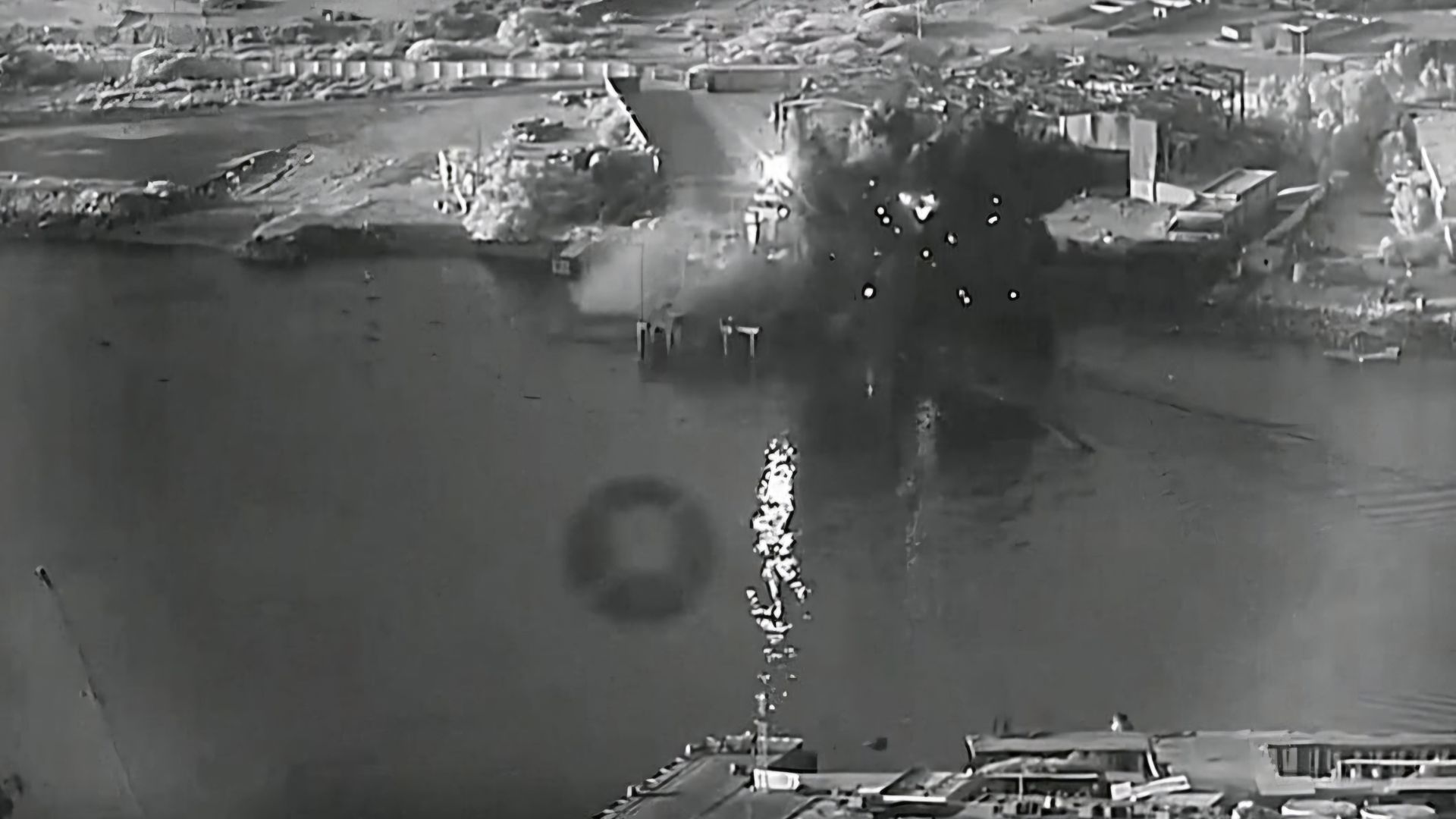
The US has conducted a historic autonomous naval strike using unmanned surface vessels against Iran’s Bandar Abbas Naval Base.
The operation was carried out on July 12, 2026, by the US Fifth Fleet’s Task Force 59 Unmanned Systems Unit. It is the first publicly announced drone boat attack by a major naval power.
According to the US Central Command (CENTCOM), three Saronic Corsair autonomous surface vessels participated in the mission. The boats approached the target from different directions without onboard crews or remote operators guiding every movement. Their mission focused on a raised dock that supported Iranian naval ships and submarines.
Each Corsair measured about 24 feet (7.3 meters) in length and featured a lightweight composite hull. The vessels gathered near a docked Ghadir-class midget submarine before detonating at the target. CENTCOM said the operation demonstrated the combat capability of autonomous naval platforms.
Autonomous Systems Take Lead
Autonomous surface vessels are boats that can navigate and complete missions using advanced software and onboard sensors. Unlike traditional remotely operated drones, they make many navigation and targeting decisions without continuous human control. This allows them to operate more quickly while reducing risks to military personnel.
The Corsair vessels are designed specifically for military missions rather than using modified commercial equipment. They combine stealth-focused hull designs with military-grade artificial intelligence and advanced sensors. These features improve navigation accuracy and help the vessels reach their assigned targets with precision.
Using unmanned boats for direct attacks reduces the need to place sailors in dangerous combat zones. It also allows naval forces to deploy multiple low-cost platforms rather than relying solely on larger warships. This approach is becoming an increasingly important part of modern military planning.
READ ALSO: Toyota GR Yaris Rally2 Unavailable? Customer 3D-Prints Rally Widebody Kit for His GR Corolla
Drone Boats Redefine Warfare
The strike reflects an important shift in how naval operations are conducted during conflicts. For many years, weaker forces often relied on small, inexpensive systems to challenge larger and more advanced militaries. Drone boats now allow powerful navies to employ similar tactics using more advanced technology.
Iran has long promoted a naval strategy based on swarms of small, fast attack boats. These vessels are equipped with lightweight missiles, rockets, and naval mines to overwhelm larger warships through numbers and speed. The US operation effectively applied a similar concept using autonomous vessels instead of crewed attack boats.
Attacking a fortified naval facility without placing sailors at risk represents a significant tactical development. Multiple autonomous vessels approaching from different directions can complicate defensive responses. Such operations may influence how future naval bases strengthen their security against unmanned threats.
Growing Role Worldwide
The latest mission follows another milestone achieved by Task Force 59 only weeks earlier. In June 2026, a Corsair autonomous vessel completed what CENTCOM described as the world’s first autonomous search-and-rescue mission. The vessel successfully recovered two US Army Apache helicopter crew members off the coast of Oman.
Ukraine has previously demonstrated the effectiveness of drone boats by using them against Russian naval targets. However, the US strike represents the first publicly acknowledged offensive use of autonomous attack boats by a major naval power. This expands the role of unmanned vessels from surveillance and support missions to direct combat operations.
READ ALSO: TKMS Partners Valbruna to Advance Canadian Patrol Submarine Project With Special Steel Supply
Task Force 59 was originally established to test and evaluate unmanned maritime technologies. The latest operation indicates that the unit is now taking on active combat responsibilities alongside its experimental work.
As autonomous systems continue to evolve, they are expected to play an important role in future naval operations and reshape maritime security strategies around the world.